
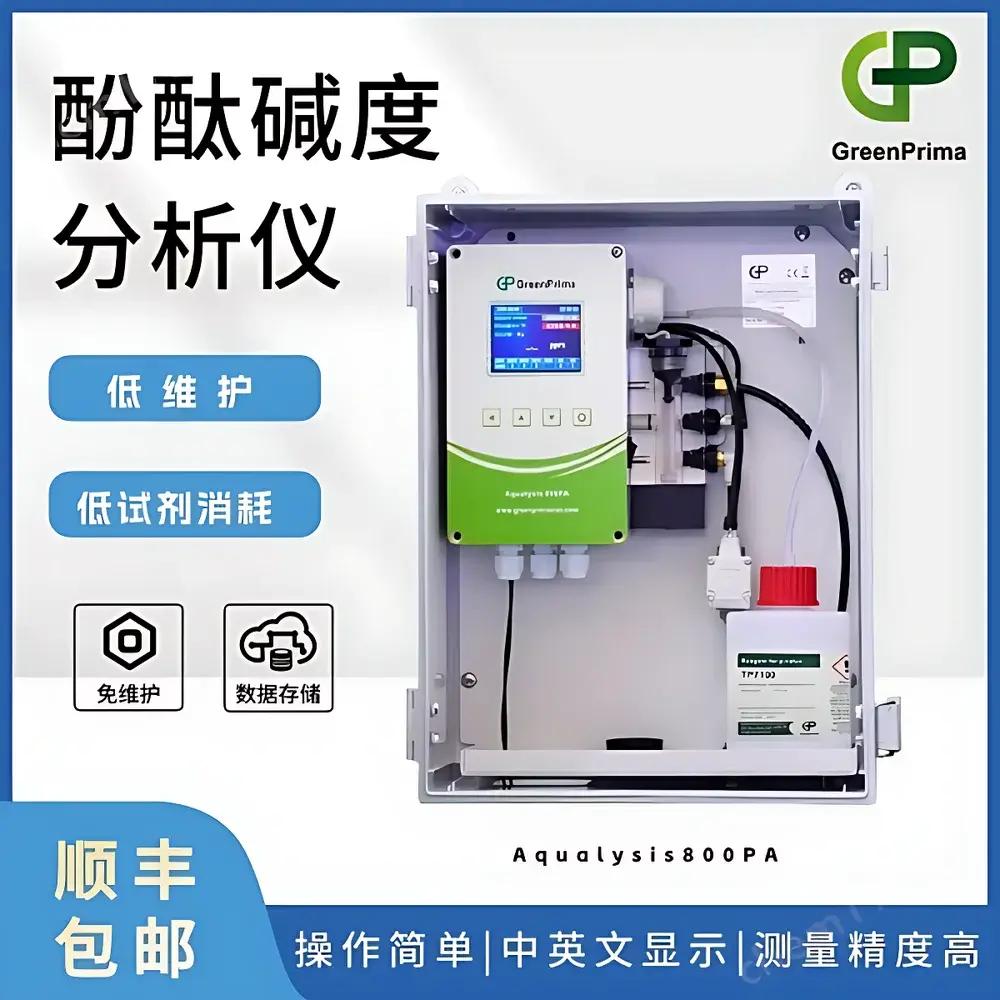
GreenPrima Aqualysis800 PA Phenolphthalein Alkalinity Analyzer – Low-Maintenance
| Brand | GreenPrima |
|---|---|
| Origin | United Kingdom |
| Manufacturer Type | Manufacturer |
| Origin Category | Imported |
| Model | Aqualysis800 PA |
| Price | Upon Request |
Overview
The GreenPrima Aqualysis800 PA Phenolphthalein Alkalinity Analyzer is a compact, microprocessor-controlled online analytical instrument engineered for continuous or interval-based determination of phenolphthalein alkalinity (P-alkalinity) in industrial water streams. It operates on the principle of potentiometrically assisted acid–base titration coupled with photometric endpoint detection: a precise volume of standardized hydrochloric acid is delivered to the sample, followed by controlled addition of phenolphthalein indicator; the resulting color shift from pink to colorless is quantified via high-stability photodiode-based absorbance measurement at 550 nm. This dual-stage optical–volumetric method ensures traceable, NIST-aligned results compliant with standard methods including ISO 9963-1, ASTM D1067, and APHA 2320 B. Designed for unattended operation in harsh plant environments, the analyzer integrates robust fluidic architecture with corrosion-resistant wetted materials (e.g., PTFE, borosilicate glass, EPDM seals), enabling stable performance across pH 4–10 and turbidity up to 100 NTU.
Key Features
- True low-maintenance design: <15 mL reagent consumption per analysis cycle; service intervals extended to ≥6 months under typical operation
- Integrated touchscreen HMI (4.3″ TFT color LCD) with bilingual (English/Chinese) interface and real-time diagnostic dashboard
- Modular architecture: Separated control unit and analyzer module allow flexible mounting—wall, panel, or skid-mounted configurations
- Programmable measurement modes: Continuous (fixed interval: 1–360 min), external trigger (dry contact or pulse signal), or flow-synchronized sampling
- Comprehensive I/O suite: Four programmable relay outputs (250 VAC / 4 A), two digital inputs (start/stop analysis), one isolated 4–20 mA analog output (max. 750 Ω load), and RS485 Modbus RTU for SCADA integration
- Environmental resilience: IP65-rated enclosure; operational ambient temperature range 10–40 °C; sample temperature tolerance 5–40 °C; inlet pressure 0.2–5 bar (optimal 1–2 bar)
- Onboard data logging: Internal non-volatile memory stores >10,000 measurement records, calibration logs, and fault timestamps with ISO 8601 timestamping
Sample Compatibility & Compliance
The Aqualysis800 PA is validated for use with cooling tower blowdown, blast furnace gas scrubber water, recirculating turbid-loop systems, boiler feedwater, and desalination pre-treatment streams. Sample matrix limitations are strictly defined to ensure metrological integrity: dissolved iron ≤3 ppm, copper ≤0.2 ppm, aluminum ≤0.1 ppm, manganese ≤0.2 ppm—exceeding these thresholds risks indicator complexation and endpoint drift. All internal wetted components conform to FDA CFR Title 21 Part 177 (food-contact plastics) and EU Regulation (EC) No 1935/2004. The analyzer supports GLP/GMP audit trails via optional firmware upgrade (including electronic signature, user access levels, and change history). Calibration verification follows ASTM D5117 protocols using certified reference standards traceable to NPL (UK) or NIST SRM 3109a.
Software & Data Management
Firmware v3.2+ includes embedded data management tools compliant with 21 CFR Part 11 requirements when deployed with optional password-protected administrator mode. Raw absorbance curves, titrant dosing profiles, and endpoint stability metrics are exportable via USB or RS485 as CSV files. Remote configuration and firmware updates are supported through secure HTTP (TLS 1.2) interface. Optional cloud gateway (GreenPrima CloudLink™) enables MQTT-based telemetry to enterprise MES or CMMS platforms, with configurable alarm thresholds and automated report generation (daily/weekly PDF summaries).
Applications
Primary deployment domains include metallurgical process water monitoring (e.g., BOF gas cleaning circuits), HVAC system chemistry control, power plant condensate polishing loops, and municipal wastewater tertiary treatment effluent compliance tracking. The instrument is routinely specified in EPC contracts for steelmaking facilities where rapid P-alkalinity response (<8 min cycle time) prevents caustic carryover into steam generation systems. Its ability to operate reliably under variable flow and particulate load makes it suitable for integration upstream of reverse osmosis trains or ion exchange columns where alkalinity excursions directly impact membrane fouling rates.
FAQ
What is the difference between phenolphthalein alkalinity and total alkalinity?
Phenolphthalein alkalinity (P-alkalinity) measures hydroxide and half the carbonate alkalinity (OH⁻ + ½CO₃²⁻) via titration to pH ≈ 8.3. Total alkalinity (T-alkalinity) extends to pH ≈ 4.5 and includes all buffering species (OH⁻ + CO₃²⁻ + HCO₃⁻).
Can the Aqualysis800 PA measure both P- and T-alkalinity in one cycle?
No—it is optimized exclusively for phenolphthalein endpoint detection. For total alkalinity, GreenPrima recommends the Aqualysis800 TA variant with dual-indicator (methyl orange + phenolphthalein) capability.
Is field calibration required after installation?
Yes—a two-point calibration using certified buffer standards (pH 8.3 and pH 4.5) is mandatory before commissioning; subsequent verification is recommended every 30 days or per site QA/QC protocol.
Does the analyzer support automatic reagent replenishment alerts?
Yes—integrated reagent level sensing triggers relay alarms and displays low-reagent warnings on the HMI with remaining cycle count estimation.
What maintenance tasks are required quarterly?
Visual inspection of tubing integrity, valve actuation test, optical path cleaning with isopropyl alcohol swab, and verification of pump stroke accuracy using gravimetric dispensing check.
Related Products







