
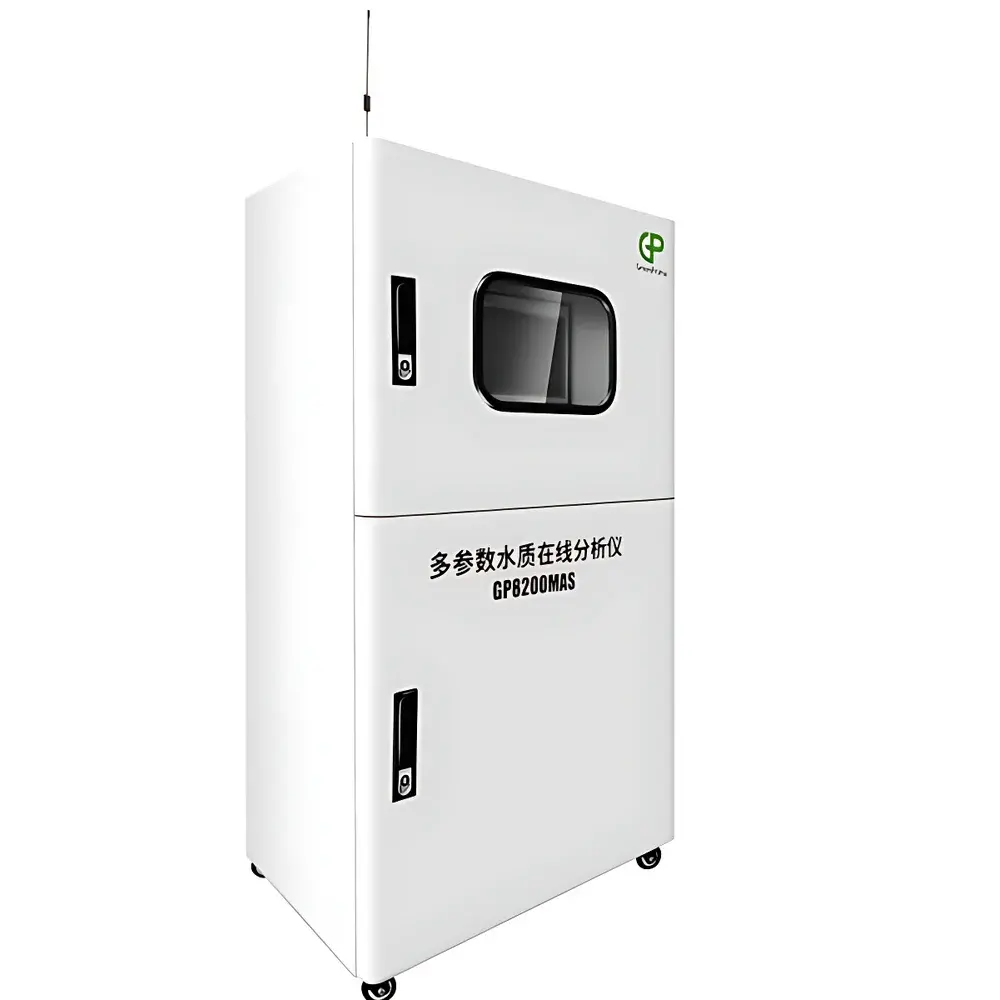
GreenPrima GP 8200 MAS Online Multi-Parameter Water Quality Analyzer
| Brand | GreenPrima |
|---|---|
| Origin | Shanghai, China |
| Manufacturer Type | Manufacturer |
| Product Category | Domestic |
| Model | GP 8200 MAS |
| Instrument Type | Online Analyzer |
| Temperature Range | -5–100 °C |
| pH Range | 0–12 |
| Dissolved Oxygen Range | 0–20 ppm |
| Conductivity Range | 0–200 mS/cm |
| Turbidity Range | 0–100 NTU |
Overview
The GreenPrima GP 8200 MAS is an industrial-grade online multi-parameter water quality analyzer engineered for continuous, real-time monitoring of critical physicochemical parameters in diverse aquatic environments. Built upon a modular sensor architecture and embedded microprocessor control, the system applies standardized electrochemical (pH, ORP, dissolved oxygen), conductometric (conductivity), optical (turbidity), and thermometric (temperature) measurement principles—each conforming to established metrological practices outlined in ISO 7888 (conductivity), ISO 5667-22 (turbidity), ASTM D1293 (pH), and APHA Standard Methods 4500-O (dissolved oxygen). Designed for unattended operation in municipal drinking water distribution networks, secondary urban water supply systems, aquaculture ponds, riverine and estuarine monitoring stations, and regulated effluent discharge points, the GP 8200 MAS delivers stable, traceable measurements under variable hydraulic and environmental conditions. Its robust enclosure and IP65-rated front panel ensure operational integrity in outdoor installations, including rooftop, bankside, or submersible mounting configurations.
Key Features
- Modular sensor architecture with independent, galvanically isolated measurement channels—enabling parameter-specific calibration, diagnostics, and replacement without system interruption
- Reagent-free operation across all core parameters (pH, conductivity, turbidity, DO, ORP, temperature), eliminating chemical waste and secondary contamination risks
- Integrated automatic temperature compensation (ATC) using NTC10K or PT1000 sensors across pH, conductivity, and DO modules, with configurable compensation algorithms per parameter
- 10-inch capacitive touchscreen HMI with localized Chinese interface, supporting intuitive configuration, real-time trend visualization, alarm acknowledgment, and historical data review
- Flexible analog and digital I/O: up to eight programmable SPST relays (5 A @ 250 VAC / 30 VDC), eight optional 4–20 mA outputs, RS485 Modbus RTU, Ethernet (TCP/IP), and optional GPRS/Wi-Fi connectivity
- Expandable architecture supporting optional add-ons: flow rate sensing, level transduction, suspended solids (MLSS) measurement, and chlorine residual detection (free/total)
Sample Compatibility & Compliance
The GP 8200 MAS is validated for use with natural surface waters, groundwater, potable water, wastewater effluents, recirculating aquaculture systems (RAS), and industrial process streams. Sensor materials—including food-grade EPDM O-rings, titanium or 316L stainless steel housings, and optical-grade sapphire windows—are selected to resist biofouling, chemical corrosion, and mechanical abrasion. All electrical safety and electromagnetic compatibility (EMC) design complies with IEC 61326-1 (industrial environment) and IEC 61000-6-2/-4. The system supports audit-ready data logging with timestamped records, meeting foundational requirements for GLP-compliant environmental monitoring programs and preliminary alignment with US EPA Method 1600-series documentation expectations. Optional DTU integration enables secure TLS-encrypted data transmission to cloud platforms compliant with ISO/IEC 27001 information security frameworks.
Software & Data Management
Data acquisition, storage, and remote access are managed via the戈普 Cloud Monitoring Platform (GopCloud™)—a web-based SaaS platform accessible via desktop browsers, iOS/Android native applications, and WeChat Mini Programs. The platform provides time-synchronized multi-parameter dashboards, customizable alarm thresholds (email/SMS/app push notifications), configurable reporting intervals (1 min to 24 h), and exportable CSV/Excel archives with metadata (sensor ID, calibration date, firmware version). Audit trails record all user-initiated actions—including parameter reconfiguration, calibration events, and relay state changes—with immutable timestamps. Firmware updates are delivered over-the-air (OTA) with SHA-256 signature verification. For on-premise deployment, Modbus TCP or OPC UA server modules can be enabled to integrate with SCADA, DCS, or MES systems.
Applications
- Municipal secondary water supply systems: continuous surveillance of residual disinfectant, turbidity, and pH to verify compliance with GB 5749–2022 (China’s Drinking Water Standard)
- River and lake ecological monitoring: long-term tracking of eutrophication indicators (DO, conductivity, turbidity) for early warning of algal bloom conditions
- Smart city infrastructure: integration into urban IoT networks for real-time water quality mapping and predictive maintenance of pumping stations
- Aquaculture facilities: closed-loop control of dissolved oxygen and temperature to optimize feed conversion ratios and reduce mortality rates
- Industrial effluent outfalls: automated regulatory reporting for discharge permits requiring continuous monitoring of conductivity, pH, and turbidity per local environmental authority mandates
FAQ
What communication protocols does the GP 8200 MAS support natively?
RS485 Modbus RTU is standard; optional Ethernet (Modbus TCP), GPRS (tri-band: China Mobile/Unicom/Telecom), Wi-Fi (802.11 b/g/n), and 4–20 mA analog outputs are available as factory-configured options.
Can the system operate independently without cloud connectivity?
Yes—the onboard controller logs data locally to internal flash memory (≥30 days at 1-min intervals) and supports full local HMI operation, relay control, and alarm activation without network dependency.
Is calibration traceability documented?
Each sensor module includes a factory calibration certificate referencing NIST-traceable standards where applicable; users may perform two-point pH, single-point conductivity, and zero/span turbidity calibrations with audit-log recording.
What power supply configurations are supported?
Standard AC 220 V ±10 %, 50 Hz, 20 W; optional DC 24 V input (e.g., solar-battery hybrid systems) with low-power sleep mode for remote deployments.
How is sensor fouling mitigated in long-term deployments?
Optional ultrasonic cleaning modules (for turbidity and DO sensors) and mechanical wiper assemblies (for pH/conductivity electrodes) are available; all sensors feature anti-fouling coatings and self-diagnostic impedance checks.
Related Products







