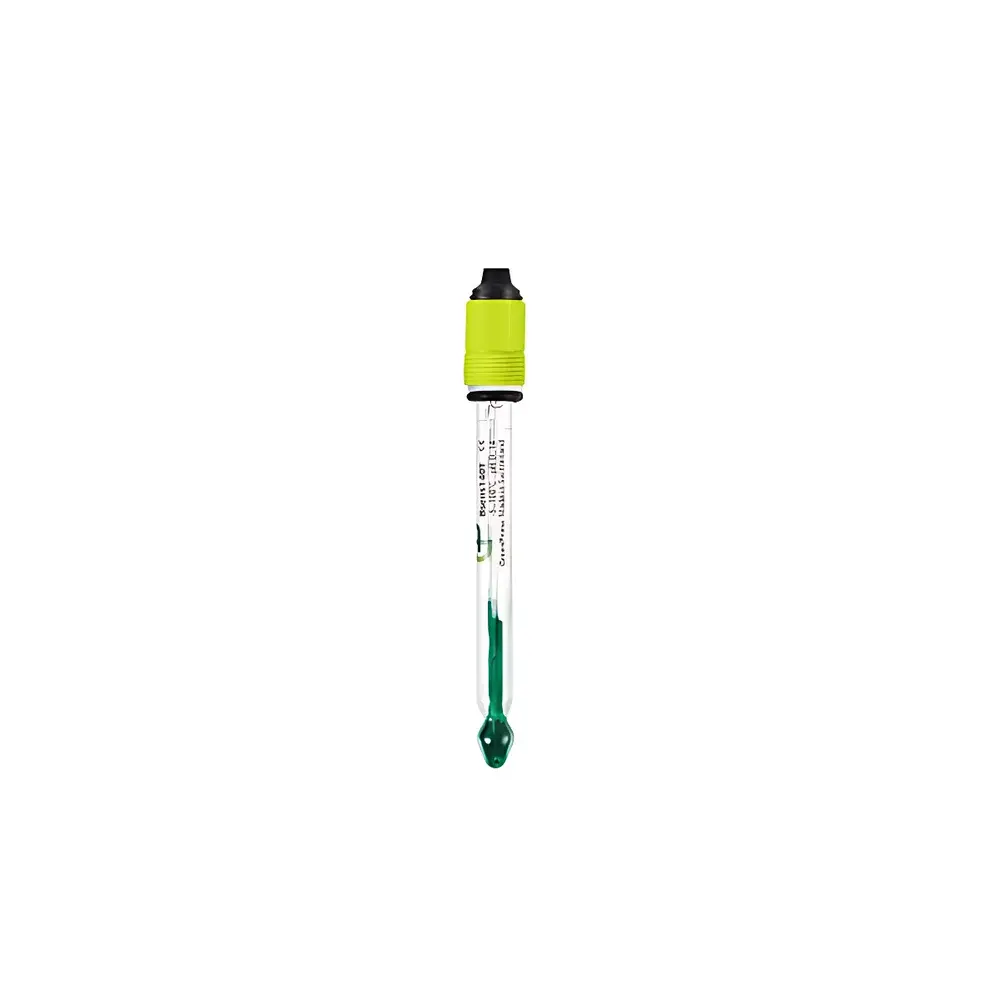
GreenPrima Bsens140T Pure Water pH Sensor
| Brand | GreenPrima |
|---|---|
| Origin | United Kingdom |
| Manufacturer Type | Original Equipment Manufacturer (OEM) |
| Product Category | Imported |
| Model | Bsens 140T |
| Measurement Range | 0–14 pH |
| Operating Temperature | −5 to 100 °C |
| Reference Electrode | Ag/AgCl Cartridge |
| Electrode Body Material | Glass |
| Electrolyte | Polymer-Gel Electrolyte |
| Junction | Triple Ceramic Porous Junction |
| pH-Sensing Membrane | S-Type Low-Resistance Glass |
| Integrated Temperature Sensor | PT1000 |
| Maximum Process Pressure | 6 bar |
| Minimum Immersion Depth | 20 mm |
| Zero Potential | ±20 mV |
| Sensitivity | 57–59 mV/pH at 25 °C |
| Minimum Sample Conductivity | 0.1 µS/cm |
| Response Time (pH 4–7) | <30 s |
| Process Connection | PG13.5 |
| Standard Cable Length | 5 m |
Overview
The GreenPrima Bsens140T Pure Water pH Sensor is an industrial-grade, in-line pH electrode engineered specifically for reliable and stable measurement in low-conductivity aqueous media—including ultrapure water (UPW), deionized water (DIW), reverse osmosis (RO) permeate, and boiler feedwater. Unlike conventional pH electrodes optimized for buffered or conductive solutions, the Bsens140T employs a specialized S-type low-resistance glass membrane combined with a triple-ceramic junction and polymer-gel electrolyte to minimize liquid junction potential drift and stabilize reference potential under conditions where ionic strength falls below 0.1 µS/cm. Its design adheres to fundamental electrochemical principles of the Nernst equation while addressing the unique challenges of low-conductivity environments: high electrical resistance, slow ion exchange kinetics at the reference junction, and susceptibility to static charge buildup. The integrated PT1000 temperature sensor enables real-time, two-point temperature compensation per IEC 60746-2 and ASTM D1293 standards, ensuring traceable accuracy across dynamic thermal profiles typical in power plant condensate loops or semiconductor fab UPW distribution systems.
Key Features
- S-type low-resistance glass membrane optimized for rapid equilibration and reduced asymmetry potential in ultrapure water
- Triple-ceramic porous junction providing consistent electrolyte outflow and minimizing clogging in particle-sensitive applications
- Polymer-gel electrolyte eliminating leakage risk and enabling maintenance-free operation over extended service intervals
- Integrated PT1000 platinum resistance thermometer (±0.1 °C accuracy) supporting automatic temperature compensation (ATC) and compliance with ISO/IEC 17025 calibration traceability requirements
- Robust all-glass body construction rated for continuous operation up to 6 bar process pressure and temperatures from −5 to 100 °C
- PG13.5 metric process thread for direct insertion into sanitary or industrial piping systems; compatible with standard pH transmitters supporting millivolt input and RTD temperature input
- Minimum immersion depth of only 20 mm—enabling installation in compact bypass cells or low-volume sample streams without compromising signal stability
Sample Compatibility & Compliance
The Bsens140T is validated for use in water matrices with conductivity as low as 0.1 µS/cm, making it suitable for critical applications governed by ASTM D5127 (Standard Guide for Ultra-High-Purity Water Used in the Semiconductor Industry), USP (Water for Pharmaceutical Use), and IAPWS TR-2 (International Association for the Properties of Water and Steam). Its stable zero potential (±20 mV) and high sensitivity (57–59 mV/pH at 25 °C) ensure conformity with IEC 62255-2 for online water quality monitoring in power generation and microelectronics manufacturing. The device complies with RoHS 2011/65/EU and meets IP68 ingress protection when installed with appropriate gland fittings. It supports GLP/GMP data integrity workflows when paired with compliant pH transmitters featuring audit-trail-enabled firmware (e.g., compliant with FDA 21 CFR Part 11 requirements for electronic records).
Software & Data Management
While the Bsens140T is an analog sensor requiring external signal conditioning, it is fully interoperable with industrial pH transmitters supporting 4–20 mA output, Modbus RTU/ASCII, or HART 7 protocols. When connected to systems such as Emerson DeltaV, Yokogawa CENTUM VP, or Siemens Desigo CC, its output integrates seamlessly into asset management databases and predictive maintenance dashboards. The stable millivolt signal (<30 s response time from pH 4 to 7) minimizes filtering artifacts during transient events—critical for detecting early-stage corrosion or resin breakthrough in demineralizer effluent. Calibration verification logs, slope/offset tracking, and temperature-compensated pH history can be archived in accordance with ISO/IEC 17025 clause 7.7 and ALCOA+ data governance principles (Attributable, Legible, Contemporaneous, Original, Accurate, Complete, Consistent, Enduring, Available).
Applications
- Real-time pH monitoring in ultrapure water loops for semiconductor wafer cleaning and photolithography tool supply
- Condensate polishing systems in fossil and nuclear power plants per EPRI guidelines and ASME PTC 19.11
- Pharmaceutical water-for-injection (WFI) and purified water (PW) distribution networks meeting EU GMP Annex 1 and USP
- RO and EDI system performance validation in biotech process water utilities
- Steam cycle chemistry control in combined-cycle gas turbine (CCGT) facilities
- Environmental monitoring of low-ionic-strength surface waters and groundwater remediation effluents
FAQ
What distinguishes the Bsens140T from general-purpose pH electrodes?
The Bsens140T features a low-resistance S-glass membrane, triple-ceramic junction, and polymer-gel electrolyte—engineered to maintain stable junction potential and minimize drift in conductivity below 1 µS/cm, where standard electrodes exhibit significant error and sluggish response.
Can the Bsens140T be used in pressurized hot water systems?
Yes—it is rated for continuous operation up to 6 bar and 100 °C, making it suitable for boiler feedwater and turbine condensate applications when installed with appropriate thermal isolation and pressure-rated housings.
Is temperature compensation mandatory for accurate readings?
Yes. Due to the strong temperature dependence of both the Nernst slope and liquid junction potential in low-conductivity water, integrated PT1000-based ATC is essential to meet ±0.05 pH accuracy specifications per IEC 60746-2.
How often should calibration be performed in ultrapure water service?
Initial calibration is recommended before commissioning; subsequent verification should occur at intervals defined by risk assessment—typically every 7–14 days in GMP environments, supported by documented bracketing checks using NIST-traceable pH 4.01 and 7.00 buffers.
Does the sensor require special cabling or shielding?
Yes. High-impedance pH signals demand shielded, twisted-pair cable with grounded braided shielding. GreenPrima recommends low-noise coaxial cable for runs exceeding 10 m, especially in electrically noisy industrial settings.
Related Products