
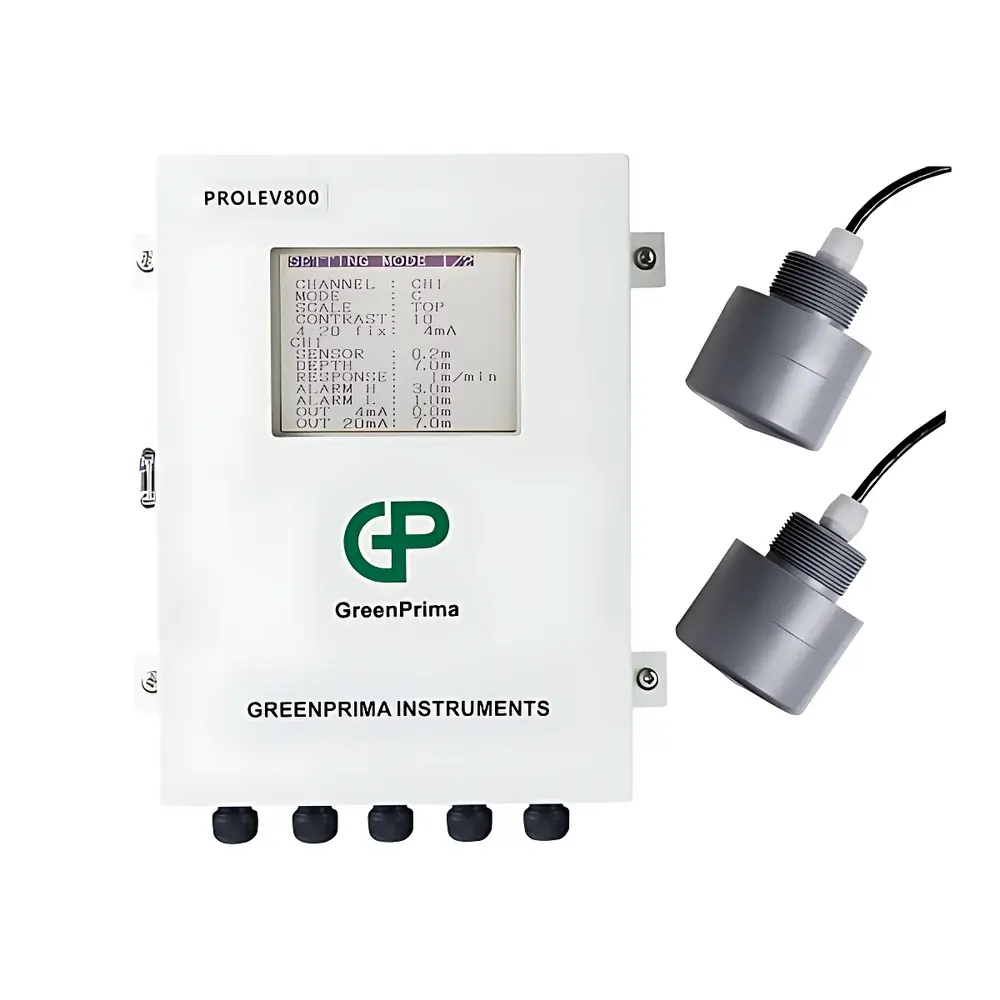
GreenPrima ProLev 800 Ultrasonic Sludge Interface Gauge
| Brand | GreenPrima |
|---|---|
| Origin | Japan |
| Manufacturer Type | Original Equipment Manufacturer (OEM) |
| Product Category | Imported Instrument |
| Model | ProLev 800 |
| Price Range | USD 1,400 – 2,800 |
| Measurement Principle | Ultrasonic Time-of-Flight (ToF) |
| Measuring Range | 0.4–10 m |
| Sensor Capacity | Up to 2 independent transducers |
| Accuracy | ±1 cm |
| Response Time | 1 s |
| Operating Ambient Temperature | −20 to +60 °C |
| Display | Large Backlit LCD with Graphical Interface (Digital Readout, Trend Plot, Echo Waveform Visualization) |
| Enclosure Rating | IP68 |
| Host Weight | 3.6 kg |
| Transducer Weight | 3.0 kg each |
| Output Signal | 4–20 mA (HART-compatible), Dual High/Low Alarm Relay Outputs |
| Communication Interface | RS-232C (cable length ≤10 m) |
| Power Supply | 85–264 VAC, 10 VA |
| Cable Length | 20 m standard |
Overview
The GreenPrima ProLev 800 is an industrial-grade ultrasonic sludge interface gauge engineered for continuous, non-invasive monitoring of sludge blanket depth and settling behavior in wastewater treatment basins. Based on time-of-flight (ToF) ultrasonic measurement principles, the instrument emits low-frequency acoustic pulses from a submersible transducer mounted above the liquid surface; the elapsed time between pulse transmission and echo return from the sludge–liquid interface is precisely measured and converted into distance data. This enables real-time quantification of both the supernatant height and the thickness of the suspended solids layer—critical parameters for optimizing clarifier hydraulics, controlling return activated sludge (RAS) flow rates, and preventing sludge bulking or washout. Designed for deployment in primary sedimentation tanks, secondary clarifiers, thickeners, and ash settling ponds, the ProLev 800 delivers stable, drift-free performance under variable influent loading, temperature fluctuations, and high-turbidity conditions.
Key Features
- Large-format backlit LCD display supporting simultaneous numeric readout, real-time echo waveform visualization, and dynamic trend plotting (5-minute to 48-hour history)
- Dual-transducer capability: a single converter unit supports two independent ultrasonic probes—enabling differential interface tracking or redundancy configuration
- Embedded microprocessor with adaptive signal processing algorithms ensures robust echo detection even in acoustically challenging environments (e.g., foam layers, scum accumulation, or suspended floc interference)
- No moving parts or immersed electronics: transducers are sealed stainless-steel housings rated IP68, minimizing maintenance and eliminating mechanical wear
- Adjustable display brightness and intuitive menu navigation via membrane keypad simplify field commissioning and routine parameter verification
- Configurable 4–20 mA analog output with HART protocol support enables seamless integration into existing SCADA or DCS architectures
- Two programmable relay outputs provide fail-safe high/low level alarms for process deviation alerts or automatic pump interlock control
Sample Compatibility & Compliance
The ProLev 800 is validated for use in municipal and industrial wastewater streams containing suspended solids concentrations up to 30,000 mg/L, as well as coal washing effluents, fly ash slurries, and pre-concentrated biosolids. Its ultrasonic frequency range (20–50 kHz) avoids resonance interference from common basin structures while maintaining sufficient penetration through flocculated suspensions. The device complies with IEC 61326-1 (EMC for industrial environments), IEC 60529 (IP68 ingress protection), and meets functional safety requirements per IEC 61508 SIL 2 for critical level monitoring applications. It supports audit-ready operation under GLP and GMP frameworks through timestamped event logging and configurable alarm history retention.
Software & Data Management
Local data acquisition and visualization occur entirely onboard the host unit—no external PC or proprietary software is required for basic operation. All trend plots, alarm events, and current analog output values are stored in non-volatile memory with timestamps. For extended diagnostics, RS-232C serial communication allows connection to third-party historian systems or custom LabVIEW/Python-based data loggers (cable length limited to 10 m without repeater). Configuration parameters—including damping factor, averaging window, alarm thresholds, and display contrast—are retained across power cycles. While no cloud connectivity or remote firmware update capability is embedded, the device’s deterministic response time (<1 s) and 1 cm resolution ensure compatibility with PLC-driven closed-loop control strategies compliant with ISA-88 and ISA-95 process automation standards.
Applications
- Real-time optimization of RAS and WAS flow rates in activated sludge systems
- Early detection of sludge blanket rise preceding clarifier overflow or effluent turbidity excursions
- Performance evaluation of lamella settlers and tube settlers in potable water plants
- Monitoring separation efficiency in gravity thickeners handling anaerobically digested sludge
- Process validation during startup, seasonal load shifts, or chemical dosing trials (e.g., coagulant optimization)
- Supporting ISO 5667-3-compliant sampling protocol design by identifying stable interface zones for grab sampling
FAQ
Can the ProLev 800 distinguish between multiple sludge layers (e.g., primary vs. secondary sludge interfaces)?
No—the instrument reports the strongest echo return, typically corresponding to the dominant upper interface. Multi-layer resolution requires advanced multi-frequency or pulse-echo spectral analysis not supported by this model.
Is calibration required after installation?
Zero-point calibration is performed once during commissioning using a known reference distance; no periodic recalibration is needed due to the inherent stability of ultrasonic ToF measurement.
What is the maximum allowable suspended solids concentration for reliable operation?
Field validation confirms consistent performance up to 30,000 mg/L TSS; beyond this, signal attenuation may reduce effective range but does not compromise safety or structural integrity.
Does the device support Modbus RTU or Profibus DP protocols?
No—only RS-232C ASCII command set and 4–20 mA analog output are provided; protocol conversion requires an external gateway.
Can the unit operate continuously in freezing temperatures?
Yes—the electronics housing is rated for −20 °C ambient; however, ice formation on the transducer face must be prevented via mechanical wipers or heated mounting brackets (not included).







