
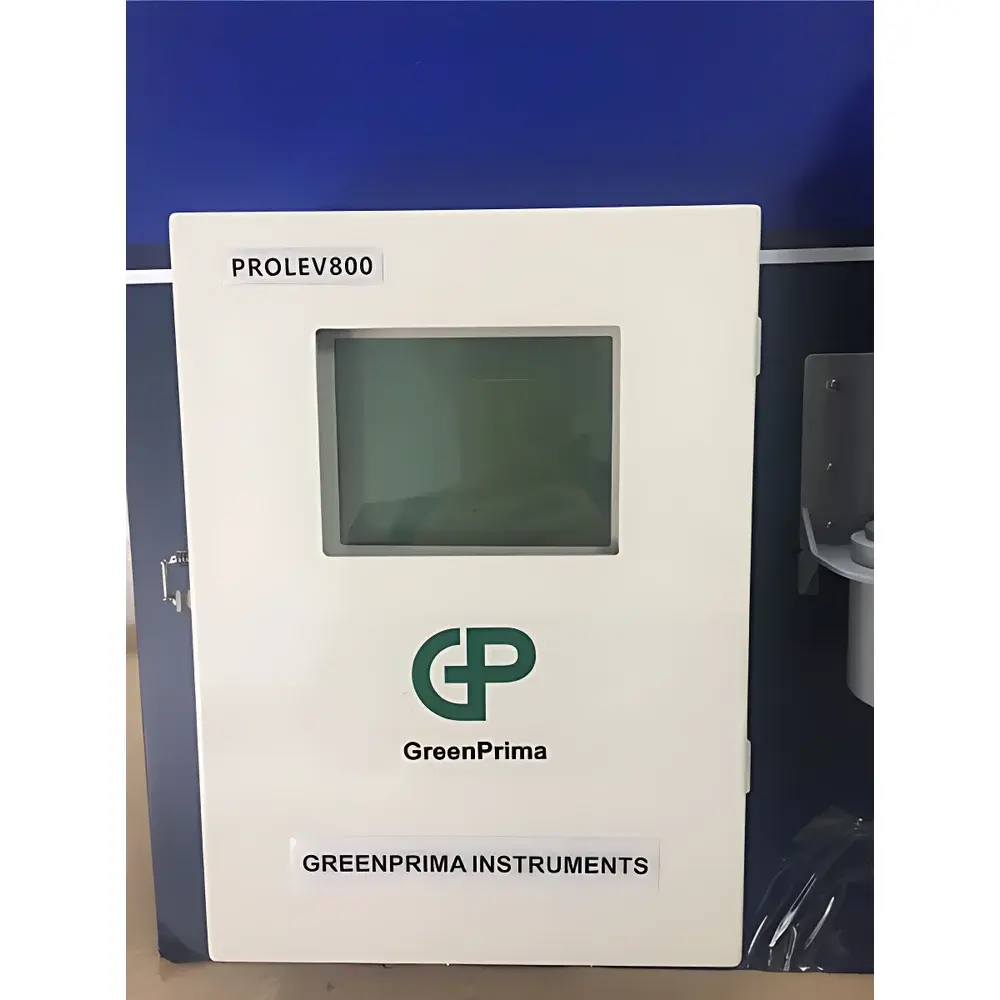
GreenPrima ProL ev800 Ultrasonic Sludge Interface Level Gauge
| Brand | GreenPrima |
|---|---|
| Origin | Japan |
| Manufacturer Type | Manufacturer |
| Origin Category | Imported |
| Model | ProL ev800 |
| Price Range | USD 2,800 – 7,000 |
| Measurement Range | 0.4–10 m |
| Sensor Capacity | Up to 2 independent probes |
| Accuracy | ±1 cm |
| Response Time | 1 s |
| Operating Ambient Temperature | −20 to +60 °C |
| Display | Large LCD with digital readout, trend graph, and real-time echo waveform |
| Enclosure Rating | IP68 |
| Weight | 3.6 kg (transmitter), 3 kg (probe) |
| Output | 4–20 mA analog output |
| Alarms | Dual programmable high/low level relays |
| Communication | RS-232C (≤10 m cable length) |
| Power Supply | 85–264 VAC, 10 VA |
| Cable Length | 20 m |
Overview
The GreenPrima ProL ev800 is a precision-engineered ultrasonic sludge interface level gauge designed for continuous, non-invasive monitoring of suspended solids concentration gradients in water and wastewater treatment processes. Operating on the principle of time-of-flight ultrasonic pulse-echo measurement, the instrument emits low-frequency acoustic waves (typically 1–2 MHz) into the liquid column and analyzes the amplitude and transit time of reflected signals from density discontinuities—primarily the sludge-water interface and, where present, secondary layers such as scum or compacted sludge beds. This enables accurate determination of both interface height and settled sludge thickness with ±1 cm repeatability under field conditions. The system is deployed in primary and secondary clarifiers, thickening tanks, pre-concentration basins, and ash settling ponds—where reliable real-time interface data supports hydraulic loading optimization, return activated sludge (RAS) control, waste activated sludge (WAS) scheduling, and early detection of process upsets including sludge bulking or blanket formation.
Key Features
- Large-format backlit LCD display supporting simultaneous numeric depth values, real-time ultrasonic echo waveform visualization, and dynamic trend graphs (5 minutes to 48 hours).
- Embedded microprocessor architecture ensures stable signal processing via adaptive gain control and noise rejection algorithms—eliminating mechanical moving parts and minimizing drift.
- Single transmitter unit configurable to interface with up to two independent ultrasonic probes, enabling dual-point profiling across tank width or layered interface tracking.
- Adjustable screen brightness and intuitive menu navigation simplify commissioning and routine parameter configuration—including zero calibration, damping settings, and alarm thresholds.
- Robust IP68-rated housing (transmitter and probe) certified for continuous submersion in aggressive municipal and industrial effluents; stainless steel 316L wetted parts ensure long-term corrosion resistance.
- Integrated dual relay outputs support fail-safe high/low level alarms, while the 4–20 mA analog output provides direct integration with PLCs, DCS systems, or SCADA networks.
Sample Compatibility & Compliance
The ProL ev800 is validated for use in turbid aqueous media with total suspended solids (TSS) concentrations ranging from 50 mg/L to >30,000 mg/L. It maintains measurement integrity in environments containing fine colloidal particles, flocculated sludge, grease layers, and moderate gas entrainment—common in sedimentation basins following coagulation-flocculation or biological treatment. The device conforms to IEC 61326-1 (EMC for industrial environments), IEC 60529 (IP68 ingress protection), and meets CE marking requirements for safe operation in Zone 2 hazardous areas when installed per manufacturer guidelines. While not intrinsically safe, its low-power design and galvanically isolated outputs support deployment in facilities governed by ISO 9001, ISO 14001, and ISO/IEC 17025-accredited QA/QC frameworks.
Software & Data Management
Data acquisition and local visualization are fully self-contained within the embedded firmware—no external PC or proprietary software is required for basic operation. Trend history is stored onboard for up to 48 hours at 1-minute intervals and accessible directly via the LCD interface. For extended logging or remote diagnostics, the RS-232C port supports ASCII protocol communication (Modbus RTU optional via firmware update) compatible with industry-standard HMI platforms and historian systems (e.g., Ignition, WinCC, or PI System). Audit trails for calibration events and parameter changes are timestamped and retained in non-volatile memory, satisfying GLP-aligned documentation requirements for regulated utilities operating under national drinking water standards (e.g., U.S. EPA 40 CFR Part 141, EU Drinking Water Directive 2020/2184).
Applications
- Real-time optimization of return sludge flow rates in activated sludge plants to maintain optimal MLSS concentration.
- Monitoring sludge blanket depth in final clarifiers to prevent effluent turbidity excursions and optimize scraper cycle timing.
- Quantifying thickening efficiency in gravity thickeners and dissolved air flotation (DAF) units via interface velocity analysis.
- Supporting predictive maintenance strategies by detecting abnormal interface rise rates indicative of nitrification failure or denitrification gas entrapment.
- Providing feed-forward control inputs for chemical dosing systems in lime softening or phosphorus removal processes.
- Validating performance of lamella settlers and tube settlers through longitudinal interface profile mapping.
FAQ
Can the ProL ev800 distinguish between multiple sludge layers (e.g., light and heavy sludge)?
Yes—the instrument’s high-resolution echo waveform display and adjustable sensitivity allow operators to identify and track up to three distinct acoustic impedance boundaries, provided sufficient density contrast exists between adjacent layers.
Is recalibration required after initial installation?
A one-time zero calibration (using known empty-tank reference) is mandatory during commissioning; subsequent field verification is recommended every 6 months or after major process modifications.
Does the system support Modbus TCP/IP or Profibus?
Standard configuration includes RS-232C and 4–20 mA; Modbus RTU over RS-485 is available as an optional firmware upgrade—Modbus TCP/IP and Profibus require external protocol converters.
What maintenance is needed for submerged ultrasonic transducers?
No routine cleaning or servicing is required; however, periodic visual inspection for biofilm accumulation or mechanical damage is advised—especially in warm, nutrient-rich influent streams.
Can the device operate reliably in high-salinity or chemically aggressive wastewater?
Yes—probe housings are constructed from corrosion-resistant stainless steel 316L and EPDM-sealed electronics; operational validation includes seawater-influenced tertiary effluents and chlorinated disinfection contact basins.







