
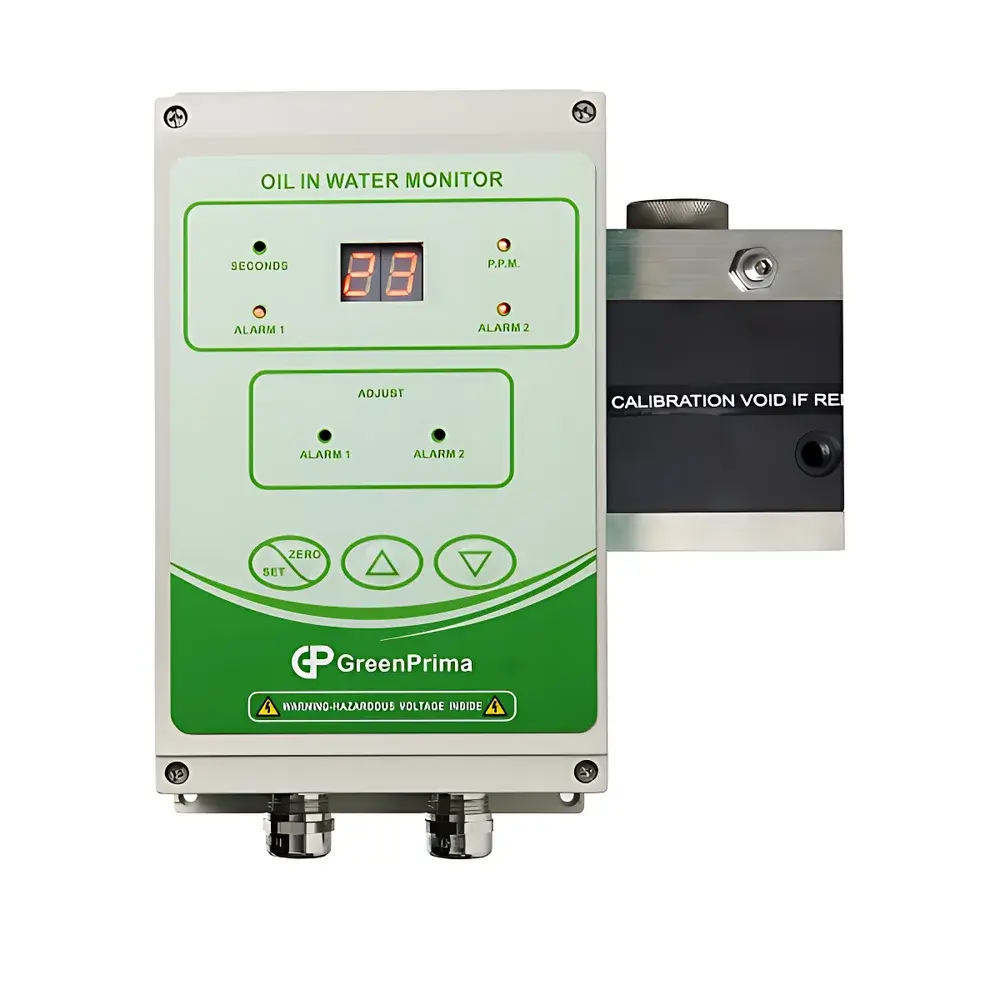
GreenPrima PROCO N7000 Online Oil-in-Water Analyzer
| Brand | GreenPrima |
|---|---|
| Origin | United Kingdom |
| Manufacturer Type | Manufacturer |
| Origin Category | Imported |
| Model | PROCO N7000 |
| Instrument Type | Online |
| Measurement Principle | Fluorescence-based optical detection (non-extractive, in-situ) |
| Measurement Range | 0–99 ppm |
| Accuracy | ±2 ppm |
| Alarm Setpoint Range | 1–98 ppm (adjustable) |
| Alarm Delay 1 | 0–60 s (adjustable) |
| Alarm Delay 2 | 10–240 s (adjustable) |
| Display | 240 × 128 pixel resistive touchscreen |
| Analog Outputs | 0/4–20 mA (min. load 820 Ω), 0–5 V / 1–5 V DC (min. load 50 kΩ) |
| Sample Flow Rate | 0.1–2 L/min |
| Sample Temperature | 1–40 °C |
| Sample Pressure | 0.1–10 bar |
| Ambient Operating Temperature | 1–60 °C |
| Relative Humidity | ≤90% RH at 55 °C |
| Enclosure Rating | IP55 |
| Electrical Safety | EN 61010-1, IEC 664 Category II |
| Power Supply | 230 V / 115 V AC or 24 V AC |
| Power Consumption | ≤10 VA |
| Weight | 2.25 kg |
| Dimensions (H×W×D) | 215 × 242 × 73 mm |
Overview
The GreenPrima PROCO N7000 Online Oil-in-Water Analyzer is an industrial-grade, fluorescence-based optical sensor system engineered for continuous, real-time monitoring of hydrocarbon contamination in aqueous process streams. Unlike extractive or gravimetric methods, the PROCO N7000 employs a non-contact, in-situ measurement principle—utilizing UV-induced fluorescence emission from aromatic hydrocarbons (e.g., mineral oils, diesel, lubricants) dissolved or dispersed in water. This approach delivers rapid response (<30 s typical), high selectivity against common interferents (e.g., humic substances, detergents), and immunity to flow-rate fluctuations within its specified range. Designed for integration into closed-loop cooling circuits, condensate return lines, and effluent discharge points, the analyzer meets operational requirements in power generation, oil refining, marine propulsion, and industrial manufacturing where early detection of oil ingress prevents equipment damage, regulatory noncompliance, and unplanned downtime.
Key Features
- Automatic self-diagnostic routine with drift compensation—ensures long-term signal stability without manual recalibration.
- Adjustable measurement interval (1–3600 seconds) to match process dynamics and data logging requirements.
- Resistive touchscreen interface (240 × 128 pixels) with intuitive menu navigation and on-device configuration of alarm thresholds, delays, and output scaling.
- Dual programmable relay outputs (8 A @ 240 V AC) for local alarm actuation, pump shutdown, or valve control—fully configurable for fail-safe operation.
- Isolated analog outputs (0/4–20 mA and 0–5 V / 1–5 V DC) compliant with standard DCS/PLC input specifications; minimum load impedance clearly defined for signal integrity.
- External start/stop trigger capability via dry-contact input—enables synchronization with sampling pumps or maintenance cycles.
- IP55-rated enclosure suitable for indoor industrial environments; optional IP65 external junction box available for hazardous-area installations.
- No consumables, reagents, or optical filters required—reducing total cost of ownership and maintenance frequency.
Sample Compatibility & Compliance
The PROCO N7000 is validated for use with freshwater, boiler condensate, engine cooling water, and treated industrial wastewater containing mineral oils, synthetic lubricants, and light distillates. It is not intended for seawater, highly turbid suspensions (>100 NTU), or emulsions stabilized by surfactants exceeding 50 mg/L. The analyzer complies with EN 61010-1 for electrical safety and IEC 664 Category II overvoltage protection. While not certified to ISO 9377-2 or ASTM D7622, its performance characteristics—including ±2 ppm accuracy across 0–99 ppm and repeatability <±1.5 ppm—align with typical QA/QC acceptance criteria for preventive maintenance monitoring per API RP 500 and IEC 61511 functional safety guidelines. Data traceability supports GLP-aligned recordkeeping when paired with time-stamped USB logging (optional module).
Software & Data Management
Local data acquisition is supported via USB 2.0 port (optional firmware upgrade), enabling export of timestamped CSV files containing oil concentration, temperature, pressure, alarm status, and diagnostic flags. No proprietary software is required—standard spreadsheet applications suffice for trend analysis. For enterprise integration, the 4–20 mA output may be connected to existing SCADA or historian systems (e.g., Siemens Desigo, Honeywell Experion) with linear scaling (0 ppm = 4 mA, 99 ppm = 20 mA). Audit trails are maintained via internal event log (last 1,000 entries), including calibration-free status alerts, power cycle timestamps, and relay activation history—facilitating root-cause analysis during incident investigations.
Applications
- Lubricating oil cooler leak detection in gas turbine and steam turbine generator sets.
- Continuous monitoring of diesel engine jacket water circuits aboard marine vessels and stationary backup generators.
- Boiler feedwater and condensate return line surveillance in combined-cycle and cogeneration plants.
- Pre-discharge verification of oily wastewater from metalworking, food processing, and automotive facilities prior to municipal sewer entry.
- Groundwater monitoring at fuel storage sites and remediation wells under EPA Region 10 or EU WFD reporting frameworks.
FAQ
Does the PROCO N7000 require periodic calibration with reference standards?
No. The instrument uses factory-traceable optical gain stabilization and built-in zero-reference compensation; no user-performed calibration is necessary under normal operating conditions.
Can it measure emulsified oil or only free-phase hydrocarbons?
It detects fluorescent aromatic compounds present in both free and stable micro-emulsions; however, sensitivity decreases significantly for non-aromatic base oils (e.g., PAO, white oils) and silicone-based fluids.
What is the maximum allowable suspended solids concentration?
Optimal performance is achieved at turbidity <30 NTU; above 50 NTU, signal attenuation may occur—installation upstream of filtration or with a side-stream bypass is recommended.
Is the 24 V AC power option compatible with SELV (Safety Extra-Low Voltage) circuits?
Yes—when supplied via a certified Class II transformer meeting EN 61558-2-6, the 24 V AC input satisfies SELV requirements for Zone 2 hazardous locations.
How is temperature compensation implemented?
An integrated Pt100 RTD measures sample temperature in real time; firmware applies empirically derived correction coefficients to maintain accuracy across the 1–40 °C operating range.







