
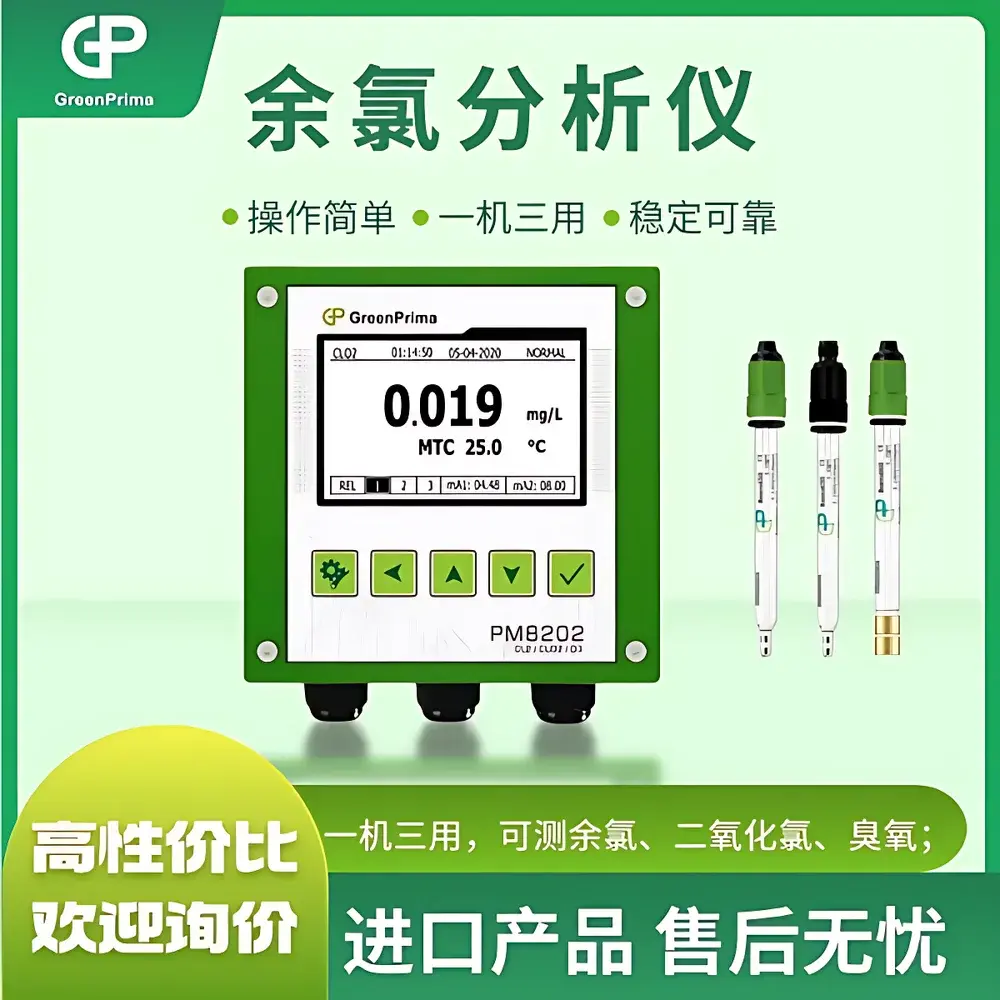
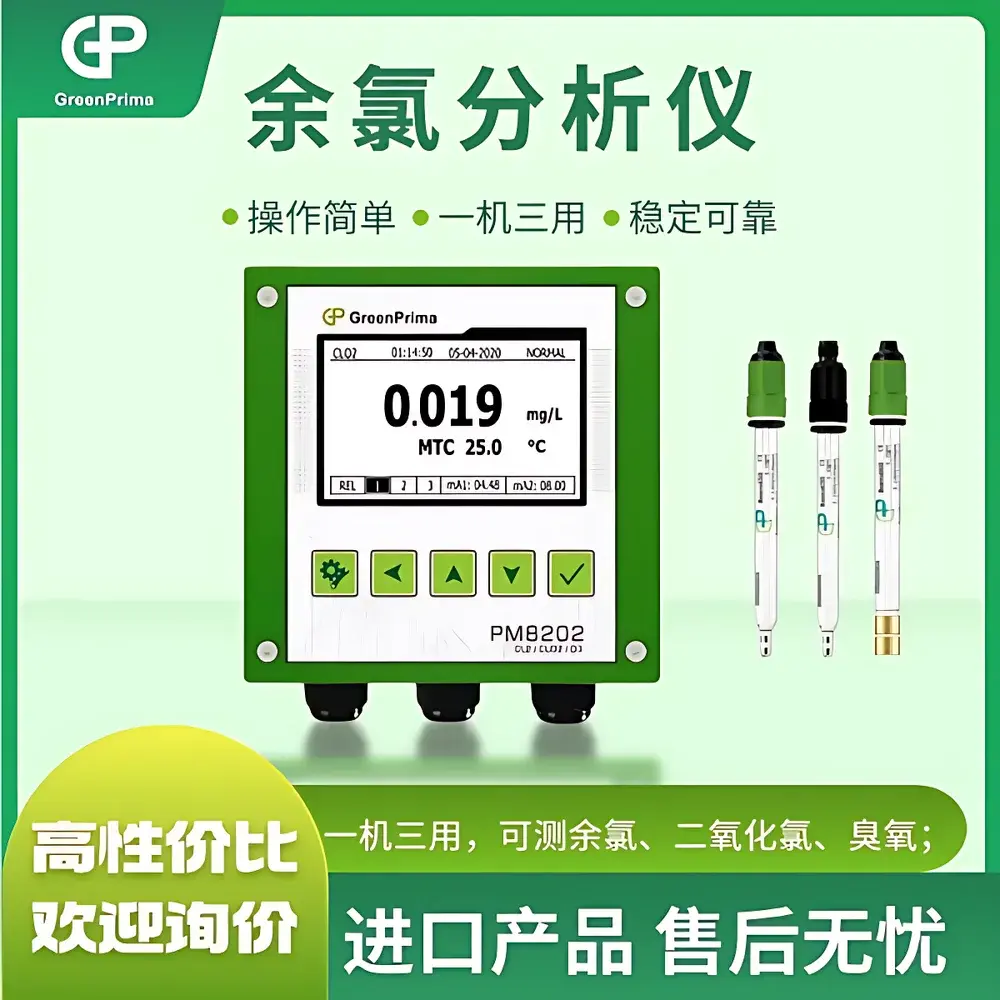
GreenPrima PM8202CL Residual Chlorine, Chlorine Dioxide and Ozone Online Analyzer
| Brand | GreenPrima |
|---|---|
| Origin | United Kingdom |
| Manufacturer Type | Manufacturer |
| Origin Category | Imported |
| Model | PM8202CL |
| Instrument Type | Online Analyzer |
| Measurement Principle | Amperometric (Constant Voltage) |
| Measured Parameters | Residual Chlorine, Chlorine Dioxide, Ozone |
| Range | 0.00–20.00 ppm / 0.00–200.00 ppb |
| Accuracy | ±2% F.S. |
| Resolution | 0.001 ppm / 0.01 ppm |
| Temperature Compensation | -10 to 130 °C (NTC10K or PT1000) |
| Operating Temperature | -10 to 70.0 °C |
| Storage Temperature | -20 to 70.0 °C |
| Display | Backlit Graphic LCD |
| Data Storage | 600,000 records |
| Power Supply | 90–260 VAC, 50/60 Hz or 24 VDC optional |
| Output | Dual isolated 4–20 mA (max. 500 Ω, 0.1% F.S.), RS485 Modbus RTU |
| Relay Outputs | 2 configurable Hi/Lo alarms (5 A / 250 VAC / 30 VDC) |
| Cleaning Cycle | 0.1–1000 h (adjustable), Duration: 1–1000 s (adjustable) |
| Enclosure Rating | IP65 |
| Dimensions | 144 × 144 × 108 mm |
| Panel Cutout | 138 × 138 mm |
| Weight | 0.87 kg |
Overview
The GreenPrima PM8202CL is an industrial-grade online amperometric analyzer engineered for continuous, real-time monitoring of residual chlorine, chlorine dioxide, and ozone in aqueous systems. It operates on the constant-voltage amperometric principle—applying a fixed bias potential across a dual-platinum (Bsens650) or gold (Bsens660) working electrode assembly immersed in a precisely controlled flow environment provided by the BAF615 dedicated constant-flow cell. This electrochemical architecture eliminates dependence on colorimetric reagents, membrane replacement, or electrolyte refilling—significantly reducing operational overhead and long-term calibration drift. The system is designed for deployment in critical water infrastructure where regulatory compliance, measurement stability, and maintenance resilience are non-negotiable: municipal drinking water distribution, hospital wastewater disinfection validation, secondary water supply networks, and process water loops in pharmaceutical and food & beverage manufacturing.
Key Features
- Triple-analyte capability: Simultaneous configuration for residual chlorine, chlorine dioxide, or ozone—without hardware modification.
- Reagent-free, membrane-free operation: Eliminates consumables, cross-contamination risks, and scheduled maintenance downtime.
- Dual-platinum electrode (Bsens650) with anti-fouling geometry and built-in reference stability—optimized for high-chloride or variable-pH matrices.
- BAF615 constant-flow cell ensures laminar, pressure-independent sample delivery at 100–300 mL/min—critical for reproducible diffusion-layer control and signal linearity.
- Integrated temperature compensation using NTC10K or PT1000 sensors, supporting manual or auto-compensation across -10 to 130 °C.
- Robust industrial enclosure rated IP65, compatible with wall-mount, panel-mount, and direct pipe-thread (½” NPT) installation.
- Configurable cleaning cycle with programmable frequency (0.1–1000 h) and duration (1–1000 s), triggered automatically or via digital input.
- Two independent relay outputs with user-defined hysteresis, supporting fail-safe shutdown or alarm escalation per local regulatory protocols.
Sample Compatibility & Compliance
The PM8202CL is validated for use in potable water, low-turbidity process streams (<5 NTU), and disinfected effluents meeting WHO Guidelines for Drinking-water Quality and EU Directive 98/83/EC. Its amperometric response remains stable across pH 4.0–8.5 and conductivity ranges of 50–2000 µS/cm—enabling reliable deployment in chloraminated systems and post-UV oxidation processes. The analyzer supports audit-ready data integrity through timestamped internal logging (600,000 records) and optional GLP-compliant event tagging (calibration, cleaning, alarm). While not intrinsically certified for hazardous areas, its 24 VDC option enables integration into SIL2-rated safety instrumented systems (SIS) when deployed with appropriate barrier modules.
Software & Data Management
Local configuration and diagnostics are executed via intuitive bilingual (English/Chinese) menu navigation on the backlit graphic LCD. All operational parameters—including range scaling, alarm thresholds, relay logic, and Modbus register mapping—are stored non-volatily. RS485 Modbus RTU (slave ID 1–247, baud rates 9600–115200) enables seamless integration with SCADA, DCS, or cloud-based IIoT platforms (e.g., Ignition, Siemens Desigo, or Azure IoT Hub). Dual isolated 4–20 mA outputs can be independently assigned to primary analyte concentration, temperature, or derived parameters (e.g., % saturation). Data export is supported via USB-C (optional adapter) for CSV archival compliant with FDA 21 CFR Part 11 requirements when paired with validated third-party software.
Applications
- Municipal drinking water: Real-time verification of chlorine residual at entry points, storage tanks, and zone boundaries per EPA Method 334.0 and ISO 7393-2.
- Hospital wastewater treatment: Monitoring of chlorine dioxide dosing efficacy prior to discharge—supporting CMS Condition of Participation (CoP) §482.42 and CDC Guideline for Disinfection and Sterilization.
- Pharmaceutical purified water (PW) and water-for-injection (WFI) loops: Continuous ozone residual tracking during sanitization cycles aligned with USP and EU GMP Annex 1.
- Food processing rinse lines: Verification of post-CIP chlorine levels to meet USDA-FSIS Directive 7120.1 and HACCP Critical Control Point logging.
- Swimming pool & spa management: Automated feedback control of chlorine dosing pumps per CDC Model Aquatic Health Code (MAHC) Section 5.003.
FAQ
What electrochemical principle does the PM8202CL employ?
It uses constant-voltage amperometry with a dual-platinum or gold working electrode—measuring current proportional to oxidant concentration under diffusion-controlled conditions.
Can the same sensor measure chlorine, chlorine dioxide, and ozone interchangeably?
Yes—the Bsens650/Bsens660 electrode and BAF615 flow cell are chemically inert and calibrated separately for each oxidant; only firmware parameter selection is required.
Is temperature compensation automatic or manual?
Both options are supported: auto-compensation using integrated NTC10K or PT1000 probes, or manual offset entry when external temperature data is supplied via Modbus.
Does the analyzer support regulatory audit trails for calibration and maintenance?
Yes—internal event logging captures timestamps for all calibration actions, cleaning cycles, alarm triggers, and configuration changes, enabling full traceability per GLP/GMP requirements.
What is the maximum allowable sample turbidity or suspended solids content?
For optimal performance and minimal electrode fouling, samples should not exceed 5 NTU turbidity and 10 mg/L total suspended solids (TSS); inline filtration (5–10 µm) is recommended upstream of the BAF615 cell in high-solids applications.







