
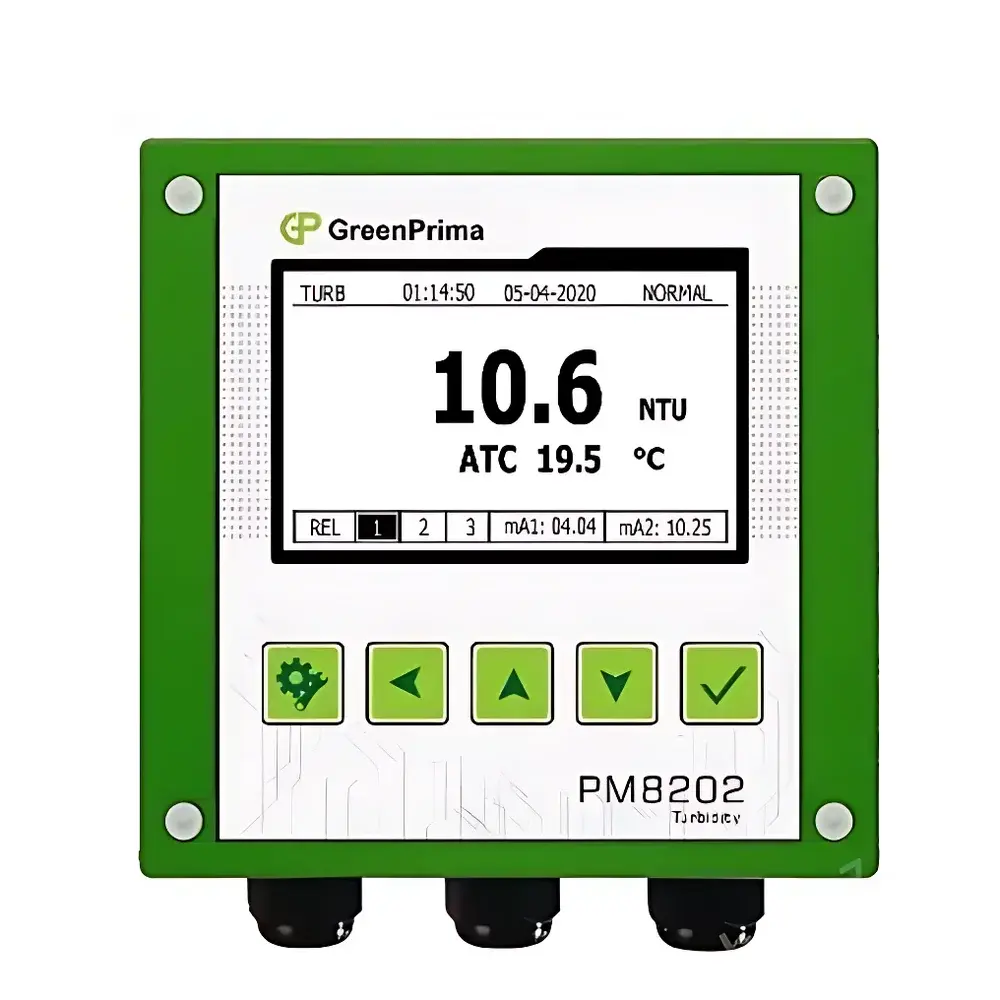
GreenPrima PM8202T Online Turbidity and Suspended Solids Analyzer
| Brand | GreenPrima |
|---|---|
| Origin | United Kingdom |
| Manufacturer Type | Original Equipment Manufacturer (OEM) |
| Product Origin | Imported |
| Model | PM8202T |
| Instrument Type | Online |
| Measurement Principle | Infrared 90° Nephelometry (Compliant with EN ISO 7027) |
| Temperature Compensation Range | –10 to 130 °C (Manual/Automatic, NTC30k or PT1000 sensor support) |
| Operating Temperature | –10 to 70.0 °C |
| Storage Temperature | –20 to 70.0 °C |
| Display | Backlit large-dot-matrix LCD |
| Language Interface | English & Chinese |
| Data Storage Capacity | 600,000 records |
| Power Supply | 90–260 VAC, 50/60 Hz or 24 VDC optional |
| Analog Outputs | Two isolated 4–20 mA outputs (max. loop resistance 500 Ω, accuracy ±0.1% F.S.) |
| Digital Communication | RS485 Modbus RTU |
| Cleaning Output | Adjustable cleaning interval (0.1–1000 h), duration (1–1000 s) |
| Alarm Outputs | Two independent Hi/Lo relay alarms (5 A / 250 VAC / 30 VDC, hysteresis configurable) |
| Mounting Options | Wall-mount, pipe-mount, panel-mount |
| Enclosure Rating | IP65 |
| Dimensions (H×W×D) | 144 × 144 × 108 mm |
| Panel Cutout | 138 × 138 mm |
| Weight | 0.87 kg |
Overview
The GreenPrima PM8202T Online Turbidity and Suspended Solids Analyzer is an industrial-grade, continuous-monitoring instrument engineered for high-reliability turbidity and suspended solids (SS) quantification in dynamic aqueous environments. It operates on the principle of infrared 90° nephelometry — a standardized optical detection method defined in EN ISO 7027 — which measures the intensity of light scattered at a right angle by suspended particles when illuminated by a near-infrared (NIR) monochromatic source. Unlike broadband white-light systems, the NIR emitter minimizes interference from natural water coloration (e.g., humic substances) and reduces photodegradation effects over extended deployment. A built-in reference photodetector continuously monitors source intensity and optical path integrity, enabling real-time compensation for lamp aging, lens fouling, and ambient chromatic drift. This dual-signal architecture ensures long-term measurement stability without frequent manual recalibration — a critical requirement for unattended operation in wastewater treatment plants, reservoir intake monitoring, and industrial process water loops.
Key Features
- Infrared 90° scattering geometry compliant with EN ISO 7027 for traceable, internationally recognized turbidity reporting in NTU or FNU units
- Integrated temperature compensation using either NTC30k or PT1000 sensors, supporting full-range correction from –10 °C to 130 °C
- IP65-rated sealed enclosure with corrosion-resistant housing, suitable for outdoor mounting, humid tunnels, and splash-prone industrial zones
- Backlit dot-matrix LCD display showing real-time turbidity, temperature, timestamp, relay status, and system diagnostics
- Dual isolated 4–20 mA analog outputs assignable to turbidity, temperature, or derived SS concentration; configurable zero/span and linearization
- RS485 Modbus RTU interface for seamless integration into SCADA, DCS, or PLC-based supervisory control systems
- Programmable automatic cleaning output supporting solenoid valves or ultrasonic wipers, with independently adjustable interval (0.1–1000 h) and duration (1–1000 s)
- User-accessible password protection (four-level hierarchy) to restrict configuration changes, calibration access, and data export functions
Sample Compatibility & Compliance
The PM8202T is validated for continuous immersion or flow-through installation in raw sewage, activated sludge effluent, surface water (rivers, lakes, reservoirs), cooling tower make-up, and pre-filtration process streams. Its optical design accommodates particle size distributions typical of municipal and industrial wastewater (0.1–100 µm), with minimal sensitivity to bubble entrainment due to directional scattering geometry. The analyzer meets electromagnetic compatibility requirements per EN 61326-1 and carries CE marking under the EU Electromagnetic Compatibility Directive. While not certified for drinking water compliance under NSF/ANSI 61 or EPA Method 180.1, its measurement traceability to EN ISO 7027 supports QA/QC protocols in non-potable applications governed by ISO 5667-2, ASTM D6508, and EU WFD monitoring frameworks.
Software & Data Management
Internal firmware supports onboard logging of up to 600,000 timestamped records (turbidity, temperature, cleaning events, alarm triggers), stored with millisecond-resolution timestamps. Data export is accessible via USB mass storage mode or Modbus register polling. No proprietary software is required for basic commissioning; configuration is performed locally via intuitive menu navigation. For centralized deployment, GreenPrima provides a Modbus register map compatible with industry-standard HMI platforms (e.g., Ignition, Siemens WinCC, Rockwell FactoryTalk). Audit trails are maintained for all parameter modifications and calibration actions, satisfying GLP-aligned record-keeping expectations in regulated wastewater operations. Firmware updates are delivered as signed binary files via secure FTP or local USB load.
Applications
- Real-time turbidity monitoring at wastewater treatment plant influent, secondary clarifier effluent, and disinfection contact basins
- Suspended solids trending in membrane bioreactor (MBR) and dissolved air flotation (DAF) unit controls
- Intake water quality surveillance for hydroelectric dams and irrigation canals
- Process water clarity verification in food & beverage, pharmaceutical, and semiconductor rinse loops
- Regulatory compliance reporting for discharge permits requiring continuous turbidity logging (e.g., EU Urban Wastewater Treatment Directive Annex I)
- Early detection of filter breakthrough or coagulant dosing inefficiency in potable water pre-treatment stages
FAQ
Does the PM8202T require periodic factory recalibration?
No scheduled factory recalibration is mandated. Field verification using certified formazin or AMCO AEPA standards is recommended every 6–12 months depending on application severity; the instrument supports user-initiated zero and span adjustments with traceable reference values.
Can the sensor be installed directly in a pressurized pipeline?
Yes — the Bsens580/Bsens580L sensor variants support inline flanged or threaded mounting (DN25–DN100) with pressure ratings up to 10 bar at 20 °C; consult the mechanical installation manual for thermal expansion allowances in hot-water service.
Is Modbus communication encrypted or authenticated?
Modbus RTU operates unencrypted over serial physical layer; security is implemented at the network infrastructure level (e.g., firewalled Modbus TCP gateways, VLAN segmentation) per IEC 62443-3-3 guidelines.
How does the reference photodetector correct for lens fouling?
The reference channel measures reflected intensity from a fixed internal reference surface adjacent to the optical path; deviation trends are used to apply multiplicative correction factors to the primary scatter signal, preserving linearity across gradual contamination buildup.
What maintenance intervals are recommended for the self-cleaning function?
Cleaning frequency should be empirically determined during commissioning; typical settings range from 2–8 hours in raw sewage, 24–72 hours in clarified effluent, and 168+ hours in low-fouling surface water — always validated against field correlation data.
Related Products







