
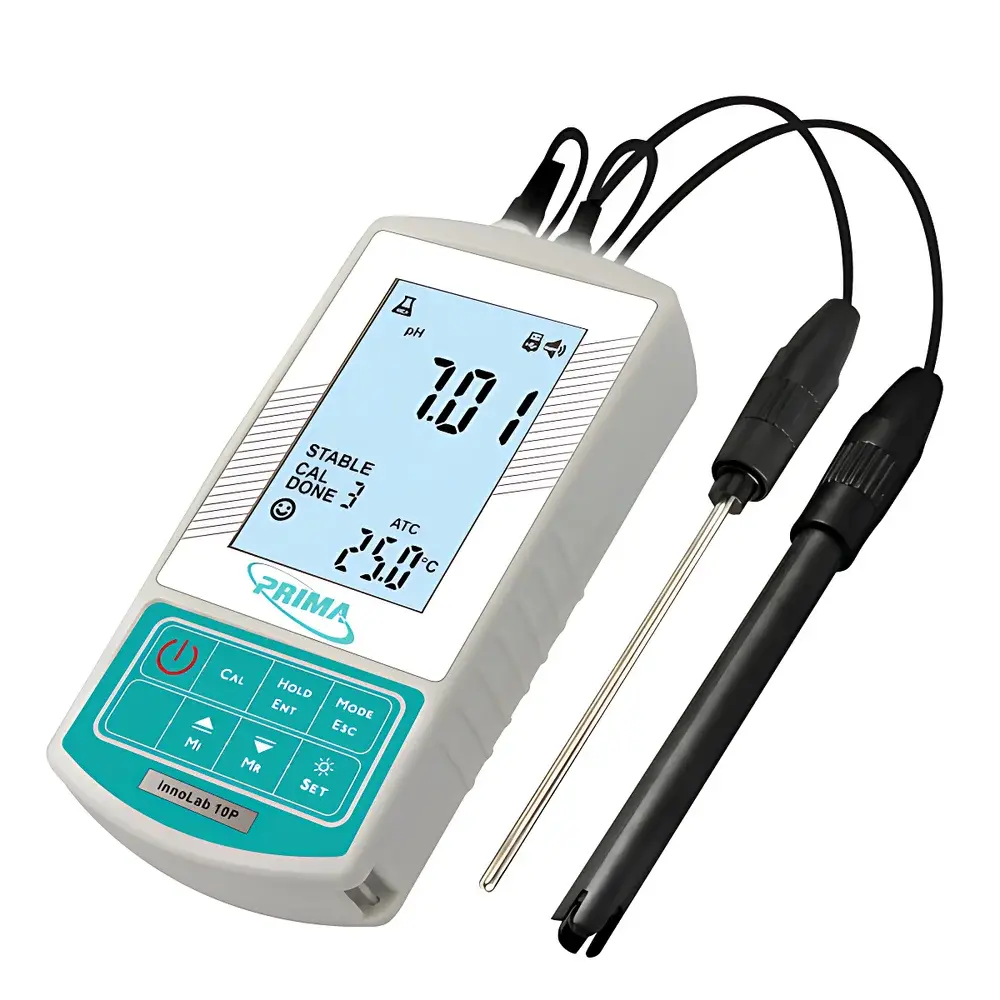
PRIMA innoLab 10P Portable pH/ORP Meter
| Brand | PRIMA (UK) |
|---|---|
| Origin | Taiwan |
| Model | innoLab 10P |
| Instrument Type | Portable/HANDHELD Water Quality Analyzer |
| Measured Parameters | pH, ORP (mV), Temperature |
| pH Range | -2.00 to 16.00 pH |
| ORP Range | -2000 to +2000 mV |
| Temperature Range | -5.0 to 120.0 °C |
| Resolution | 0.01 pH / 0.1 mV (±600.0 mV) / 0.1 °C |
| Accuracy | ±0.01 pH / ±0.2 mV (±600 mV), ±1 mV (full range) / ±0.3 °C |
| Temp. Compensation | Automatic or Manual |
| Calibration | Up to 5-point (NIST/USA buffers) |
| Memory | 100 data sets |
| Auto-Off | 10 min inactivity |
| Power | 2 × AA batteries |
| IP Rating | IP65 (pH mode), IP67 (conductivity/DO mode, not applicable here) |
| Dimensions | 73 × 152 × 42 mm |
| Weight | 250 g |
Overview
The PRIMA innoLab 10P is a rugged, field-deployable portable pH and ORP meter engineered for high reproducibility and operational reliability across diverse water quality monitoring environments. Based on potentiometric measurement principles, the instrument determines hydrogen ion activity (pH) via a glass electrode and redox potential (ORP) using a noble metal reference electrode—typically platinum or gold—paired with a stable Ag/AgCl reference system. Its dual-channel analog front-end supports simultaneous pH and temperature acquisition, enabling real-time automatic temperature compensation (ATC) per NIST-traceable algorithms. Designed for compliance with routine environmental testing workflows, the innoLab 10P meets the functional requirements of ASTM D1293 (Standard Test Method for pH of Water), ISO 10523 (Water Quality — Determination of pH), and EPA Method 150.1, making it suitable for regulatory sampling, wastewater effluent verification, drinking water distribution monitoring, and aquaculture management.
Key Features
- Rugged ergonomic housing with textured anti-slip grip and integrated lanyard hole for secure field handling
- Large 43 × 70 mm backlit LCD display with high-contrast numeric rendering and intuitive icon-based status indicators
- BNC/DIN-compatible electrode interface with sealed rear-slot design for organized probe storage and reduced cable strain
- IP65-rated enclosure ensures protection against dust ingress and low-pressure water jets—validated per IEC 60529 for laboratory and outdoor use
- Five-point pH calibration capability with support for both NIST and USA standard buffer sets (e.g., 4.01, 6.86, 7.00, 9.18, 10.01)
- HOLD function for freezing real-time measurements during unstable conditions or remote sampling
- Low-power architecture: Operates continuously for >200 hours on two standard AA alkaline cells; battery replacement requires no tools
- Copper-column battery contact system minimizes corrosion risk and ensures long-term electrical integrity under humid conditions
Sample Compatibility & Compliance
The innoLab 10P is validated for direct immersion measurement in aqueous matrices including surface water, groundwater, treated effluent, process streams, and aquarium systems. It accommodates standard combination pH electrodes (e.g., gel-filled or refillable double-junction types) as well as dedicated ORP probes with platinum sensing elements. The device complies with CE marking directives (2014/30/EU EMC and 2011/65/EU RoHS), and its measurement traceability aligns with ISO/IEC 17025–accredited calibration practices when used with certified reference materials. While not intrinsically safe, its non-explosive design satisfies general-purpose industrial hygiene requirements per OSHA 1910.1200 and EU CLP Regulation for non-hazardous chemical handling environments.
Software & Data Management
The innoLab 10P operates as a standalone analytical endpoint without proprietary software dependency. All measurement data—including timestamped pH, mV, and temperature values—are stored locally in non-volatile memory (100-entry capacity) with sequential indexing. Data export is manual via visual transcription; the unit does not feature USB, Bluetooth, or RS-232 connectivity. However, its consistent output format and stable calibration retention support integration into paper-based or LIMS-linked QA/QC documentation systems. For GLP/GMP-aligned operations, users may implement external logbooks referencing batch-specific calibration records, electrode serial numbers, and environmental ambient logs—all compatible with FDA 21 CFR Part 11 audit trail expectations when maintained manually with controlled document procedures.
Applications
- Field-based environmental monitoring: Stream health assessments, wetland pH profiling, stormwater runoff characterization
- Drinking water utilities: Residual disinfectant efficacy tracking via ORP correlation with free chlorine concentration
- Aquaculture and hydroponics: Real-time pH stabilization in recirculating aquaculture systems (RAS) and nutrient film technique (NFT) channels
- Industrial pretreatment verification: Effluent pH compliance checks prior to municipal sewer discharge (e.g., meeting local limits of pH 6–9)
- Educational laboratories: Undergraduate chemistry and environmental science instruction on acid-base equilibria and redox behavior
- Food & beverage sanitation validation: Surface rinse water pH verification following CIP cycle completion
FAQ
What electrode types are compatible with the innoLab 10P?
The meter accepts standard BNC or DIN pH electrodes and ORP probes rated for aqueous use; combination electrodes with integrated temperature sensors are recommended for optimal ATC performance.
Does the device support GLP-compliant data recording?
While it lacks electronic audit trails, its 100-entry memory, fixed calibration history, and stable time-stamping enable manual GLP documentation when paired with controlled lab notebooks and SOP-defined procedures.
Is temperature compensation fully automatic?
Yes—when a temperature probe is connected, the unit applies NIST-referenced polynomial compensation; manual input is available if probeless operation is required.
Can the innoLab 10P be used in seawater or high-salinity samples?
It is suitable for short-term immersion in brackish or marine water, though prolonged exposure may accelerate junction clogging; use of a double-junction electrode with KNO₃ electrolyte is advised.
How often should calibration be performed?
Calibration frequency follows application-specific risk assessment: daily for regulated sampling, pre- and post-shift for industrial QC, or before each discrete field session per ISO 5725 guidance on intermediate precision control.
Related Products







