
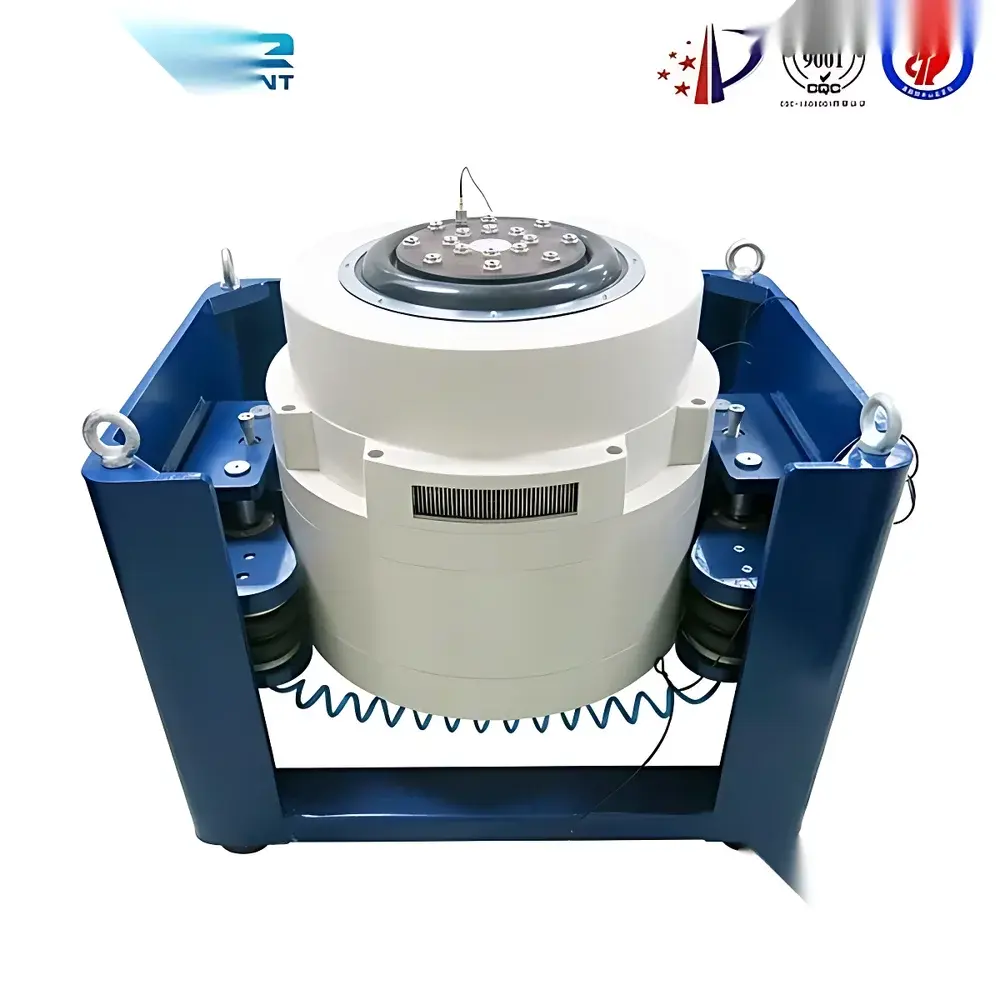
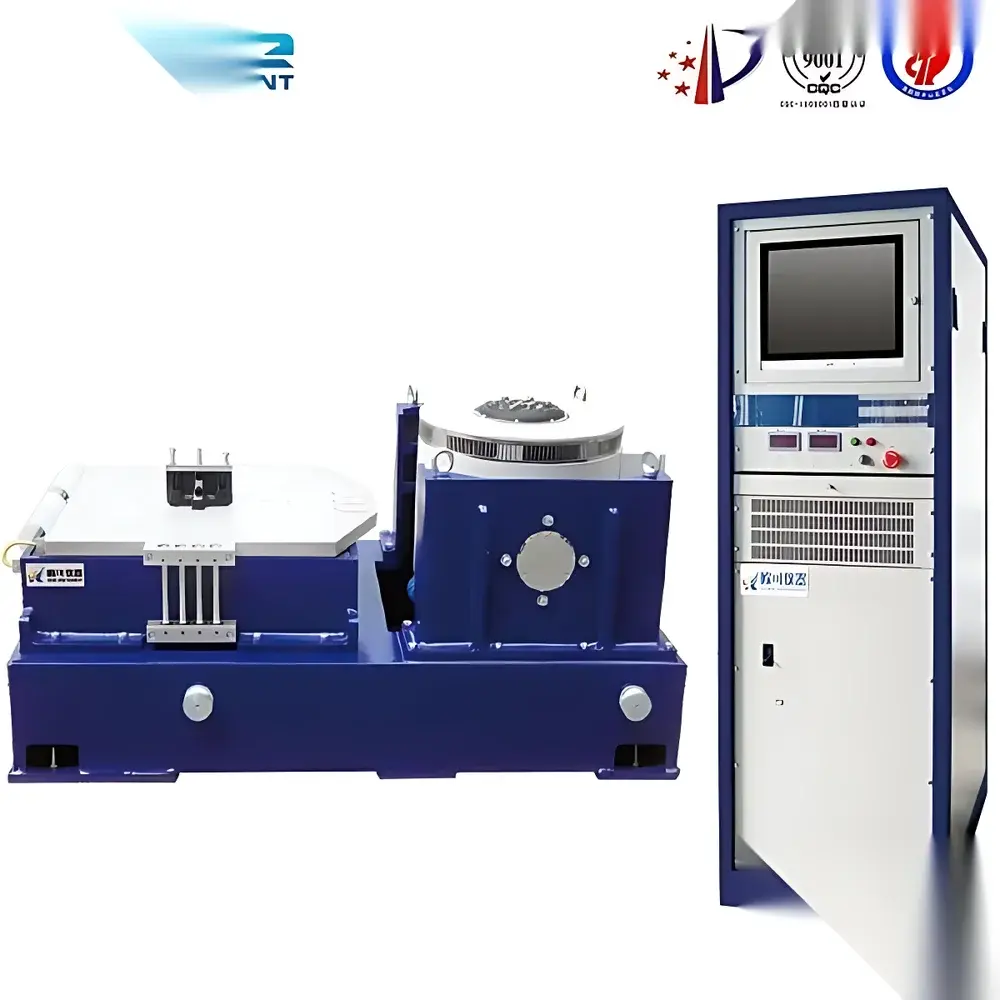
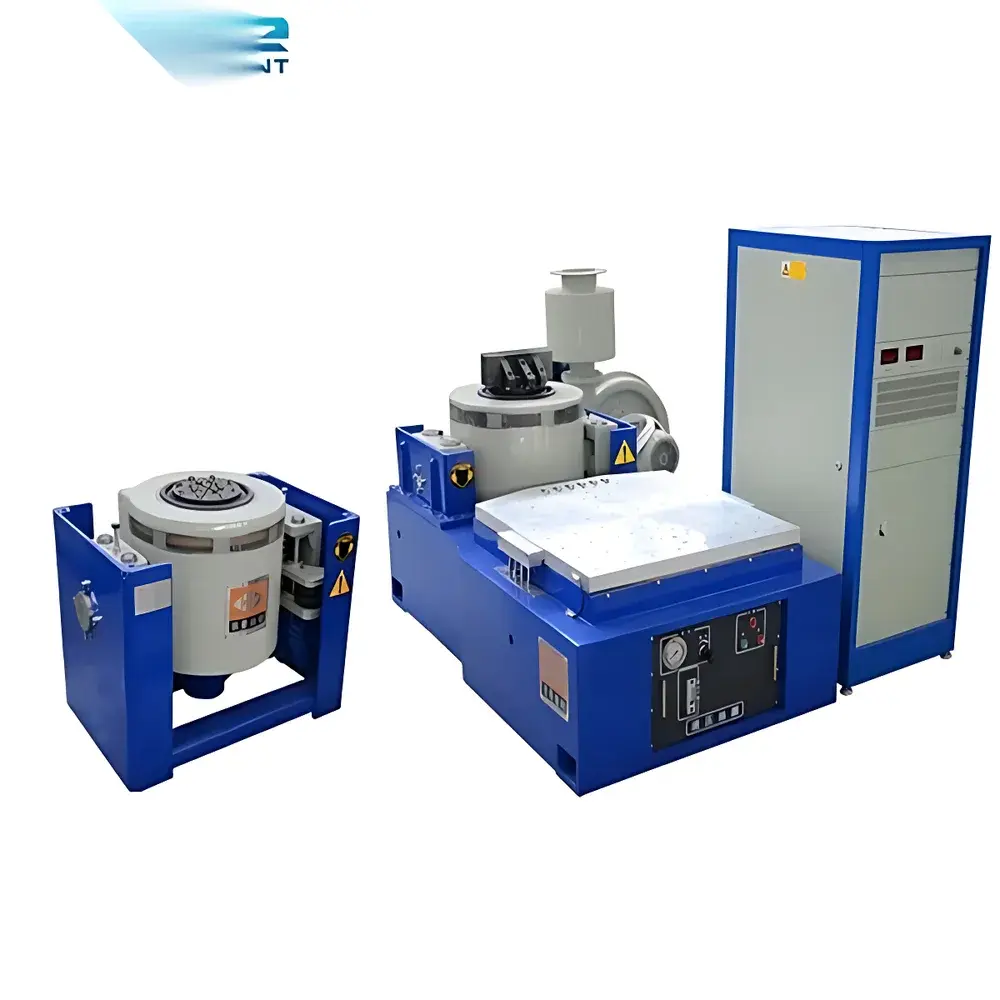
OK-ES-2 Three-Axis Electromagnetic Vibration Testing System
| Brand | Other brands |
|---|---|
| Origin | Imported |
| Manufacturer Type | General Distributor |
| Price | USD 21,000 (approx.) |
| Table Surface Dimensions | 500 × 500 mm |
| Vibration Axis | Vertical (single-axis configuration per standard compliance |
| note | “Three-Axis” in name refers to programmable multi-directional test sequencing capability, not simultaneous XYZ actuation) |
| Max Load Capacity | 100 kg |
| Frequency Range | 1–400 Hz |
| Sweep Frequency Range | 1–400 Hz |
| Displacement Amplitude | 0–5 mm peak-to-peak |
| Max Acceleration | 20 g (rms and peak values compliant with IEC 60068-2-6) |
| Time Control Resolution | 1 second, programmable up to 365 days |
| Waveforms | Sine, Half-Sine |
| Amplifier Power Rating | 2.2 kW |
| Input Voltage | 220 V ±10% AC, 50/60 Hz |
| Max Current Draw | 5 A |
| Frequency Display Resolution | 0.01 Hz |
| Frequency Accuracy | ±0.1 Hz |
| Shaker Body Dimensions (Vertical Configuration) | 500 × 500 × 160 mm |
| Compliance | GB/T 5170.14–1985, GB/T 10593.1–1989, GB/T 2423.10–1995, IEC 60068-2-6 |
Overview
The OK-ES-2 Three-Axis Electromagnetic Vibration Testing System is a high-fidelity electrodynamic shaker platform engineered for precision environmental simulation of mechanical vibration stress on electronic components, automotive modules, aerospace subassemblies, and industrial control units. Despite its designation as “Three-Axis”, the system implements sequential uniaxial excitation—vertical (Z-axis) by default—with programmable reorientation or auxiliary fixture mounting enabling controlled testing along X and Y axes via mechanical repositioning. Its core transduction principle relies on Lorentz-force-driven voice coil actuation within a high-strength permanent magnet circuit, delivering linear force response across the full 1–400 Hz operational bandwidth. Designed in strict accordance with IEC 60068-2-6 and harmonized national standards (GB/T 2423.10–1995, GB/T 5170.14–1985), the OK-ES-2 supports deterministic and random vibration profiles required for qualification testing under MIL-STD-810, RTCA DO-160, and ISO 16750-3 frameworks.
Key Features
- Electrodynamic shaker with 2.2 kW linear power amplifier, optimized for low-distortion sinusoidal and half-sinusoidal waveform generation
- Programmable sweep modes: linear, logarithmic, stepped, and resonant dwell—including frequency-modulated (FM) and amplitude-modulated (AM) profiles
- High-resolution digital controller with real-time frequency display (0.01 Hz resolution) and ±0.1 Hz absolute accuracy over full range
- Robust 500 × 500 mm stainless steel table surface, dynamically balanced to support 100 kg payload at 20 g peak acceleration without structural resonance interference
- Integrated RS-485 serial interface for remote command execution, data logging synchronization, and integration into automated test benches (SCPI-compatible protocol set)
- Thermal management system with forced-air cooling and over-temperature cut-off ensures continuous operation under sustained 10–55 Hz, 1.5 mm p-p displacement conditions
- Modular mechanical interface accommodating standard ISO 10816-3 mounting patterns and optional slip-table extensions for large-form-factor DUTs
Sample Compatibility & Compliance
The OK-ES-2 accommodates rigidly mounted samples up to 100 kg, including PCB assemblies, sensor housings, battery packs, and embedded controllers. Fixture design must conform to ISO 5344 mechanical interface guidelines to minimize parasitic resonances. All performance verifications follow GB/T 10593.1–1989 (vibration measurement methodology) and GB/T 2423.10–1995 (test procedure for sinusoidal vibration). Calibration traceability aligns with national metrology institutes per JJG 948–2012 (electrodynamic vibration shaker verification regulation). The system satisfies functional requirements for GLP-compliant reliability screening and pre-qualification testing under IATF 16949 and ISO 9001 quality management systems.
Software & Data Management
The system operates with vendor-supplied PC-based control software supporting Windows 10/11 (64-bit), offering intuitive waveform definition, real-time spectrum monitoring, and pass/fail threshold mapping. Data export formats include CSV, MATLAB (.mat), and universal HDF5 for post-processing in MATLAB, Python (SciPy), or NI DIAdem. Audit trail functionality records operator ID, timestamp, test parameters, and calibration status—meeting basic FDA 21 CFR Part 11 requirements for electronic record integrity when deployed in regulated manufacturing environments. Optional API access enables integration with LabVIEW, TestStand, or custom MES platforms via TCP/IP or RS-485.
Applications
- Environmental stress screening (ESS) of avionics hardware per RTCA DO-160 Section 8
- Vibration fatigue assessment of EV battery enclosures under ISO 16750-3 Level 3 profiles
- Resonance search and dwell testing for printed circuit board assemblies (IPC-J-STD-002)
- Qualification of industrial IoT gateways subjected to rail or marine transport spectra
- Verification of shock absorption performance in medical device packaging (ASTM D4169)
- Pre-compliance testing for CE marking under EN 60068-2-6 and EN 60068-2-27
FAQ
Does the OK-ES-2 support simultaneous three-axis vibration?
No. It is a single-axis (vertical Z-axis) electrodynamic shaker. “Three-Axis” denotes programmable test sequencing across orthogonal orientations using manual or motorized repositioning fixtures—not concurrent XYZ excitation.
Is the system compatible with third-party vibration controllers?
Yes—RS-485 interface supports SCPI command syntax; OEM controller integration requires protocol documentation review and handshake validation.
What is the maximum allowable payload at 400 Hz?
At upper-frequency limits, payload capacity is governed by force output (F = m·a) and mechanical impedance. For 20 g @ 400 Hz, max recommended mass is 35 kg to maintain waveform fidelity and thermal stability.
Can the system perform random vibration testing?
Not natively—the firmware supports only deterministic waveforms (sine, half-sine, swept sine). Random profile generation requires external signal generator + analog input upgrade (optional accessory).
How often does the system require recalibration?
Annual calibration is recommended per GB/T 5170.14–1985. Full verification—including force, displacement, and acceleration transducer linearity—should be performed before critical qualification runs or after mechanical impact events.



