
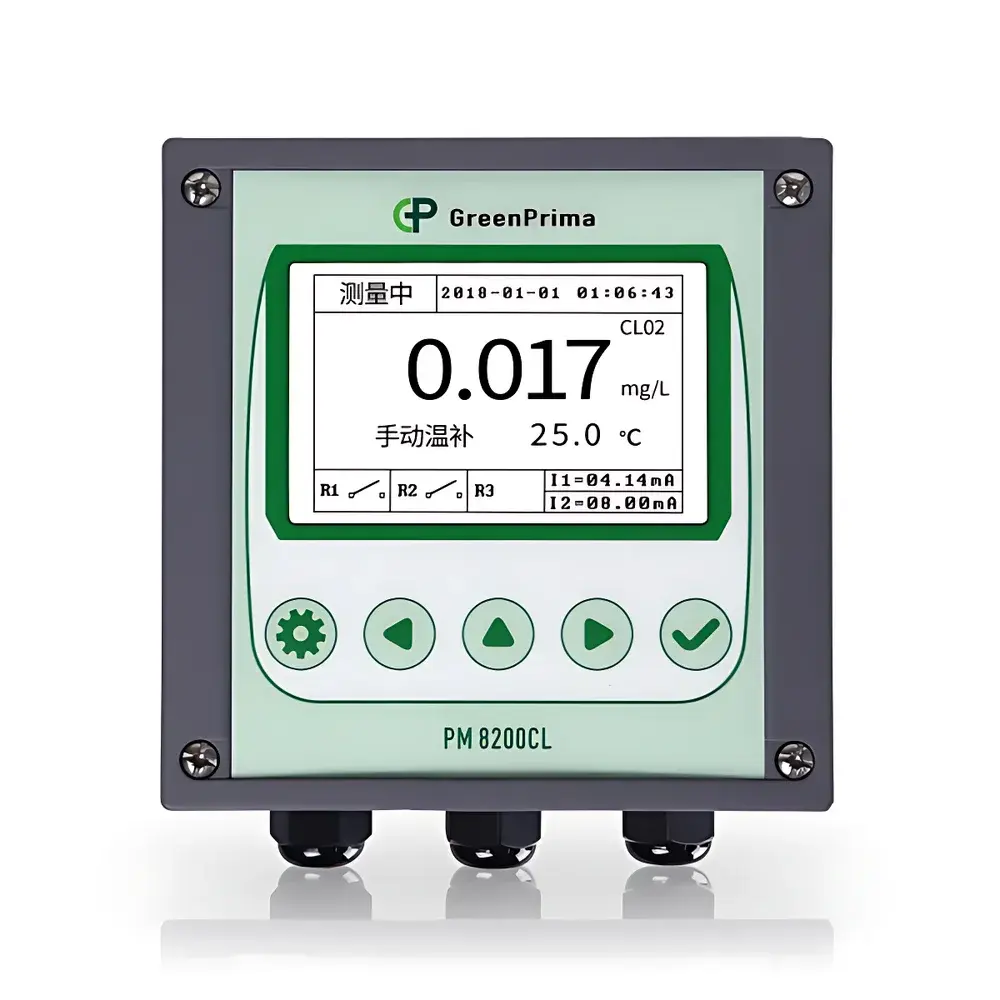
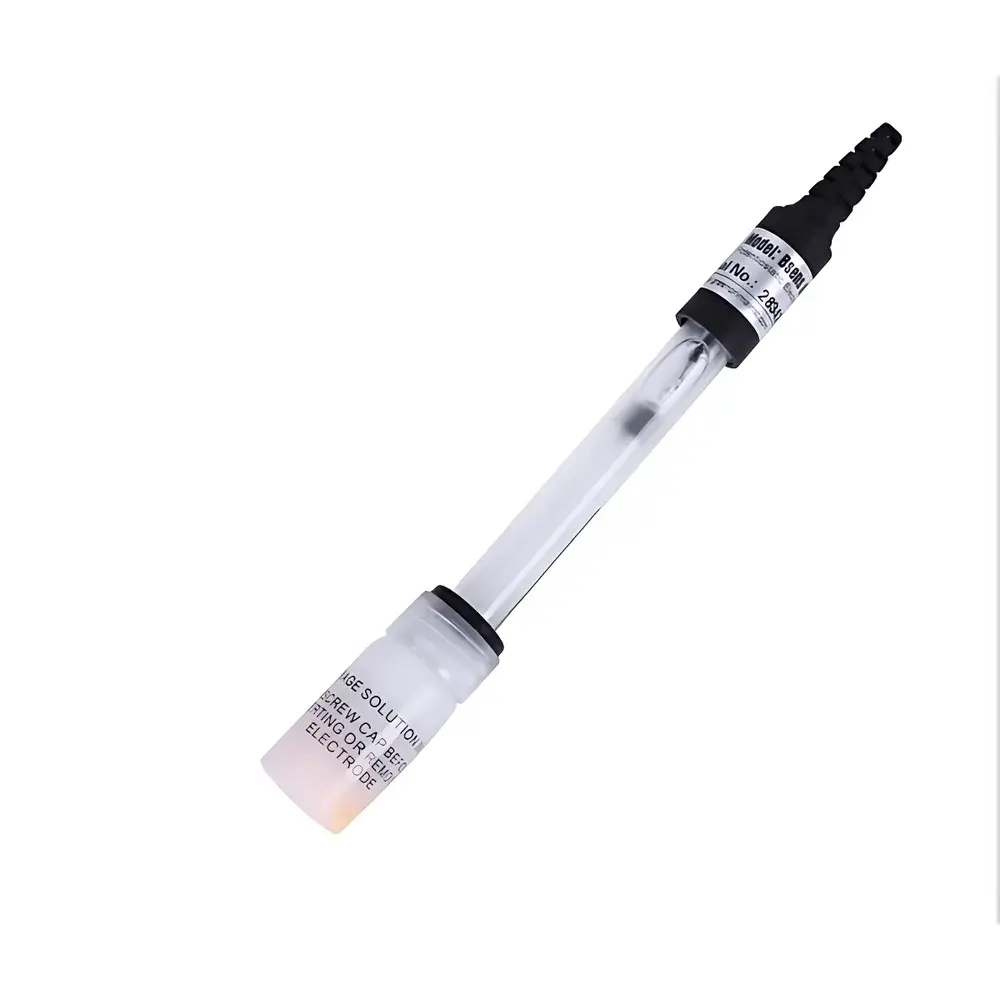
GreenPrima PM8200CL Online Chlorine Dioxide, Free Chlorine & Ozone Analyzer
| Brand | GreenPrima |
|---|---|
| Origin | United Kingdom |
| Manufacturer Type | Original Equipment Manufacturer (OEM) |
| Product Category | Imported Instrument |
| Model | PM8200CL |
| Instrument Type | Online Analyzer |
| Measurement Principle | Amperometric Sensor (Constant Voltage Polarography) |
| Measured Parameters | Free Chlorine, Chlorine Dioxide, Ozone |
| Measurement Range | 0–2.000 ppm and 0–20.00 ppm (dual-range auto-scaling) |
| Accuracy | ±0.001 ppm / ±0.01 ppm (depending on range) |
| Repeatability | ±0.001 ppm / ±0.01 ppm |
| Resolution | 0.001 ppm / 0.01 ppm |
| Detection Limit | 0.001 ppm / 0.01 ppm |
| Temperature Compensation | -10 to 130 °C (NTC10K or PT1000 selectable, manual/automatic) |
| Operating Temperature | 0 to 70.0 °C |
| Storage Temperature | -20 to 70.0 °C |
| Display | Backlit graphical LCD |
| Data Storage | 600,000 records |
| Power Supply | 90–260 VAC, 50/60 Hz or optional 24 VDC |
| Enclosure Rating | IP65 |
| Communication | RS485, MODBUS-RTU compliant |
| Analog Outputs | Two isolated 4–20 mA outputs (max. 500 Ω, accuracy ±0.1% FS) |
| Cleaning Output | Adjustable interval (0.1–1000 h) and duration (1–1000 s) |
| Mounting Options | Wall-mount, pipe-mount, panel-mount |
| Dimensions | 144 × 144 × 106 mm |
| Panel Cutout | 138 × 138 mm |
| Weight | 0.86 kg |
| Sensor Model | Bsens650 |
| Electrode Material | Glass body with dual-platinum ring working electrode |
| Max. Pressure Rating | 5 bar |
| Cable Length | 3 m |
| Sensor Operating Temp. | 0–70.0 °C |
Overview
The GreenPrima PM8200CL is a robust, three-in-one online amperometric analyzer engineered for continuous, real-time monitoring of free chlorine (Cl₂), chlorine dioxide (ClO₂), and ozone (O₃) in potable water, swimming pool circuits, wastewater disinfection processes, and pharmaceutical-grade water systems. It operates on the principle of constant-voltage polarography — a well-established electrochemical technique where a fixed potential is applied between a polarized working electrode (dual-platinum ring) and a stable reference electrode. At this optimized bias voltage, target oxidants undergo selective reduction at the electrode surface, generating a diffusion-controlled current proportional to their concentration. This method eliminates dependence on reagents, optical path length, or membrane permeability — delivering inherently stable zero points and high long-term reproducibility without consumables such as membranes or electrolyte refills.
Key Features
- Triple-parameter capability: Simultaneous or configurable single-analyte operation for Cl₂, ClO₂, and O₃ — ideal for multi-disinfectant facilities and transition-phase water treatment plants.
- Amperometric sensor architecture: Bsens650 sensor features a glass-bodied dual-platinum ring electrode, enabling rapid response (<60 s T₉₀), minimal drift, and immunity to turbidity, color, or pH fluctuations within typical operational ranges (pH 4–9).
- True maintenance-free operation: No membrane replacement, no internal electrolyte replenishment, and no chemical reagents required — significantly reducing total cost of ownership and technician intervention frequency.
- Dual-range auto-scaling measurement: Seamlessly switches between high-resolution low-range (0–2.000 ppm, 0.001 ppm resolution) and extended-range (0–20.00 ppm, 0.01 ppm resolution) modes based on process conditions.
- Comprehensive environmental compensation: Integrated temperature sensing (NTC10K or PT1000 selectable) with automatic or manual compensation across -10 to 130 °C ensures accuracy under variable thermal conditions — critical for hot-water loops or outdoor distribution networks.
- Industrial-grade connectivity: Dual isolated 4–20 mA analog outputs support legacy SCADA integration; RS485 interface complies with MODBUS-RTU protocol for PLC and DCS compatibility.
- Configurable cleaning control: Programmable cleaning cycle (interval: 0.1–1000 hours; duration: 1–1000 seconds) enables synchronization with backwash events or scheduled maintenance windows.
Sample Compatibility & Compliance
The PM8200CL is validated for use in low-conductivity applications (≥50 µS/cm) and performs reliably in chlorinated municipal water, recirculated swimming pool water (with cyanuric acid stabilization), membrane-treated ultrapure water (UPW), and secondary effluent post-ozonation. Its sensor design meets ISO 7888 (chlorine measurement), ASTM D1253 (residual chlorine), and EN ISO 20588-1 (chlorine dioxide in drinking water) requirements for field-deployable electrochemical analyzers. The instrument’s data logging functionality supports GLP-compliant audit trails when paired with timestamped storage (600,000 records), and its 4–20 mA outputs are traceable per IEC 61290-1 for industrial process instrumentation. While not FDA 21 CFR Part 11 certified out-of-the-box, the system architecture permits integration with validated LIMS or MES platforms via MODBUS for regulated environments requiring electronic record integrity.
Software & Data Management
The PM8200CL embeds firmware with embedded non-volatile memory supporting time-stamped data logging at user-defined intervals (1 s to 24 h). All measurements include associated temperature, sensor status flags (e.g., low signal, calibration overdue), and diagnostic codes. Data export is supported via RS485 using standard MODBUS register mapping, allowing direct ingestion into PI System, Ignition SCADA, or custom Python-based dashboards. The front-panel interface provides intuitive navigation through bilingual (English/Chinese) menus, real-time trend graphs, calibration history review, and alarm configuration (high/low limits with latching/non-latching options). Firmware updates are performed via USB port using signed binary files — ensuring version control and cybersecurity alignment with IEC 62443-3-3 guidelines for Level 1 devices.
Applications
- Municipal water distribution: Real-time residual disinfectant monitoring at booster stations and network endpoints to ensure regulatory compliance with WHO and EPA CT-value requirements.
- Swimming pool & spa management: Closed-loop control of ClO₂ dosing systems to maintain safe, non-irritating oxidation levels while minimizing chloramine formation.
- Hospital wastewater treatment: Verification of ozone contact time and residual decay in on-site disinfection units prior to sewer discharge.
- Pharmaceutical water systems: Monitoring of TOC-validated sanitization cycles in purified water (PW) and water-for-injection (WFI) loops per USP and EU GMP Annex 1.
- Food & beverage processing: Inline verification of chlorine dioxide efficacy during CIP rinse stages for equipment sanitation.
- Membrane desalination pre-treatment: Ozone residual tracking upstream of RO membranes to prevent biofouling without overdosing.
FAQ
Does the PM8200CL require daily calibration?
No — the amperometric sensor exhibits excellent zero stability and typically requires only quarterly verification against NIST-traceable standard solutions (e.g., DPD titration or certified ClO₂ reference standards). A full two-point calibration is recommended after sensor replacement or exposure to extreme fouling.
Can it operate in seawater or high-salinity brine?
Not recommended — the Bsens650 electrode is optimized for freshwater matrices (conductivity 50–2000 µS/cm). High chloride concentrations (>5000 mg/L) cause competitive interference and accelerated electrode passivation.
Is the flow cell (BAF615) included with the analyzer?
Yes — the PM8200CL is supplied as a complete system: controller unit, Bsens650 sensor, and BAF615 flow-through cell with PG13.5 thread connection and integrated flow regulation.
What is the expected service life of the Bsens650 sensor?
Under normal operating conditions (0–40 °C, pH 6–8, no heavy metal precipitation), the sensor demonstrates ≥24 months of functional stability before sensitivity decline exceeds ±5% FS.
How does the instrument handle air bubbles or flow interruptions?
The BAF615 flow cell incorporates an air-bleed vent and laminar-flow geometry to minimize bubble entrapment; the controller includes flow-loss detection logic that triggers alarm output and holds last valid reading during transient stoppages.
Related Products







