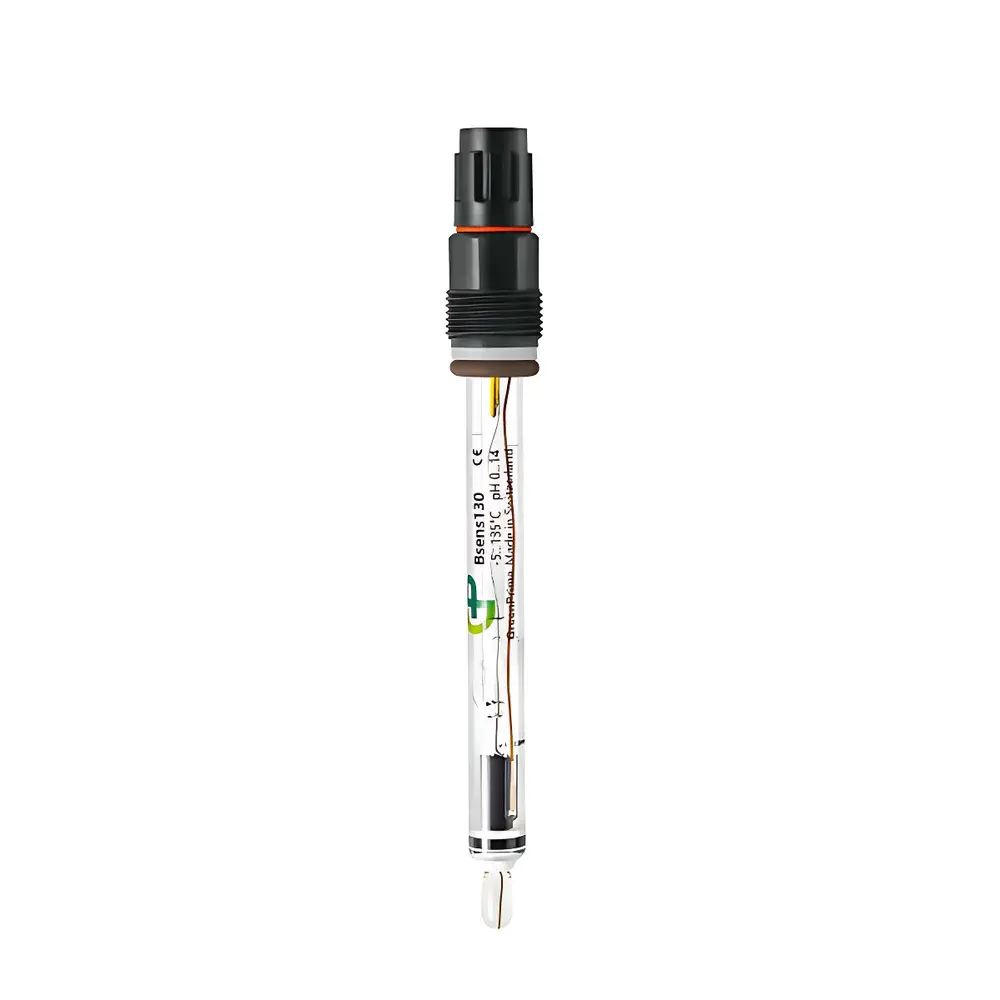
GreenPrima Bsens130 High-Temperature pH Sensor
| Brand | GreenPrima |
|---|---|
| Origin | Switzerland |
| Manufacturer Type | OEM Manufacturer |
| Product Origin | Imported |
| Model | Bsens130 |
| Operating Temperature Range | −5 °C to 135 °C |
| Pressure Rating | 6 bar |
| pH Measurement Range | 0–14 |
| Electrode Body Material | Glass |
| Reference System | Ag/AgCl Cartridge |
| Junction Type | Dual-Pore Polymer Diaphragm |
| Electrolyte | Solid-State Polymeric Gel |
| Electrode Resistance | ≤300 Ω at 25 °C |
| Zero Point | 0 ±20 mV |
| Sensitivity | 57–59 mV/pH at 25 °C |
| Minimum Sample Conductivity | 50 μS/cm |
| Response Time (pH 4.7) | <30 s |
| Immersion Depth | ≥20 mm |
| Connector | S8 (PG13.5) |
| Sensing Membrane | H-Glass |
| Cable | Not Included |
Overview
The GreenPrima Bsens130 is a high-temperature, industrial-grade pH sensor engineered for continuous, reliable measurement in demanding process environments where conventional glass electrodes fail. Designed around a robust H-glass membrane and solid-state polymeric electrolyte system, the Bsens130 operates continuously at temperatures up to 135 °C — making it suitable for sterilization-in-place (SIP), clean-in-place (CIP), and high-temperature fermentation or hydrolysis processes. Its measurement principle relies on the Nernstian potential difference generated across the pH-sensitive glass membrane relative to a stable Ag/AgCl reference element housed in a dual-pore polymer junction. This architecture minimizes liquid junction potential drift and prevents electrolyte leakage under elevated thermal and pressure loads (up to 6 bar). Unlike traditional refillable electrodes, the Bsens130’s maintenance-free, gel-filled reference system eliminates the need for periodic electrolyte replenishment and reduces clogging risk in viscous or particulate-laden streams — a critical advantage in pharmaceutical bioreactors, pulp & paper stock systems, and food thermal processing lines.
Key Features
- High-temperature capability: Continuous operation from −5 °C to 135 °C with thermal shock resistance
- H-glass membrane formulation optimized for rapid hydration and stable potential response under steam-sterilizable conditions
- Integrated Ag/AgCl cartridge reference system with dual-pore polymer junction for low-drift, high-reproducibility measurements
- Solid-state polymeric electrolyte eliminates leakage, evaporation, and crystallization issues common in aqueous KCl-based systems
- Low internal resistance (≤300 Ω at 25 °C) ensures compatibility with standard industrial pH transmitters and analog/digital I/O modules
- Compact cylindrical design (120 mm × 12 mm) with PG13.5 (S8) threaded connection for secure, leak-tight installation in sanitary or pressurized process housings
- Minimal immersion depth requirement (≥20 mm) enables use in low-volume bypass cells and micro-loop applications
Sample Compatibility & Compliance
The Bsens130 demonstrates broad chemical compatibility across aggressive media commonly encountered in regulated industries. It maintains accuracy in low-conductivity samples (≥50 μS/cm), including purified water used in pharmaceutical WFI (Water for Injection) loops and ultra-pure rinse waters in semiconductor wet benches. Its polymer junction resists fouling by proteins, colloids, sulfides, and heavy metal ions — supporting long-term stability in wastewater effluent, electroplating baths, and enzymatic hydrolysates. The sensor conforms to key international standards for process analytical technology (PAT), including ISO 15252 (industrial pH sensors), ASTM D1293 (standard test method for pH of water), and supports GLP/GMP data integrity requirements when paired with compliant transmitter systems featuring audit-trail logging and electronic signature capabilities per FDA 21 CFR Part 11.
Software & Data Management
While the Bsens130 is an analog sensing element (mV output), its performance is fully leveraged when integrated with modern pH transmitters supporting digital diagnostics, temperature compensation (Pt1000 or RTD input), and predictive maintenance algorithms. Compatible transmitters provide real-time electrode health monitoring — including asymmetry potential, slope deviation, and reference impedance tracking — enabling proactive calibration scheduling and reducing unplanned downtime. Data export formats (Modbus TCP/RTU, HART, or Profibus PA) allow seamless integration into DCS, SCADA, and MES platforms. When deployed within validated systems, raw mV and temperature signals can be archived with time-stamped metadata, fulfilling traceability and electronic record retention requirements under Annex 11 and ICH GCP guidelines.
Applications
- Pharmaceutical: In-situ pH monitoring during autoclave cycles, bioreactor cultivation, buffer preparation, and SIP/CIP validation
- Food & Beverage: Real-time control of thermal pasteurization, enzymatic hydrolysis, and acidification steps in dairy, brewing, and plant-based protein processing
- Pulp & Paper: Alkaline peroxide bleaching control, white water loop management, and caustic recovery system monitoring
- Chemical & Electroplating: Continuous pH regulation in etching baths, nickel/copper plating solutions, and waste neutralization tanks
- Environmental Engineering: Effluent pH compliance monitoring in municipal and industrial wastewater treatment plants operating at elevated temperatures
FAQ
Is the Bsens130 compatible with standard pH transmitters?
Yes — it outputs a standard mV signal referenced to Ag/AgCl and is compatible with any transmitter supporting asymmetric potential measurement, automatic temperature compensation (ATC), and slope/offset calibration routines.
Does the sensor require electrolyte refilling?
No — the solid-state polymeric gel electrolyte is sealed and maintenance-free for the sensor’s operational lifetime.
Can it be autoclaved?
Yes — the sensor is rated for repeated exposure to saturated steam at 135 °C for up to 30 minutes, meeting common SIP cycle specifications.
What is the recommended calibration frequency?
Calibration interval depends on process severity; typical practice ranges from daily (critical bioprocesses) to weekly (stable wastewater streams), guided by drift monitoring and regulatory validation protocols.
Is cable included with the sensor?
No — the Bsens130 is supplied as a bare sensor with S8 (PG13.5) connector; shielded, temperature-compensated cable must be selected separately based on installation length and EMI environment.