
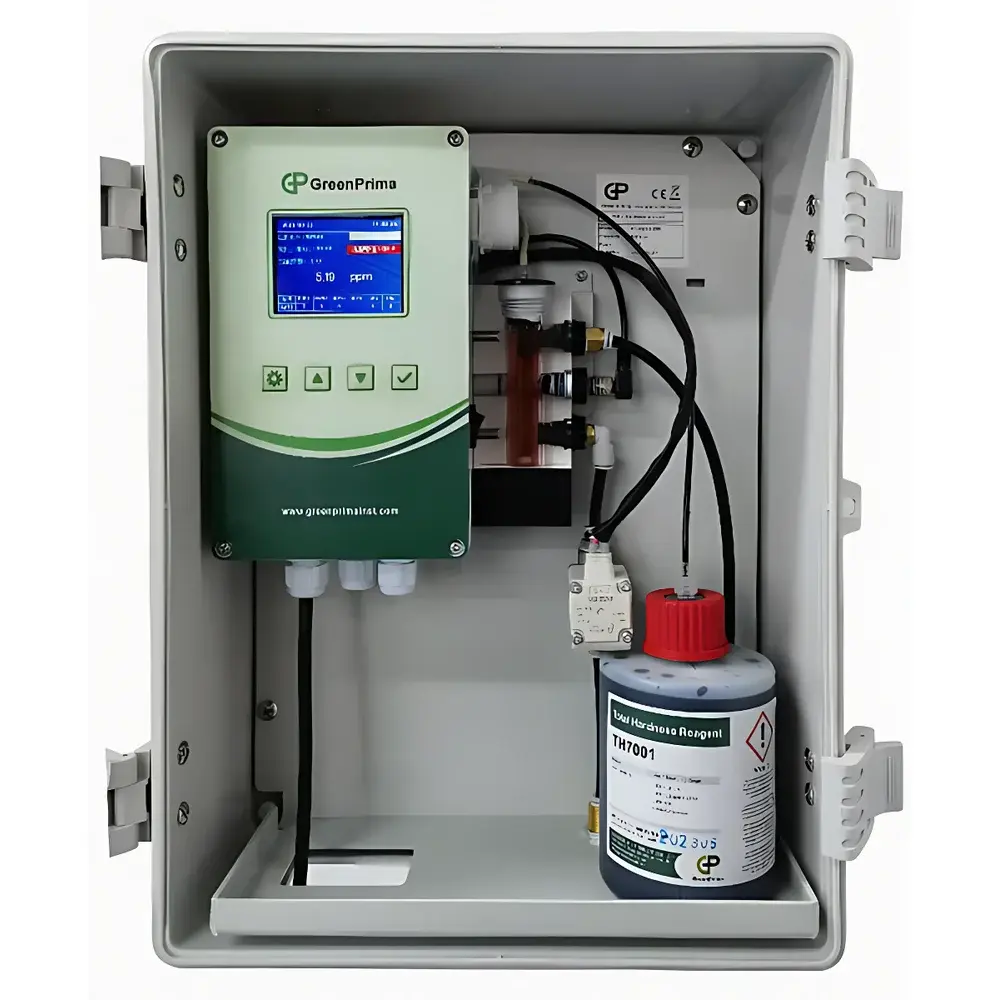
GreenPrima Aqualysis 800 Online Water Hardness Analyzer
| Brand | GreenPrima |
|---|---|
| Origin | Shanghai, China |
| Manufacturer Type | Manufacturer |
| Regional Classification | Domestic (China) |
| Model | Aqualysis 800 |
| Instrument Type | Online Water Quality Analyzer |
| Measured Parameter | Calcium & Magnesium Hardness (as CaCO₃) |
| Measurement Method | Titrimetric Colorimetry |
| Measurement Range | 0.447–625.8 ppm CaCO₃ |
| Accuracy | ±2% of selected reagent upper limit |
| Repeatability | ±1% of selected reagent upper limit |
| Cycle Time | ~3 minutes (hardness-dependent) |
| Display | Color LCD (bilingual: English/Chinese) |
| Dimensions | 400 × 300 × 180 mm (W×H×D) |
| Weight | 4 kg |
| Enclosure Rating | IP65 |
| Power Supply | 85–265 VAC, 47–63 Hz |
| Power Consumption | 25 VA (operational), 3.5 VA (standby) |
| Output Interfaces | 4 programmable relay outputs (250 VAC, 4 A), 1 × 4–20 mA (max. 750 Ω), 1 × RS485 |
| Digital Inputs | 2 programmable (IN1: start analysis |
| IN2 | stop analysis) |
| Data Storage | Internal logging |
| Sample Requirements | pH 4–10 |
| Sample Temp. | 5–40 °C |
| Ambient Temp. | 10–40 °C |
| Operating Pressure | 0.2–6 bar (recommended: 1–2 bar) |
| Mounting | Wall-mounted |
| Compatible Reagents | TH7001, TH7003, TH7005, TH7010, TH7030, TH7050, TH7100 |
| Optional Multi-Channel Expansion | MCS series distributor (2–8 channels) |
Overview
The GreenPrima Aqualysis 800 is an online water hardness analyzer engineered for continuous, unattended monitoring of calcium and magnesium ion concentration—expressed as calcium carbonate (CaCO₃) equivalents—in industrial and regulated water streams. It operates on the principle of automated titrimetric colorimetry: a precise volume of sample is mixed with a buffered indicator solution and titrated with a standardized EDTA reagent. The endpoint is detected photometrically via absorbance change (extinction measurement) at a defined wavelength, ensuring high specificity for total hardness in complex matrices. Unlike conductivity-based proxies or ion-selective electrodes, this method delivers chemically specific, stoichiometrically grounded results traceable to volumetric standards. Designed for integration into boiler feedwater circuits, cooling tower sidestreams, pharmaceutical purified water (PW) distribution loops, and reverse osmosis (RO) permeate lines, the Aqualysis 800 provides real-time data essential for softener regeneration control, scale risk assessment, and compliance with pharmacopeial water specifications (e.g., USP , EP 2.2.42).
Key Features
- Compact wall-mountable enclosure (400 × 300 × 180 mm, 4 kg) with IP65-rated housing for humid or splash-prone environments
- Bilingual color LCD interface supporting both English and Chinese navigation—optimized for operator accessibility across multinational facilities
- Low-maintenance architecture: no moving parts in fluid path beyond solenoid valves; reagent consumption optimized to extend cartridge life up to 30 days per set (dependent on cycle frequency and range)
- Configurable measurement interval (0–360 minutes) and programmable rinse duration (15–1800 s), enabling adaptive scheduling for low-activity or high-criticality applications
- Four independently programmable relay outputs (250 VAC, 4 A) for alarm staging, softener trigger signals, or SCADA interlock logic
- Dual digital inputs (IN1/IN2) to synchronize analysis initiation or halt with external process events (e.g., pump status, valve position)
- Integrated data retention with timestamped event logging; export-capable via RS485 Modbus RTU protocol for historian or MES integration
Sample Compatibility & Compliance
The Aqualysis 800 is validated for use with clarified, non-turbid water samples meeting specified matrix constraints: pH 4–10, iron < 3 ppm, copper < 0.2 ppm, aluminum < 0.1 ppm, and manganese < 0.2 ppm. These limits ensure minimal interference with the EDTA–metal chelation reaction and photometric endpoint detection. While not certified to ISO/IEC 17025 for accredited testing, the instrument supports GLP/GMP-aligned operational practices through audit-ready features—including user-accessible calibration logs, reagent lot tracking, and configurable password-protected parameter changes. Its analog 4–20 mA output and digital interfaces comply with standard industrial automation protocols, facilitating integration into systems governed by FDA 21 CFR Part 11 when paired with validated software platforms.
Software & Data Management
Data handling is implemented via embedded firmware—not cloud-dependent software—ensuring deterministic response times and resilience in offline or air-gapped installations. All measurements are time-stamped and stored locally with configurable retention depth. The RS485 interface supports Modbus RTU register mapping for seamless ingestion into PI System, Ignition SCADA, or custom LabVIEW/HMI dashboards. The 4–20 mA output is linearly scaled to the full measurement span (e.g., 0.447–625.8 ppm), allowing direct connection to PLC analog inputs without signal conditioning. Firmware updates are performed via USB port using signed binary files, preserving integrity and version traceability—a requirement in regulated manufacturing environments.
Applications
- Boiler feedwater hardness surveillance to prevent Ca/Mg scaling in economizers and steam drums
- Softener effluent verification prior to service loop reintroduction
- Cooling tower blowdown control based on real-time saturation index inputs
- Pharmaceutical purified water (PW) and water-for-injection (WFI) system validation and routine monitoring per EU GMP Annex 1 and USP
- RO system performance trending—detecting membrane fouling or breakthrough via hardness creep
- Industrial steam generation plants requiring ASME B31.1-compliant water chemistry records
- District heating networks in northern regions where hardness-induced precipitation compromises heat exchanger efficiency
FAQ
What measurement principle does the Aqualysis 800 employ?
It uses automated titrimetric colorimetry with EDTA as the titrant and a metallochromic indicator; endpoint detection is optical (absorbance extinction), not potentiometric.
Can it measure hardness independently of alkalinity or pH fluctuations?
Yes—the buffered titration system maintains optimal pH (~10) during analysis, isolating the Ca²⁺/Mg²⁺ reaction from ambient sample pH variations within the validated range (pH 4–10).
Is reagent selection fixed or configurable?
Reagents are range-specific (TH7001 to TH7100); users select the appropriate kit based on expected hardness levels—each defines the upper measurement limit and corresponding accuracy specification.
Does it support multi-point calibration or only factory calibration?
Calibration is performed using NIST-traceable hardness standards; field verification and adjustment of zero/span are supported via the service menu, with full audit trail logging.
How is sample integrity preserved during extended unattended operation?
The system includes timed purge cycles, air-gap isolation between reagent and sample lines, and pressure-regulated flow control (1–2 bar recommended) to minimize carryover and biofilm formation.







