
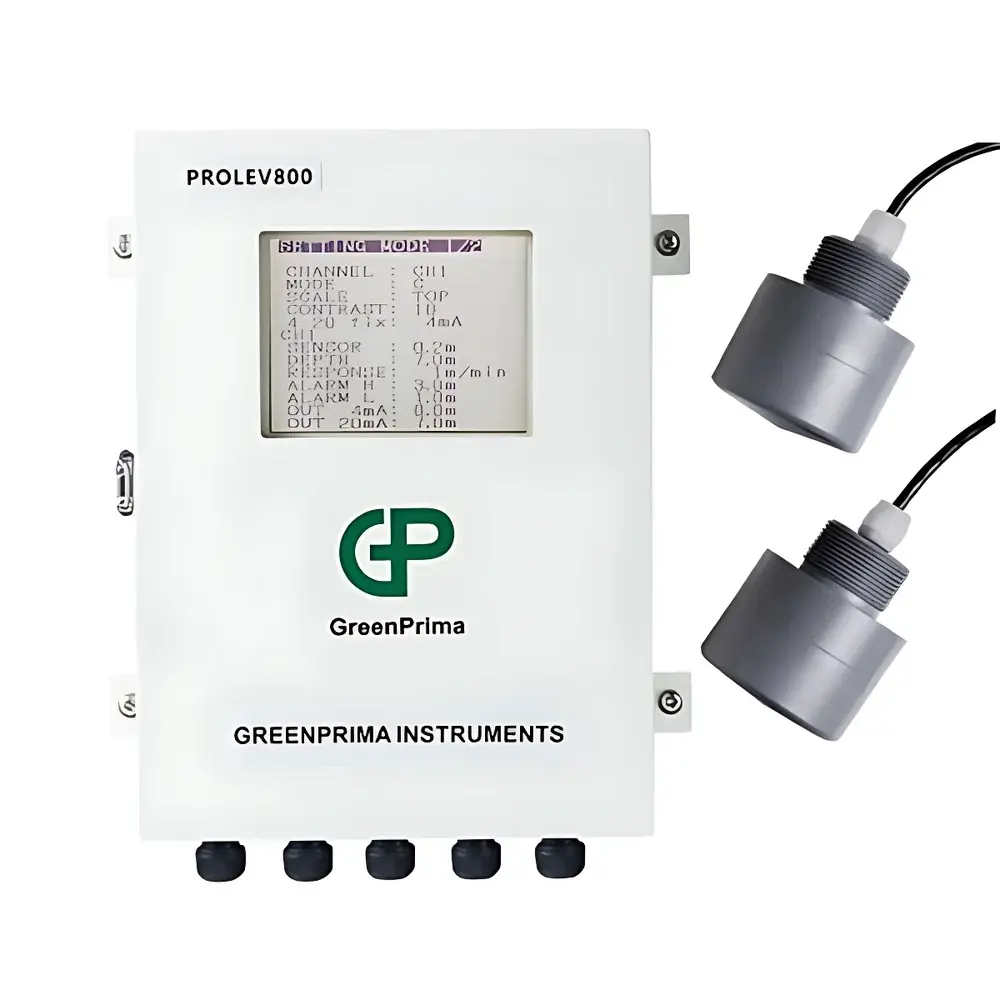
GreenPrima PROLEV 800 Ultrasonic Sludge Interface Monitor
| Brand | GreenPrima |
|---|---|
| Origin | United Kingdom |
| Manufacturer Type | Original Equipment Manufacturer (OEM) |
| Product Origin | Imported |
| Model | PROLEV 800 |
| Measurement Range | 0.4–10 m |
| Sensor Capacity | Up to 2 independent ultrasonic transducers |
| Accuracy | ±1 cm |
| Response Time | 1 s |
| Operating Temperature | –20 to +60 °C |
| Display | Large-backlit LCD with graphical interface (numeric, trend plot, echo waveform) |
| Enclosure Rating | IP68 |
| Weight | 3.6 kg (transmitter), 3 kg (probe) |
| Output Signal | 4–20 mA analog output |
| Alarm Outputs | 2 programmable high/low level relays |
| Communication Interface | RS-232C (cable length ≤10 m) |
| Power Supply | 85–264 VAC, 10 VA |
| Cable Length | 20 m |
Overview
The GreenPrima PROLEV 800 Ultrasonic Sludge Interface Monitor is an industrial-grade, non-invasive instrumentation system engineered for continuous, real-time measurement of sludge blanket depth and thickness in wastewater treatment clarifiers, thickeners, and settling basins. Based on time-of-flight ultrasonic pulse-echo principles, the device emits low-frequency acoustic pulses from a submerged transducer and precisely calculates the distance to the sludge–water interface by measuring the return signal’s transit time. This enables quantitative tracking of sedimentation dynamics—including sludge blanket rise, compaction rate, and stratification stability—critical for process control in activated sludge systems, primary and secondary clarifiers, and gravity thickeners. Unlike optical or conductivity-based methods, ultrasonic sensing remains unaffected by turbidity, suspended solids concentration, or chemical composition variations, ensuring stable performance across fluctuating influent loads and seasonal temperature shifts.
Key Features
- Large backlit LCD display supporting simultaneous numeric readout, real-time echo waveform visualization, and dynamic trend plotting (5-minute to 48-hour historical profiles)
- Embedded microprocessor architecture enabling continuous signal averaging, noise suppression, and adaptive threshold detection—ensuring robust interface identification even under turbulent or foamy surface conditions
- Sludge interface tracking algorithm with automatic drift compensation and dynamic baseline adjustment, eliminating manual recalibration during normal operation
- No moving parts or immersed electronics; transducer and transmitter are mechanically isolated, minimizing maintenance requirements and extending service life
- Configurable dual-sensor support: one transmitter unit can independently acquire and process data from two spatially separated ultrasonic probes—ideal for cross-sectional profiling or redundancy-critical applications
- Adjustable display brightness and user-friendly menu navigation via membrane keypad, optimized for field technicians operating under variable ambient lighting
- Integrated analog output (4–20 mA) with scalable range mapping, plus two relay outputs for programmable high/low interface alarms—directly interfacing with PLCs, SCADA systems, or DCS controllers
Sample Compatibility & Compliance
The PROLEV 800 is validated for use in municipal and industrial wastewater streams, including primary effluent, mixed liquor, digested sludge, and coal washery tailings. Its IP68-rated transducer housing ensures reliable submersion in aggressive aqueous environments containing abrasives, oils, or biogas. The instrument complies with IEC 61326-1 (EMC for industrial measurement equipment) and meets the mechanical and environmental testing requirements of EN 60529 for ingress protection. While not certified for SIL-rated safety loops, its design supports integration into GMP-aligned wastewater operations where traceability and operational consistency are required per ISO 9001 and ISO 14001 frameworks. Data logging functionality aligns with basic GLP documentation needs, though full 21 CFR Part 11 compliance requires external audit-trail-enabled SCADA integration.
Software & Data Management
Data acquisition is handled locally via the onboard microcontroller, with real-time values and waveform snapshots accessible through the front-panel LCD. RS-232C serial communication (up to 10 m cable length) enables connection to local PCs or edge gateways for periodic configuration updates, firmware upgrades, or short-term data capture using standard terminal emulators (e.g., PuTTY). No proprietary software is bundled; however, ASCII-formatted output protocols are documented in the technical manual to facilitate custom script development (Python, LabVIEW, Node-RED). Trend history is stored in volatile RAM—retained for up to 48 hours at default sampling intervals—and exported only upon manual query via serial interface. For long-term archival or cloud-based analytics, integration with third-party historian platforms (e.g., Ignition, Siemens Desigo CC) is supported via Modbus RTU over RS-485 (requires optional converter module).
Applications
- Optimization of return activated sludge (RAS) and waste activated sludge (WAS) flow rates based on real-time sludge blanket elevation
- Early detection of sludge bulking or deflocculation events through abnormal interface velocity trends
- Monitoring separation layer formation in pre-thickening basins prior to anaerobic digestion
- Control logic input for automated scraper bridge speed modulation in large-diameter circular clarifiers
- Performance validation of lamella settlers and tube settlers in potable water treatment plants
- Interface surveillance in coal preparation plant thickener underflows and ash slurry ponds in thermal power generation facilities
FAQ
Can the PROLEV 800 distinguish between multiple layers (e.g., scum, clarified water, sludge, and compacted sludge)?
The device is calibrated to detect the dominant acoustic impedance discontinuity—the primary sludge–water interface. While advanced echo analysis may reveal secondary reflections, multi-layer resolution is not a designed function and requires post-processing with specialized ultrasonic analysis software.
Is calibration required after installation?
A one-time zero-point calibration (using known still-water level) is recommended during commissioning. Subsequent drift correction is managed automatically by the internal algorithm; no routine recalibration is necessary under stable mounting conditions.
What is the maximum allowable suspended solids concentration for reliable operation?
The system maintains accuracy across typical municipal wastewater TSS ranges (50–15,000 mg/L). Performance degradation may occur above 30,000 mg/L if particle size distribution includes >200 µm aggregates that attenuate ultrasonic energy.
Does the unit support Modbus or HART communication protocols?
Standard configuration includes RS-232C only. Modbus RTU support is available via optional hardware adapter; HART is not supported.
How is probe fouling mitigated in high-fouling environments?
The transducer face incorporates a self-cleaning acoustic pulse sequence and is constructed from chemically inert PVDF polymer. Periodic manual cleaning is advised in plants with heavy grease or calcium carbonate scaling.
Related Products







