
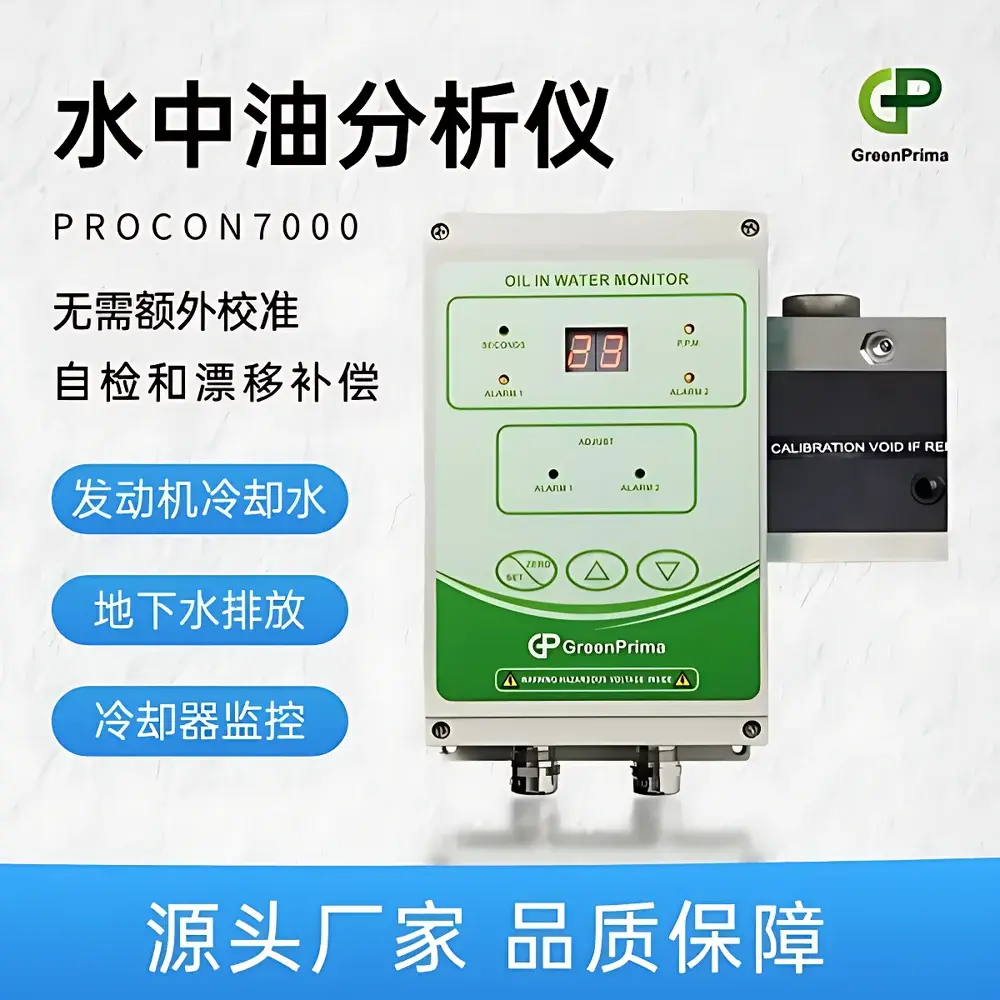
GreenPrima PROCON N7000 Online Oil-in-Water Analyzer
| Brand | GreenPrima |
|---|---|
| Origin | United Kingdom |
| Manufacturer Type | Manufacturer |
| Origin Category | Imported |
| Model | PROCON N7000 |
| Instrument Type | Online |
| Measurement Principle | Fluorescence-based Optical Detection (Non-Extractive) |
| Measurement Range | 0–99 ppm |
| Accuracy | ±2 ppm |
| Alarm Setpoint Range | 1–98 ppm (adjustable) |
| Alarm Delay 1 | 0–60 s (adjustable) |
| Alarm Delay 2 | 10–240 s (adjustable) |
| Display | 240 × 128 pixel touch screen |
| Output Signals | 0/4–20 mA (min. load 820 Ω), 0–5 V / 1–5 V DC (min. load 50 kΩ) |
| Sample Flow Rate | 0.1–2 L/min |
| Sample Temperature | 1–40 °C |
| Sample Pressure | 0.1–10 bar |
| Ambient Operating Temperature | 1–60 °C |
| Relative Humidity | ≤90% RH at 55 °C |
| Enclosure Rating | IP55 |
| Electrical Safety | EN 61010-1, IEC 664 Category II |
| Power Supply | 230 V / 115 V AC or 24 V AC |
| Max. Power Consumption | 10 VA |
| Dimensions (H×W×D) | 215 × 242 × 73 mm |
| Weight | 2.25 kg |
Overview
The GreenPrima PROCON N7000 Online Oil-in-Water Analyzer is an industrial-grade, fluorescence-based optical analyzer engineered for continuous, real-time monitoring of hydrocarbon contamination in aqueous streams. Unlike extractive or gravimetric methods, the PROCON N7000 employs a non-contact, solvent-free excitation/emission detection principle—optimized for aromatic and aliphatic hydrocarbons commonly found in lubricating oils, diesel, fuel oil, and hydraulic fluids. Its measurement architecture eliminates reagent consumption, sample conditioning, and manual intervention, making it suitable for unattended operation in demanding environments such as power plant condensate loops, refinery cooling water circuits, and wastewater effluent channels. The instrument operates on the principle that dissolved and dispersed oil compounds fluoresce under UV excitation at characteristic wavelengths; signal intensity is linearly correlated to oil concentration across its calibrated 0–99 ppm range, with trace-level sensitivity down to sub-ppm detection limits under stable flow conditions.
Key Features
- Automated self-diagnostic routine with drift compensation—performed prior to each analysis cycle to ensure long-term baseline stability
- Configurable measurement intervals (1–60 minutes), enabling optimization of data density versus maintenance frequency
- Integrated 240 × 128 pixel resistive touch display with intuitive icon-driven navigation—no external PC required for setup or operation
- Dual independently programmable alarm outputs (Alarm 1 and Alarm 2) with adjustable delay timers (0–60 s and 10–240 s respectively) to mitigate transient spikes
- Isolated 0/4–20 mA analog output with configurable scaling and fault signaling (e.g., sensor failure, flow loss), compliant with standard DCS/PLC input specifications
- Optional USB data logging interface (USB-B port) supporting CSV export for offline trend analysis and regulatory reporting
- External start/stop trigger capability via dry-contact input—enabling synchronization with pump cycles or process valves
- IP55-rated enclosure with reinforced polymer housing—suitable for indoor control rooms and semi-outdoor technical enclosures
- No field calibration required after initial commissioning; factory calibration traceable to NIST-traceable reference standards
Sample Compatibility & Compliance
The PROCON N7000 is validated for use with clarified, low-turbidity water matrices including boiler feedwater, turbine condensate, closed-loop cooling water, and pre-treated industrial effluent. It is not intended for raw sewage, highly emulsified oily wastewater, or samples containing suspended solids >10 mg/L without upstream filtration. The analyzer meets EN 61010-1 safety requirements for measurement and control equipment and conforms to IEC 664 insulation coordination standards for Pollution Degree 2 environments. While not intrinsically safe, its Class II overvoltage category rating permits installation downstream of standard industrial isolators. For regulated facilities operating under ISO 14001, EPA Method 1664B (for method correlation), or EU WFD compliance frameworks, the PROCON N7000 supports audit-ready data integrity when paired with timestamped USB logs and analog output recording.
Software & Data Management
The device operates autonomously without embedded firmware updates or cloud connectivity. All configuration—including alarm thresholds, output scaling, and analysis timing—is performed locally via the touchscreen interface. USB data export generates time-stamped .CSV files containing timestamp, measured ppm value, temperature, flow status, and diagnostic flags (e.g., “lamp aging,” “window soiling warning”). No proprietary software is required to parse exported data; files are natively compatible with Excel, LabVIEW, and SCADA historian systems. For facilities requiring electronic record retention per FDA 21 CFR Part 11 or EU Annex 11, integration with third-party validation-ready data acquisition platforms (e.g., Siemens Desigo CC, Honeywell Experion PKS) is supported through standard 4–20 mA or Modbus RTU (optional add-on module).
Applications
- Early leak detection in lube oil coolers and steam turbine condensers—preventing catastrophic bearing damage and extending equipment service life
- Continuous monitoring of freshwater makeup systems in combined-cycle power plants to safeguard heat exchanger integrity
- Effluent compliance verification at industrial outfalls prior to discharge into municipal sewers or surface water bodies
- Groundwater remediation site monitoring where hydrocarbon plume migration must be quantified against regulatory action levels (e.g., EPA Region 1 Tier 1 screening values)
- Pre-treatment verification in zero-liquid-discharge (ZLD) systems to protect downstream RO membranes from organic fouling
FAQ
Does the PROCON N7000 require periodic recalibration?
No. The instrument performs automatic zero tracking and lamp intensity normalization during each measurement cycle. Factory calibration remains valid for 24 months under normal operating conditions; revalidation is recommended only after physical impact, exposure to extreme temperature shock, or replacement of the optical module.
Can it measure emulsified oil?
Yes—within limits. The fluorescence method detects both free and finely dispersed (sub-micron) oil droplets, but performance degrades above ~50 NTU turbidity or in the presence of strong fluorescent interferents (e.g., certain surfactants, quenching agents). Pre-filtration to <5 µm is advised for highly emulsified streams.
What maintenance is required?
Quarterly visual inspection of the quartz flow cell window for fouling; cleaning with isopropyl alcohol and lint-free wipe if deposits are observed. Annual verification of flow sensor accuracy using a calibrated rotameter is recommended for critical applications.
Is hazardous area certification available?
Not as standard. The PROCON N7000 is rated IP55 and Class II—suitable for Zone 2/Class I Division 2 when installed in ventilated enclosures. ATEX or IECEx variants are not offered; consult GreenPrima Engineering for custom barrier-integrated configurations.
How is sample flow controlled?
The analyzer requires an external, stable supply of 0.1–2 L/min at 0.1–10 bar. It does not include an integrated pump; users must provide a metering pump or pressure-regulated bypass loop with flow stabilization (e.g., laminar flow element + back-pressure regulator).
Related Products







