
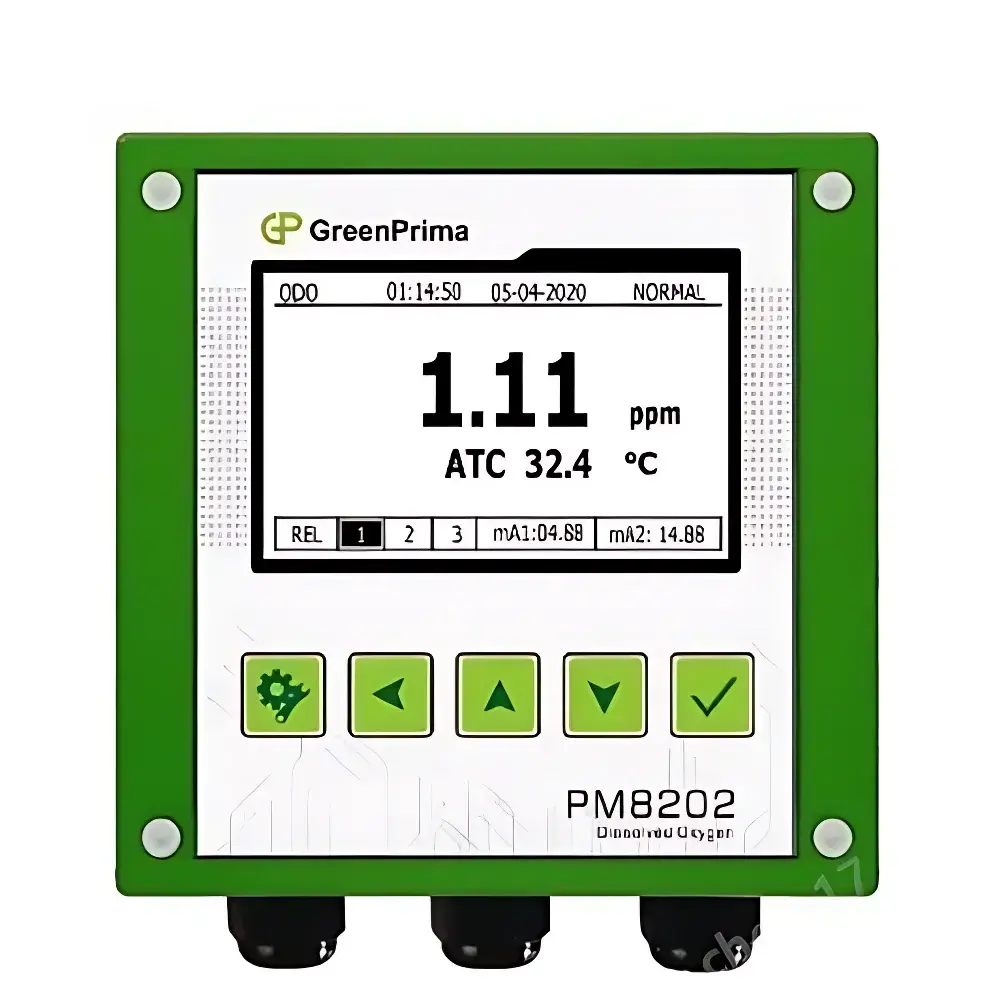
GreenPrima PM8202D Fluorescence-Based Online Dissolved Oxygen Analyzer
| Brand | GreenPrima |
|---|---|
| Origin | United Kingdom |
| Manufacturer Type | Original Equipment Manufacturer (OEM) |
| Origin Category | Imported |
| Model | PM8202D |
| Instrument Type | Online Analyzer |
| Measurement Principle | Fluorescence Quenching |
| Measurement Range | 0.00–20.00 ppm |
| Accuracy | ±0.01 ppm |
| Resolution | 0.01 ppm |
| Temperature Compensation Range | −10 to 130 °C (NTC30K/PT1000, manual or automatic) |
| Operating Temperature | −10 to 70.0 °C |
| Storage Temperature | −20 to 70.0 °C |
| Display | Backlit large-dot-matrix LCD |
| Language Interface | English & Chinese |
| Data Storage Capacity | 600,000 records |
| Power Supply | 90–260 VAC, 50/60 Hz or optional 24 VDC |
| Analog Outputs | Two isolated 4–20 mA outputs (max. loop resistance 500 Ω, accuracy 0.1% FS, configurable for DO or temperature) |
| Digital Communication | RS485 Modbus RTU |
| Cleaning Output | Adjustable cleaning interval (0.1–1000 h) and duration (1–1000 s) |
| Alarm Outputs | Two independent Hi/Lo relay outputs (5 A / 250 VAC / 30 VDC, with hysteresis setting) |
| Enclosure Rating | IP65 |
| Mounting Options | Wall-mounted, pipe-mounted, panel-mounted |
| Dimensions (W×H×D) | 144 × 144 × 108 mm |
| Panel Cutout | 138 × 138 mm |
| Weight | 0.87 kg |
| Electrode Material | 316L stainless steel |
| Optional Feature | Air-driven self-cleaning module |
Overview
The GreenPrima PM8202D is an online dissolved oxygen (DO) analyzer engineered for continuous, high-stability measurement in demanding water quality monitoring applications. It employs optical fluorescence quenching technology—based on the Stern–Volmer principle—to quantify dissolved molecular oxygen concentration without electrochemical consumption. Unlike traditional Clark-type amperometric sensors, the PM8202D utilizes a solid-state luminescent sensor spot excited by blue LED light; the resulting phase shift or intensity decay of emitted red fluorescence is inversely proportional to local O₂ partial pressure. This non-consumptive, membrane-free detection method eliminates zero drift, eliminates the need for electrolyte refills or membrane replacements, and ensures stable calibration over extended periods—even under low-flow or stagnant conditions typical in wastewater channels, aquaculture tanks, and surface water monitoring stations.
Key Features
- Fluorescence-based sensing with no oxygen consumption—ideal for low-circulation or static water environments
- Zero-maintenance optical transducer: no membranes, no electrolytes, no cathode poisoning or polarization delays
- Digital sensor architecture with embedded temperature compensation (NTC30K or PT1000 selectable), supporting full-range compensation from −10 °C to 130 °C
- High-precision measurement: ±0.01 ppm accuracy and 0.01 ppm resolution across 0.00–20.00 ppm range
- Robust 316L stainless steel sensor body rated IP65 for industrial enclosure integrity
- Configurable dual 4–20 mA analog outputs with independent scaling for DO and temperature signals
- RS485 Modbus RTU interface compliant with industry-standard SCADA integration protocols
- Onboard data logging capacity of 600,000 timestamped records with user-defined sampling intervals
- Optional air-driven self-cleaning system to mitigate biofouling in untreated or high-suspended-solid environments
- Multi-language UI (English/Chinese), password-protected configuration menu, and backlit dot-matrix display for low-light visibility
Sample Compatibility & Compliance
The PM8202D is validated for use across heterogeneous aqueous matrices—including raw sewage, activated sludge effluent, river and reservoir surface water, recirculating aquaculture systems (RAS), and industrial cooling water loops. Its optical design renders it insensitive to hydrogen sulfide, chlorine, carbon monoxide, and other common interferents that affect electrochemical DO sensors. The instrument complies with ISO 5814:2012 (Water quality — Determination of dissolved oxygen — Electrochemical probe method) for performance validation methodology, and supports audit-ready operation per GLP and GMP frameworks through time-stamped event logs, calibration history tracking, and change-control access restrictions. While not FDA 21 CFR Part 11 certified out-of-the-box, its secure user authentication, immutable data storage, and configurable audit trail parameters enable qualification for regulated environmental monitoring programs.
Software & Data Management
Data acquisition and remote supervision are supported via native Modbus RTU register mapping, enabling seamless integration into PLCs, DCS platforms, and cloud-based IIoT dashboards. The onboard memory retains up to 600,000 readings with microsecond-level timestamping, including sensor diagnostics, temperature values, alarm states, and cleaning actuation events. Configuration and firmware updates are performed locally via front-panel navigation or remotely via Modbus write commands. All parameter changes are logged with operator ID (if enabled) and timestamp, satisfying traceability requirements for ISO/IEC 17025-accredited laboratories and EPA-compliant wastewater treatment facilities.
Applications
- Real-time DO monitoring in municipal and industrial wastewater treatment plants—particularly in anoxic/oxic zone control loops
- Process optimization in activated sludge, SBR, and MBR bioreactors where precise O₂ setpoint maintenance affects nitrification efficiency
- Environmental compliance reporting for surface water bodies under EU WFD or US Clean Water Act regulatory frameworks
- Health management in finfish and shellfish aquaculture systems, where sub-lethal hypoxia thresholds must be detected proactively
- Industrial cooling tower and boiler feedwater monitoring to prevent microbiologically influenced corrosion (MIC)
- Research-grade field deployments requiring long-term unattended operation in remote hydrological stations
FAQ
Does the PM8202D require periodic calibration?
No routine calibration is required due to inherent stability of the fluorescence chemistry and built-in temperature compensation. A single factory calibration is traceable to NIST-certified standards; field verification using air-saturated water or Winkler titration is recommended only for QA/QC audits.
Can the sensor operate in viscous or high-turbidity water?
Yes—the optical sensing mechanism is unaffected by suspended solids or viscosity. Optional air-jet cleaning prevents biofilm accumulation on the sensing window in such environments.
Is the 4–20 mA output intrinsically safe?
The analog outputs are isolated but not intrinsically safe rated; for hazardous area installations, external IS barriers compliant with IEC 60079-11 must be used.
What temperature probes are supported for compensation?
Both NTC30K thermistors and PT1000 RTDs are software-selectable; the controller auto-detects probe type upon power-up if configured accordingly.
How is sensor fouling mitigated during continuous operation?
The integrated air-pulse cleaning module delivers programmable bursts of compressed air directly onto the optical face—configurable from 1 second to 1000 seconds duration and 0.1 to 1000 hours interval.







