
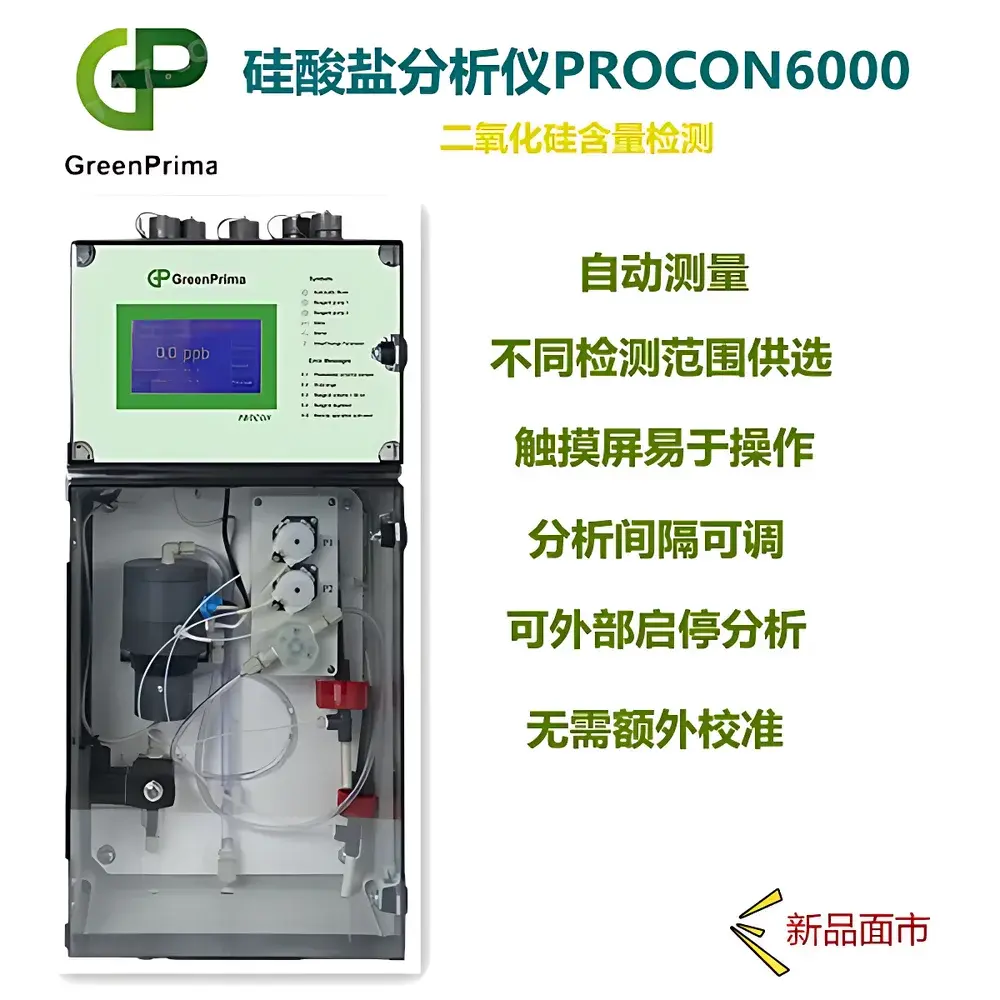
GreenPrima PROCON 6000 Online Silicate (Silicon Dioxide) Analyzer
| Brand | GreenPrima |
|---|---|
| Origin | United Kingdom |
| Manufacturer Type | Original Equipment Manufacturer (OEM) |
| Product Category | Imported Instrument |
| Model | PROCON 6000 |
| Instrument Type | Online Analyzer |
| Measurement Principle | Photometric Detection of Reduced β-Molybdo-Silicic Acid Complex |
| Measuring Range Options | 1–100 ppb, 4–999 ppb, 0.02–3 ppm SiO₂ |
| Resolution | 0.1 ppb / 1 ppb / 0.01 ppm |
| Accuracy | ±2% of full scale |
| Repeatability | ±0.5 ppb / ±4 ppb / ±0.02 ppm |
| Zero Stability | Automatic Drift Compensation |
| Analysis Cycle Time | 13 min (standard), adjustable from 1–99 min or externally triggered |
| Display | 240×128 pixel monochrome touchscreen |
| Output | 0/4–20 mA (max. load 500 Ω), USB data logging (optional) |
| Environmental Operating Temperature | 5–45 °C |
| Power Supply | 110–230 V AC, 50/60 Hz |
| Power Consumption | ~16 VA |
| Enclosure Rating | IP65 |
| Dimensions (H×W×D) | 640×315×190 mm |
| Relay Outputs | 3× isolated dry-contact relays (alarm, limit, analysis), 230 V AC / 3 A |
Overview
The GreenPrima PROCON 6000 is a fully automated, online photometric analyzer engineered for continuous, real-time quantification of dissolved silicate (as SiO₂) in ultra-pure water streams. It operates on the classical heteropoly blue method: orthosilicic acid reacts with molybdate under acidic conditions to form a yellow silicomolybdic acid complex, which is subsequently reduced to an intense blue-colored β-molybdo-silicic acid species. The absorbance of this chromophore at 815 nm is linearly proportional to silicate concentration within defined ranges. Designed specifically for high-reliability operation in critical thermal power generation and microelectronics manufacturing environments, the PROCON 6000 delivers stable baseline performance across extended unattended intervals—essential for monitoring steam purity, condensate quality, and feedwater integrity in once-through boilers and nuclear secondary loops.
Key Features
- Integrated microprocessor-controlled fluidics system with peristaltic metering pumps, solenoid valves, and temperature-stabilized optical cell
- Automatic self-diagnostic routines including daily zero-point verification, reagent blank validation, and optical path integrity checks
- Three user-selectable measurement ranges (ppb- and ppm-level) with automatic range-switching logic to maintain optimal signal-to-noise ratio
- Capacitive touchscreen interface (240×128 pixels) with multilingual menu navigation and real-time trend visualization
- Configurable alarm thresholds with latching/non-latching behavior, relay outputs compliant with IEC 61000-4 immunity standards
- Isolated 4–20 mA analog output with programmable scaling, HART-compatible configuration mode (optional)
- USB port supporting CSV-formatted data export for external audit trails and long-term trending (GLP-compliant timestamping enabled)
- IP65-rated enclosure suitable for installation in turbine halls, chemical dosing rooms, and clean utility corridors
- No manual calibration required during routine operation—zero stability maintained via adaptive baseline correction algorithm
Sample Compatibility & Compliance
The PROCON 6000 is validated for use with deionized water, reverse osmosis permeate, boiler feedwater, steam condensate, and ultrapure water (UPW) meeting ASTM D5127 and SEMI F63 specifications. Its reagent formulation complies with ISO 10523 (water quality — determination of pH) and ISO 11929 (evaluation of measurement uncertainty). All wetted components—including PTFE tubing, quartz flow cell, and ceramic valve seats—are chemically inert to silica-rich matrices and resistant to hydrolysis under low-conductivity conditions. The instrument meets electromagnetic compatibility requirements per EN 61326-1 and safety standards per EN 61010-1. Optional 21 CFR Part 11 compliance package available for pharmaceutical and biotech applications requiring electronic record integrity and user access control.
Software & Data Management
Firmware v3.2+ supports dual-mode operation: standalone autonomous analysis or integration into plant-wide SCADA systems via Modbus RTU (RS-485) or optional Ethernet/IP protocol stack. Internal memory retains ≥30 days of 1-minute resolution data with time-stamped event logs (sample start, reagent addition, photometric reading, error flags). Audit trail functionality records all parameter modifications, calibration events (if manually initiated), and user login/logout sequences. Data export via USB adheres to ISO/IEC 17025 traceability principles, with checksum-verified file integrity. Remote firmware updates are supported through secure HTTPS-based OTA mechanism with digital signature validation.
Applications
- Steam cycle chemistry control in fossil-fueled and nuclear power plants (ASME PTC 19.11, EPRI TR-102394)
- Monitoring silica breakthrough in mixed-bed ion exchange polishers and electrodeionization (EDI) units
- Ultrapure water quality assurance in semiconductor fab UPW distribution networks (SEMI F63 Class C/D)
- In-process control of silica removal efficiency in pharmaceutical WFI (Water for Injection) purification skids
- Early detection of heat exchanger tube leakage via rising silicate levels in closed-loop cooling systems
- Regulatory reporting support for EPA Clean Water Act Section 304(h) and EU Directive 2000/60/EC Annex V
FAQ
What is the minimum detectable silicate concentration?
The lower limit of quantitation (LLOQ) is 1 ppb SiO₂ in the 1–100 ppb range, verified per ISO 11843-2 using standard addition methodology.
Can the analyzer operate without reagent replacement for extended periods?
Reagent cartridges provide ≥30 days of continuous operation at 13-minute cycle intervals; shelf life of unopened reagents is 12 months when stored at 15–25 °C.
Is the optical system susceptible to fouling in high-turbidity samples?
The PROCON 6000 is not intended for raw surface water or wastewater; it requires pre-filtration to ≤0.45 µm and conductivity <1 µS/cm to prevent particulate deposition on the quartz flow cell.
How does the instrument handle temperature-induced drift in ambient installations?
An integrated Peltier-cooled reference photodiode and dual-beam optical architecture compensate for thermal effects on LED intensity and detector responsivity.
Does the analyzer support regulatory audit requirements for pharmaceutical water systems?
Yes—when equipped with the optional Part 11 Compliance Kit, it provides electronic signatures, role-based access control, and immutable audit logs aligned with FDA guidance for computerized systems in GMP environments.







