
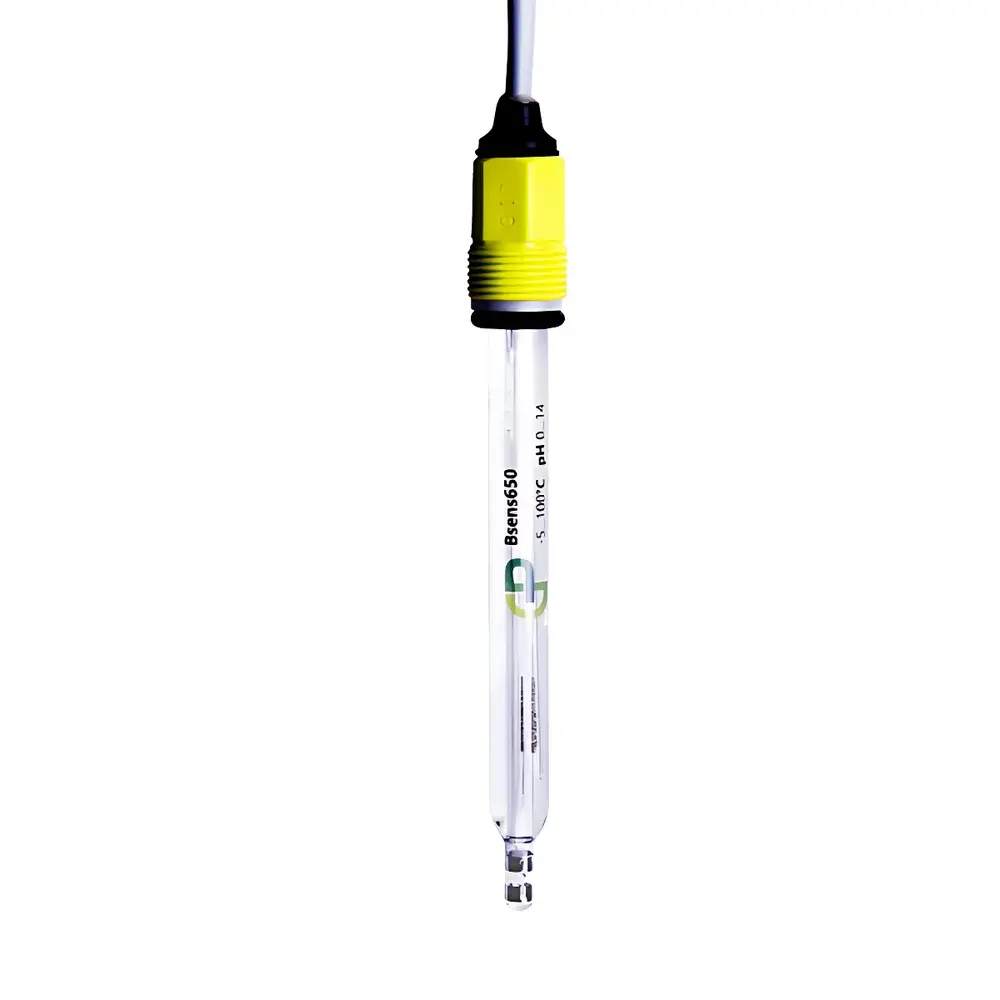
GreenPrima BSENS650 Residual Chlorine Electrode
| Brand | GreenPrima |
|---|---|
| Origin | Germany |
| Manufacturer Type | Manufacturer |
| Origin Category | Imported |
| Model | BSENS650 |
| Instrument Type | Online Analyzer |
| Measurement Principle | Amperometric Electrochemical Sensor (Constant Voltage Mode) |
| Measured Parameter | Free Residual Chlorine |
| Range | 0–2 ppm and 0–20 ppm (switchable or dual-range configuration) |
| Accuracy | ≤ ±2% of reading |
| Repeatability | ±0.01 ppm |
| Resolution | 0.001 ppm |
| Limit of Detection | 0.001 ppm |
| Operating Temperature | –5 to 100 °C |
| Max. Working Pressure | 6 bar |
| Housing Material | Borosilicate Glass |
| Membrane | Triple Ceramic Junction (3× porous frit) |
| Diameter | 12 mm |
| Length | 120 mm |
| Connection | PG13.5 threaded gland |
| Cable Length | 3 m |
| Sensing Element | Dual Platinum Ring Electrodes |
| Minimum Immersion Depth | 25 mm |
| Electrolyte | Polymer-Gelified KCl |
| Reference System | Ag/AgCl |
Overview
The GreenPrima BSENS650 is a high-stability, amperometric residual chlorine electrode engineered for continuous, real-time monitoring of free chlorine in aqueous systems. It operates on the constant-voltage amperometric principle: a fixed potential is applied between the working (dual Pt ring) and reference (Ag/AgCl) electrodes, enabling selective electrochemical reduction of hypochlorous acid (HOCl) at the cathode surface. The resulting diffusion-controlled current is linearly proportional to the concentration of freely dissolved HOCl—predominant species in the pH range of 4–7.5—providing direct, reagent-free quantification without optical interference or chemical consumption. Designed for integration with the PM8200CL controller (sold separately), the BSENS650 delivers robust performance in dynamic water matrices including cooling towers, potable water distribution networks, swimming pools, hospital sterilization circuits, and industrial process streams where regulatory compliance and operational continuity are critical.
Key Features
- True reagent-free operation: Eliminates need for colorimetric DPD kits, reducing consumables, calibration drift, and operator dependency.
- Glass-bodied construction with triple-ceramic junction: Ensures mechanical durability, chemical resistance to oxidants and chloramines, and stable liquid junction potential over extended deployment.
- Dual platinum ring working electrode: Enhances signal-to-noise ratio and improves long-term reproducibility by mitigating edge effects and ensuring uniform current density distribution.
- Gelified KCl electrolyte with Ag/AgCl reference system: Provides low-drift reference potential, eliminates electrolyte leakage, and extends service intervals under variable pressure and temperature conditions.
- Wide operational envelope: Rated for continuous use from –5 °C to 100 °C and up to 6 bar static pressure—suitable for hot water loops, pressurized distribution lines, and HVAC condensate return systems.
- No sample pre-treatment required: Direct immersion measurement maintains integrity of transient chlorine species and avoids artifacts introduced by filtration or pH adjustment.
Sample Compatibility & Compliance
The BSENS650 demonstrates high selectivity for free residual chlorine in complex matrices containing common interferents such as chloride (≤ 5,000 mg/L), sulfate, nitrate, and low concentrations of monochloramine (10 ppm total suspended solids or strong reducing agents (e.g., sulfite, thiosulfate) without upstream oxidation control. The sensor meets material compatibility requirements per ISO 10523 (pH measurement), ASTM D1293 (electrochemical water analysis), and EN ISO 9001-certified manufacturing protocols. Its design supports GLP-compliant data acquisition when paired with PM8200CL units configured with audit-trail logging and user-access controls compliant with FDA 21 CFR Part 11 Annex 11 principles.
Software & Data Management
When interfaced with the GreenPrima PM8200CL transmitter, the BSENS650 supports digital output via 4–20 mA analog signal, Modbus RTU (RS-485), or optional HART 7 protocol. The embedded firmware enables automatic temperature compensation (NTC thermistor integrated within probe body), range switching between 0–2 ppm and 0–20 ppm, and configurable alarm thresholds with hysteresis. Data logging intervals down to 1-second resolution are supported, with local storage capacity for ≥30 days of timestamped measurements. All calibration events—including zero point verification using dechlorinated water and span adjustment with NIST-traceable chlorine standards—are recorded with user ID, timestamp, and deviation metrics, satisfying traceability requirements for ISO/IEC 17025 accredited laboratories.
Applications
- Municipal drinking water: Continuous monitoring at treatment plant effluent points and distribution system endpoints to ensure regulatory compliance with EPA 40 CFR Part 141 and EU Directive 98/83/EC.
- Cooling water management: Real-time control of biocide dosing in open recirculating systems to prevent Legionella proliferation while minimizing corrosion risk.
- Healthcare facilities: Verification of disinfectant residuals in endoscope reprocessing water, dialysis feedwater, and sterile utility loops per AAMI ST108 and HTM 01-05 guidelines.
- Food & beverage processing: Monitoring chlorine levels in CIP rinse cycles and process water contact points aligned with SQF Code Edition 9 and BRCGS Global Standard for Food Safety Issue 9.
- Pharmaceutical water systems: Support for PW and WFI distribution loop surveillance per USP and EU GMP Annex 1, particularly during sanitization hold periods.
FAQ
What is the recommended calibration frequency for the BSENS650 in continuous operation?
Calibration should be performed at least once per 7 days in stable applications; daily verification is advised in highly variable or aggressive matrices (e.g., wastewater influent or high-TDS industrial effluents).
Can the BSENS650 measure combined chlorine (chloramines)?
No—it is optimized for free chlorine (HOCl/OCl⁻) detection only. Combined chlorine requires separate amperometric sensors with different polarization potentials or spectrophotometric methods.
Is the electrode suitable for seawater or brackish water applications?
Yes, provided chloride concentration remains below 5,000 mg/L and fouling from biofilm or calcium scaling is managed via periodic cleaning with dilute HCl (0.1 M) or enzymatic solutions.
Does the probe require membrane replacement or electrolyte refilling?
No—its gel-filled, maintenance-free reference system and solid-state ceramic junction eliminate routine servicing; typical service life exceeds 18 months under normal operating conditions.
How does temperature affect measurement accuracy?
The integrated NTC sensor enables automatic temperature compensation across the full –5 °C to 100 °C range; uncompensated errors are typically <0.5% per °C outside this correction algorithm.
Related Products







