
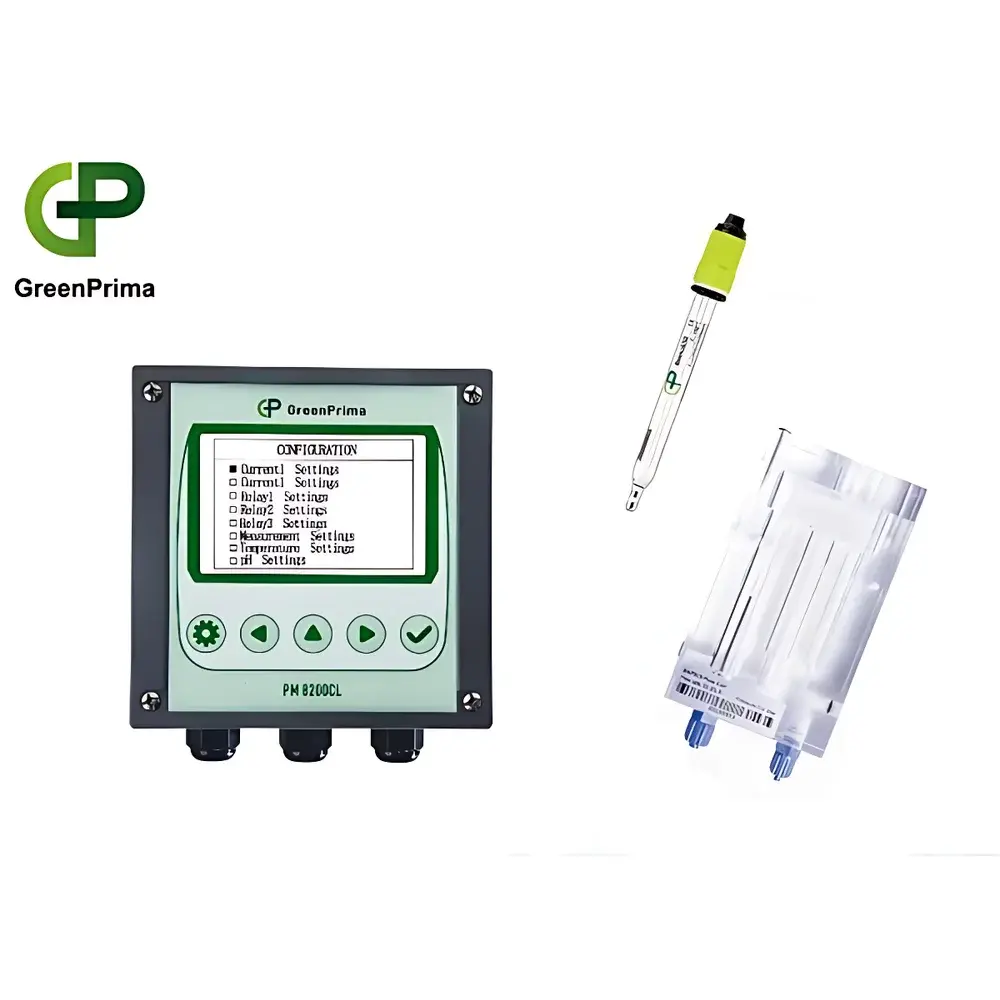
GreenPrima PM8200CL Online Residual Chlorine, Chlorine Dioxide and Ozone Analyzer
| Brand | GreenPrima |
|---|---|
| Origin | Shanghai, China |
| Manufacturer Type | Manufacturer |
| Product Category | Domestic |
| Model | PM8200CL |
| Instrument Type | Online Analyzer |
| Measurement Principle | Amperometric Electrochemical Sensor (Constant Potential Method) |
| Measured Parameters | Free Chlorine, Combined Chlorine, Chlorine Dioxide, Ozone |
| Measurement Range | 0–2.000 ppm and 0–20.00 ppm (dual-range auto-switching) |
| Accuracy | ±0.001 ppm / ±0.01 ppm (depending on range) |
| Repeatability | ±0.001 ppm / ±0.01 ppm |
| Resolution | 0.001 ppm / 0.01 ppm |
| Detection Limit | 0.001 ppm / 0.01 ppm |
| Temperature Compensation | -10 to 130 °C (NTC10K or PT1000 selectable) |
| Operating Temperature | 0–70 °C |
| Storage Temperature | -20 to 70 °C |
| Enclosure Rating | IP65 |
| Power Supply | 90–260 VAC, 50/60 Hz or 24 VDC optional |
| Output | Dual isolated 4–20 mA (max. 500 Ω, 0.1% FS), RS485 MODBUS RTU |
| Relay Output | 1 multifunction relay (cleaning, alarm, fault) |
| Data Logging | 600,000 records with timestamped query |
| Display | Backlit graphical LCD with adjustable contrast |
| Mounting | Wall-mounted, panel-mounted or pole-mounted |
| Dimensions | 144 × 144 × 106 mm |
| Panel Cutout | 138 × 138 mm |
| Weight | 0.86 kg |
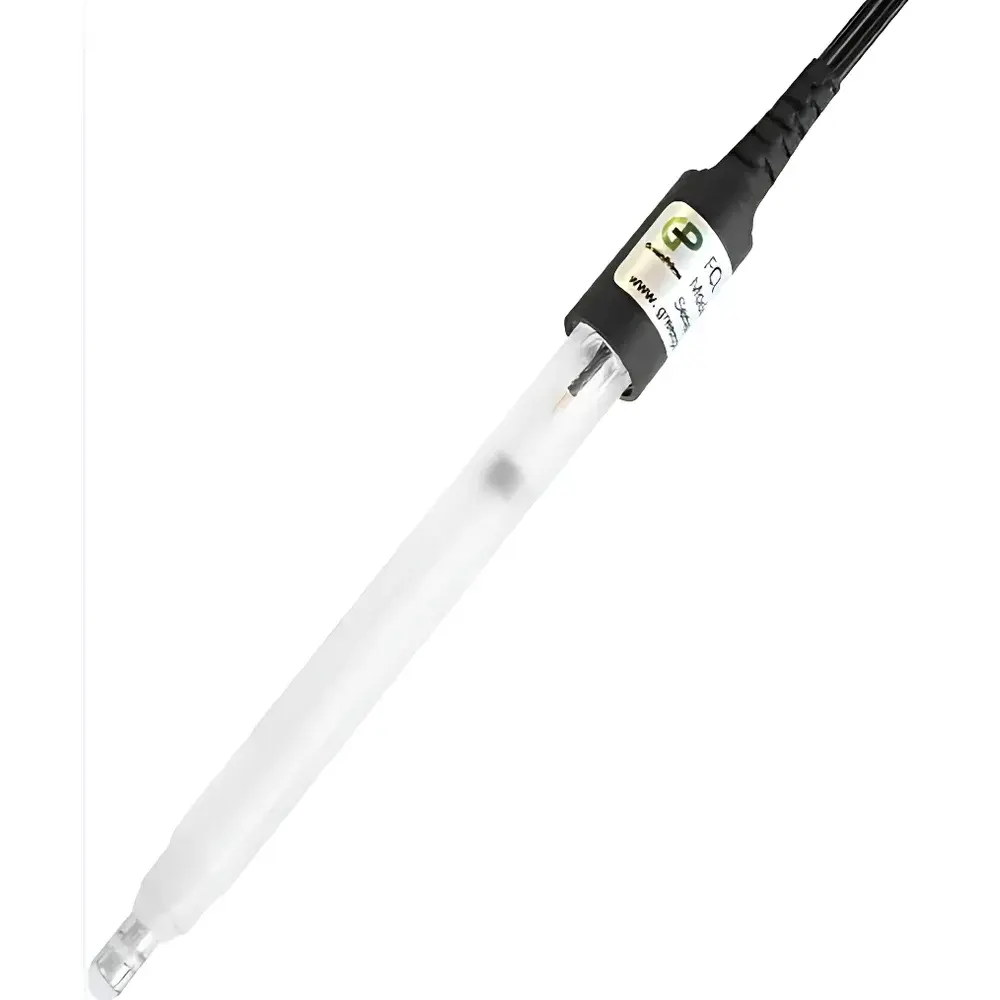
| Electrode Model | Bsens650 |
| Electrode Material | Glass body with dual-platinum ring working electrode |
| Max. Pressure Rating | 5 bar |
| Electrode Accuracy | ±2% FS |
Overview
The GreenPrima PM8200CL is a high-stability online analyzer engineered for continuous, real-time monitoring of residual chlorine (free and combined), chlorine dioxide (ClO₂), and ozone (O₃) in aqueous systems. It operates on the amperometric electrochemical principle—specifically, the constant-potential (potentiostatic) method—where a precisely controlled voltage is applied between a working electrode (dual-platinum ring) and a reference electrode. Target oxidants undergo selective electrochemical reduction at this fixed potential, generating a diffusion-limited current proportional to their concentration. This approach eliminates reliance on colorimetric reagents or membrane-based sensors, delivering inherently stable, low-maintenance measurements with minimal drift over extended deployment cycles.
Key Features
- True multi-analyte capability: single instrument and sensor (Bsens650) simultaneously supports calibration and measurement for free chlorine, chlorine dioxide, and ozone—reducing operational complexity and total cost of ownership.
- Membrane-free and electrolyte-free operation: the solid-state, glass-bodied Bsens650 electrode requires no membrane replacement, electrolyte refilling, or routine polarization conditioning—enabling >12 months of uninterrupted service under typical municipal water conditions.
- Dual-range automatic switching: seamlessly transitions between high-sensitivity (0–2.000 ppm) and extended-range (0–20.00 ppm) modes without manual intervention, ensuring optimal resolution across disinfectant dosage control and distribution network monitoring.
- Robust industrial architecture: IP65-rated sealed enclosure with wide operating temperature tolerance (0–70 °C), compatible with wall, panel, or pole mounting; designed for unattended operation in pump stations, chlorination rooms, and rooftop HVAC cooling towers.
- Comprehensive digital interface: dual isolated 4–20 mA outputs (configurable per parameter), RS485 MODBUS RTU protocol support, and timestamped data logging of 600,000 records—fully traceable and exportable for regulatory reporting and trend analysis.
- Intelligent maintenance logic: programmable cleaning cycle (0.1–1000 h interval, 1–1000 s duration) via integrated relay output; configurable alarms for sensor timeout, signal saturation, temperature out-of-range, and communication failure.
Sample Compatibility & Compliance
The PM8200CL is validated for use in potable water distribution networks, wastewater disinfection effluent streams, swimming pool recirculation systems, hospital sterilization loops, and pharmaceutical process water lines. Its electrochemical selectivity minimizes cross-sensitivity to common interferents—including nitrate, bromide, and hydrogen peroxide—when operated within specified pH (5.5–8.5) and conductivity (>50 µS/cm) ranges. The system supports compliance with multiple international standards: EPA Method 334.0 (amperometric chlorine), ISO 7393-2 (chlorine dioxide), and ASTM D1253 (residual oxidants). For regulated environments, its audit-trail-capable data logger and MODBUS-enabled SCADA integration align with GLP and GMP documentation requirements; while the absence of hazardous reagents simplifies chemical inventory management under OSHA and CLP frameworks.
Software & Data Management
No proprietary software is required for basic configuration—the front-panel graphical LCD provides intuitive bilingual (English/Chinese) navigation with real-time display of measured value, temperature, relay status, and clock. Advanced functionality—including calibration history review, curve fitting diagnostics, and output scaling—is accessible via MODBUS register mapping. Logged data includes full timestamp (YYYY-MM-DD HH:MM:SS), parameter ID, raw current (nA), compensated concentration (ppm), and temperature (°C). Export is supported via serial dump or third-party SCADA platforms (e.g., Ignition, Siemens Desigo, or Schneider EcoStruxure). All stored records retain integrity through power loss due to non-volatile flash memory architecture.
Applications
- Municipal drinking water treatment: real-time feedback control of chlorine dosing pumps at clearwells and booster stations.
- Secondary distribution monitoring: verification of residual oxidant levels at critical junctions and dead-end zones to ensure microbial safety per WHO Guidelines for Drinking-water Quality.
- Recreational water facilities: automated dosing control in swimming pools and spas to maintain 0.4–3.0 ppm free chlorine or 0.2–0.8 ppm ClO₂ per CDC Model Aquatic Health Code.
- Healthcare wastewater: continuous verification of ozone contact time and concentration prior to discharge from sterilization autoclave effluent lines.
- Food & beverage process water: validation of final rinse water disinfection in CIP systems where chlorine or ClO₂ residuals must be verified below 2 ppm before equipment reuse.
FAQ
Does the Bsens650 electrode require recalibration after switching between chlorine, chlorine dioxide, and ozone measurements?
No—calibration is analyte-specific but performed once per parameter during commissioning. The instrument retains separate calibration curves and automatically applies the correct one based on selected measurement mode.
Can the PM8200CL operate in seawater or high-chloride brine applications?
Not recommended. While the electrode housing is chemically resistant, chloride concentrations >5,000 mg/L induce significant background current and reduce selectivity; dedicated marine-grade sensors with Ag/AgCl reference systems are advised.
Is temperature compensation mandatory, and what sensor types are supported?
Yes—temperature directly affects diffusion rate and reaction kinetics. The analyzer accepts either NTC10K or PT1000 probes; automatic compensation is applied across -10 to 130 °C using built-in polynomial algorithms per ISO 7393-2 Annex B.
How is sensor fouling mitigated in turbid or biofouling-prone streams?
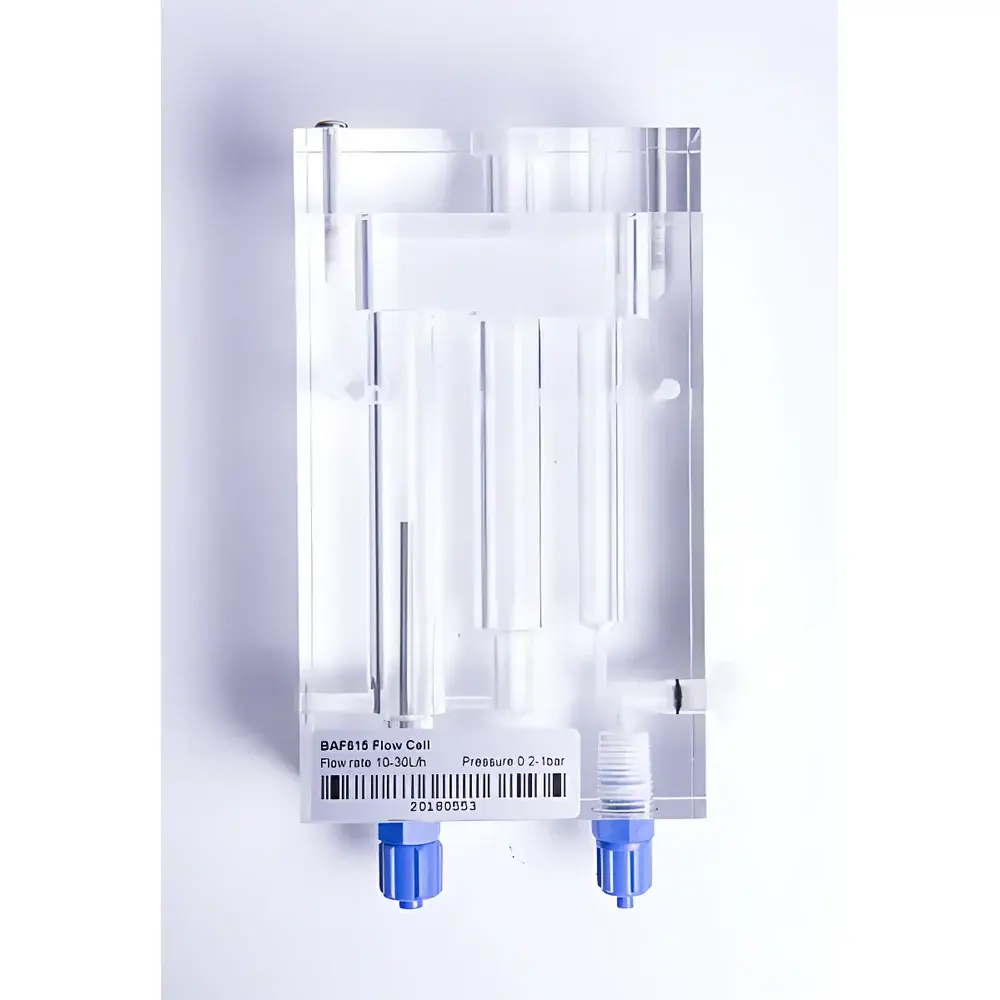
The Bsens650’s smooth glass surface and optional programmable air-pulse or chemical cleaning cycle (via relay-controlled solenoid valve) minimize organic adhesion; flow cell design maintains laminar flow >10 cm/s to prevent sediment deposition.
Does the device meet cybersecurity requirements for IIoT integration?
It implements MODBUS RTU over RS485—a serial protocol with no inherent network stack—eliminating exposure to TCP/IP vulnerabilities. When integrated via industrial gateways, it complies with IEC 62443-3-3 Level 1 segmentation guidelines when deployed behind firewalled PLC networks.
Related Products







