
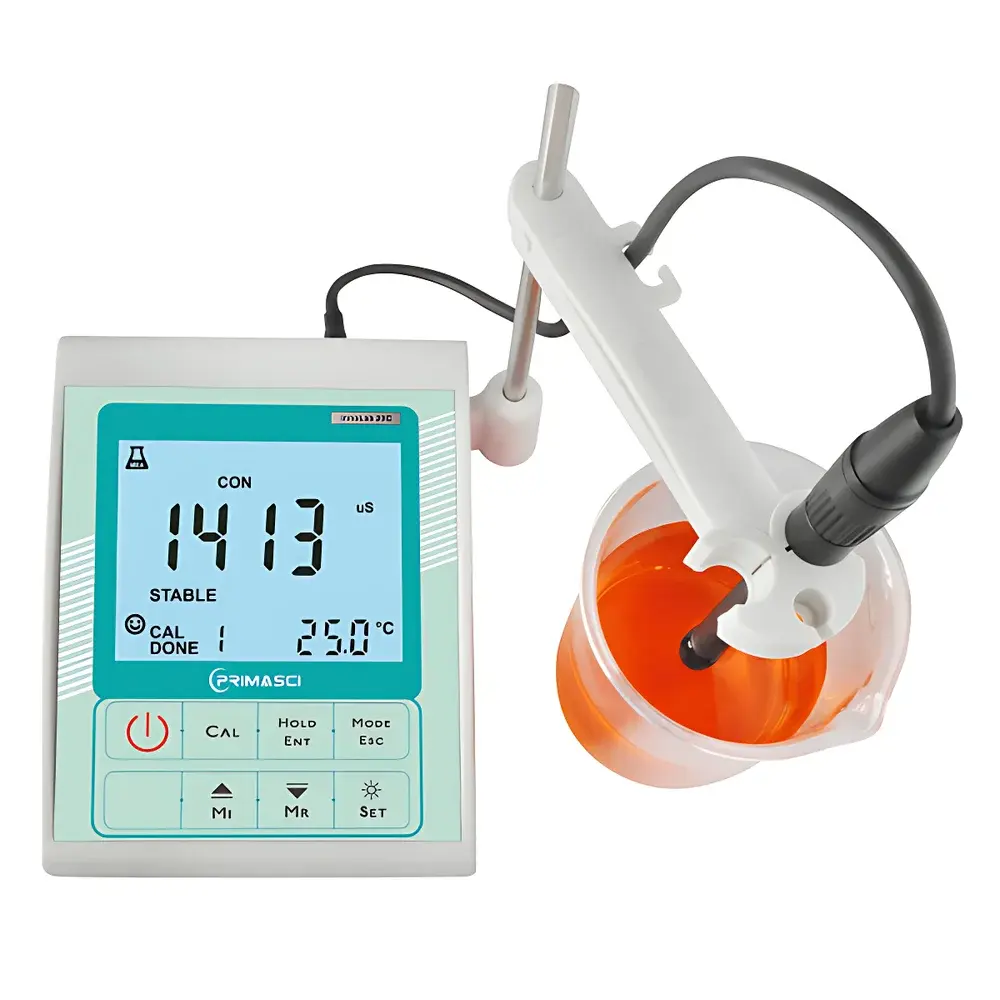
PRIMASCI innoLab 20C Benchtop Conductivity / Resistivity / TDS / Salinity Analyzer
| Brand | PRIMASCI |
|---|---|
| Origin | Taiwan |
| Model | innoLab 20C |
| Form Factor | Benchtop |
| Conductivity Range | 0–500 mS/cm |
| TDS Range | 0–500,000 ppm (as NaCl) |
| Resistivity Range | 0–18.30 MΩ·cm |
| Salinity Range | 0–325 ppt |
| Temperature Range | −5 to +120 °C |
| Accuracy | ±0.5% of Full Scale |
| Minimum Resolution | 0.001 µS/cm (at lowest range) |
| Electrode Constants Supported | 0.01, 0.1, 1.0, 10.0 cm⁻¹ |
| Temperature Compensation | Automatic or Manual (−5 to 120 °C), Reference Temp: 15–30 °C (default 25 °C) |
| TDS Conversion Factor | Adjustable 0.40–1.00 |
| Salinity Conversion Factor | Fixed 0.65 |
| Data Storage | 100 measurement records |
| Power | AC 100–240 V + internal rechargeable Li-ion battery (1300 mAh) |
| Dimensions | 150 × 194 × 56 mm (W × L × H) |
| Weight | 1.0 kg |
Overview
The PRIMASCI innoLab 20C is a precision-engineered benchtop conductivity analyzer designed for rigorous laboratory environments where multi-parameter water quality assessment is essential. It operates on the principle of two-electrode conductometric measurement: an alternating current is applied across a pair of electrodes immersed in the sample, and the resulting conductance is measured to determine electrical conductivity (σ), from which resistivity (ρ = 1/σ), total dissolved solids (TDS), and practical salinity are derived using standardized conversion algorithms. Built-in temperature compensation—per ASTM D1125 and ISO 7888—ensures all conductivity readings are normalized to a reference temperature (typically 25 °C), correcting for the inherent thermal dependence of ionic mobility. The instrument supports four electrode constants (K = 0.01, 0.1, 1.0, and 10.0 cm⁻¹), enabling accurate measurement across ultrapure water (≥18.2 MΩ·cm), process streams, seawater analogs, and aggressive industrial effluents—without manual range switching.
Key Features
- High-contrast 100 × 74 mm LCD display with 120° viewing angle and anti-scratch, splash-resistant front panel
- Auto-ranging conductivity measurement with seamless switching between µS/cm, mS/cm, and MΩ·cm units
- True multi-parameter capability: simultaneous real-time display of conductivity, resistivity, TDS, salinity, and temperature (°C/°F)
- Configurable temperature coefficient (0.00–9.99%/°C) and non-linear ultra-pure water compensation per IAPWS guidelines
- HOLD function with STABLE indicator for reliable endpoint capture during kinetic or low-conductivity measurements
- 100-entry internal memory with timestamped storage; export via USB not supported, but data logging compatible with optional PC software
- Rechargeable 1300 mAh Li-ion battery enables uninterrupted operation during power fluctuations or mobile lab use
- Patented dual-side universal electrode holder and telescopic clamp (145–220 mm travel) accommodating rods up to Ø6 mm
- Calibration flexibility: automatic single-point calibration per range or manual multi-point calibration with user-defined standards
Sample Compatibility & Compliance
The innoLab 20C accommodates aqueous samples ranging from deionized water (0.055 µS/cm) to saturated brines (up to 500 mS/cm), including boiler feedwater, pharmaceutical WFI/PW, electroplating baths, wastewater influent/effluent, and marine simulation solutions. Its electrode portfolio includes graphite (K = 1.0), titanium (K = 0.1 and 0.01), and glass (K = 10.0) sensors—each with integrated Pt1000 temperature sensing and 8-pin DIN connectors. All configurations comply with IP65-rated ingress protection when mounted. While the device itself is not FDA 21 CFR Part 11–certified, its calibration traceability, audit-ready manual logs, and GLP/GMP-aligned operational protocols support compliance in regulated QC labs. Measurement uncertainty conforms to ISO/IEC 17025 requirements when used with NIST-traceable KCl standards.
Software & Data Management
The innoLab 20C operates as a standalone instrument with no embedded firmware-based data export. However, it supports external integration via optional RS-232 or USB-to-serial adapters (sold separately), enabling connection to laboratory information management systems (LIMS) or custom Python/Matlab acquisition scripts. All stored measurements include date/time stamps, electrode constant, temperature, and raw conductivity value—facilitating retrospective validation. Calibration history is retained per sensor type and can be manually documented for audit trails. Firmware updates are performed via micro-USB port using PRIMASCI’s proprietary configuration utility, which enforces version-controlled parameter locking for SOP adherence.
Applications
- Pharmaceutical water systems: monitoring USP purified water and water for injection (WFI) resistivity stability
- Power generation: boiler feedwater purity assurance and condensate loop leak detection
- Electroplating & anodizing: bath concentration control via conductivity drift analysis
- Environmental labs: TDS/salinity profiling in estuarine and wastewater treatment studies
- Academic research: ion transport kinetics in electrolyte solutions under controlled thermal conditions
- Food & beverage QA: brine strength verification for pickling, curing, and fermentation processes
FAQ
Does the innoLab 20C support automatic temperature compensation (ATC) across its full measurement range?
Yes—it features dual-mode ATC (−5 to +120 °C) using integrated Pt1000 sensors in all compatible electrodes, with configurable β-coefficient and reference temperature settings.
Can I use third-party conductivity electrodes with this instrument?
Only electrodes with 8-pin DIN connectors, built-in temperature sensing, and impedance-matched output are guaranteed functional; PRIMASCI does not validate non-OEM probes.
What is the recommended recalibration frequency for routine QC use?
Per ISO 5725 and ASTM D1125, daily verification with a mid-range standard (e.g., 1413 µS/cm KCl at 25 °C) is advised, with full multi-point calibration every 7–14 days depending on usage intensity.
Is the resistivity measurement linearly derived from conductivity, or does it apply correction for water dissociation?
For resistivity values >1 MΩ·cm, the instrument applies empirically validated non-linear compensation based on the temperature-dependent equilibrium constant of water (Kw), improving accuracy in ultrapure water applications.
How is data integrity maintained during battery-powered operation?
All measurements—including calibration events—are written to non-volatile memory prior to display update, ensuring no loss during unexpected power-down or battery depletion.






