
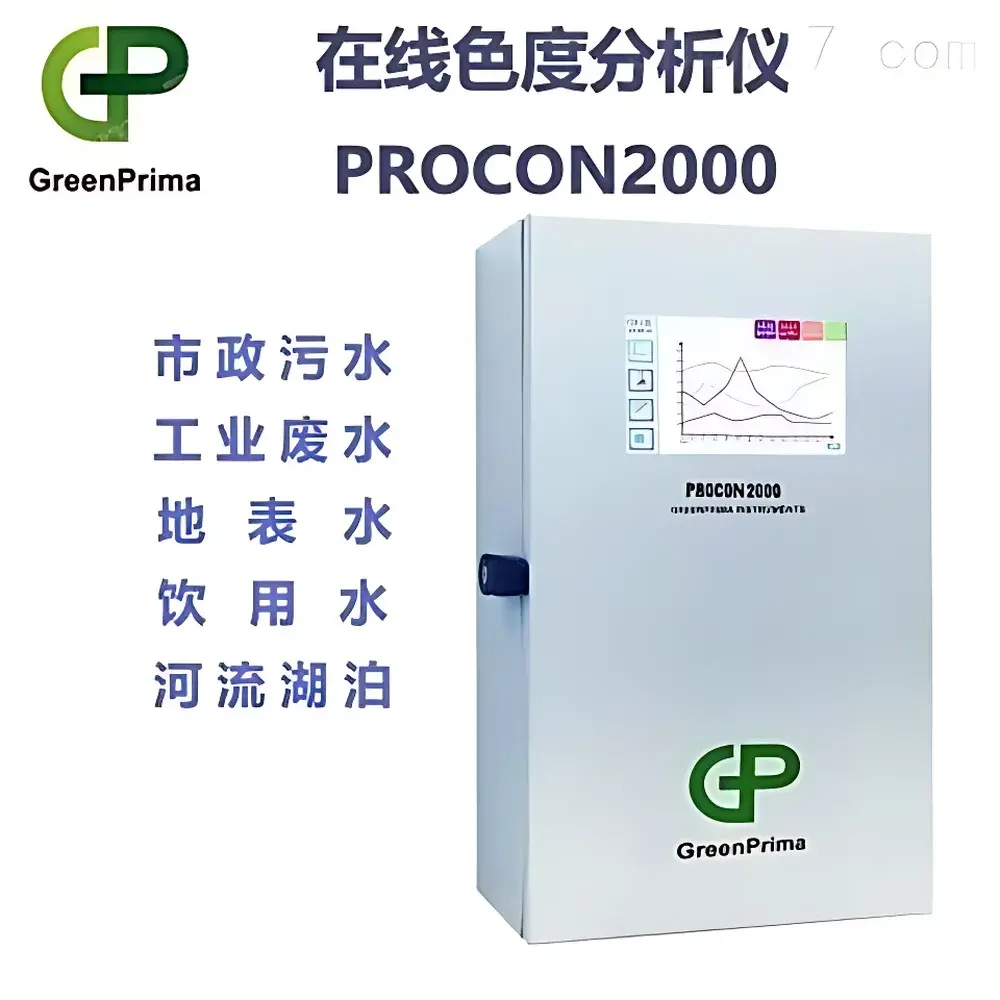
GreenPrima PROCON 2000 Online Colorimeter
| Brand | GreenPrima |
|---|---|
| Origin | United Kingdom |
| Manufacturer Type | Original Equipment Manufacturer (OEM) |
| Product Origin | Imported |
| Model | PROCON 2000 |
| Pricing | Upon Request |
Overview
The GreenPrima PROCON 2000 Online Colorimeter is an industrial-grade, real-time color measurement system engineered for continuous, reagent-free monitoring of liquid color in open-channel and pressurized flow applications. It operates on the principle of UV-VIS absorption spectrophotometry—measuring spectral absorbance across the 200–800 nm range—to quantify color intensity according to standardized Pt-Co (Platinum-Cobalt) units. Unlike traditional benchtop colorimeters requiring manual sampling and chemical reagents, the PROCON 2000 integrates a flow-through optical cell with dual-beam photometric architecture, enabling drift-compensated, high-reproducibility measurements under dynamic process conditions. Designed specifically for demanding environmental and industrial water matrices—including municipal wastewater, industrial effluents, seawater, drinking water, and surface runoff—the instrument delivers regulatory-compliant data traceable to ISO 7887, ASTM D1209, and APHA Standard Methods 2120B.
Key Features
- Reagent-free operation: Eliminates chemical consumption, hazardous waste generation, and associated disposal compliance burdens.
- Multi-mode measurement scheduling: Supports on-demand manual triggering, programmable periodic acquisition (e.g., every 1, 5, or 15 minutes), and event-driven sampling synchronized with flow or pH signals.
- Robust optical path design: Quartz cuvette and FPM-sealed optical windows ensure long-term stability in turbid, particulate-laden, or biofouling-prone streams; cross-interference from suspended solids is minimized via optimized flow cell geometry and real-time baseline correction.
- Ultra-low maintenance architecture: LED light source rated for >100,000 hours (≈11.4 years continuous operation); no consumables, no lamps to replace, no filters to clean.
- Sub-5-second measurement cycle: Full spectral acquisition, internal zeroing, calibration verification, and result output completed within 4.8 seconds—enabling responsive feedback for closed-loop process control.
- Fully autonomous operational sequence: Integrated self-diagnostic routines execute automatic zero adjustment (using deionized water or air reference), factory-calibration validation, flow-path cleaning (via integrated pneumatic or hydraulic purge), and fault recovery without operator intervention.
- Pre-treatment module: Optional inline filtration and bubble removal unit with passive hydrodynamic design—requires no scheduled servicing, backwashing, or membrane replacement.
Sample Compatibility & Compliance
The PROCON 2000 accommodates aqueous samples with flow rates from 0 to 2 L/min and operating pressures up to 2 bar. Sample contact materials include fused quartz (optical path), polypropylene (housing), FPM fluoroelastomer (seals), 316L stainless steel (wetted fittings), and borosilicate glass (reference cell)—all compliant with USP Class VI and FDA 21 CFR 177.2400 for indirect food contact. The analyzer meets IP65 ingress protection for outdoor cabinet installation and offers optional ATEX certification for Zone 1/Zone 2 hazardous areas (II 2G Ex db IIB T4 Gb). Data integrity conforms to ALCOA+ principles, with full audit trail support in firmware for GLP/GMP environments.
Software & Data Management
The embedded controller features an 8.5-inch TFT capacitive touchscreen (800 × 480 resolution) with intuitive HMI navigation and multilingual interface (English, German, French, Spanish). Internal 8 GB SD card stores ≥12 months of timestamped spectral scans, Pt-Co values, diagnostic logs, and calibration history. Data export is supported via USB mass storage or Modbus RTU over RS485 (slave/master configurable). Analog 4–20 mA output provides galvanically isolated, NIST-traceable transmission to DCS/SCADA systems with <0.5% full-scale linearity error. Firmware supports remote firmware updates and secure configuration backup/restoration via encrypted USB key.
Applications
- Municipal wastewater treatment: Real-time monitoring of effluent color as a surrogate for residual organics, humic substances, or dye breakthrough.
- Pulp & paper manufacturing: In-line control of bleach plant effluent color and pulp brightness consistency.
- Textile dyeing operations: Closed-loop feedback for dye bath concentration and rinse water clarity verification.
- Pharmaceutical process water: Verification of purified water (PW) and water-for-injection (WFI) color conformity per USP and EP 2.2.17.
- Food & beverage production: Monitoring of syrup, juice, or brine color stability during thermal processing and filling.
- Environmental compliance reporting: Automated generation of EPA-approved color trend reports aligned with NPDES permit requirements.
FAQ
Does the PROCON 2000 require daily calibration or standardization?
No. Factory calibration is stable for ≥12 months under normal operating conditions. Automatic zero-reference cycles occur before each measurement; optional NIST-traceable liquid standards can be scheduled weekly or monthly via software.
Can it operate in high-turbidity wastewater with >100 NTU?
Yes. The dual-beam optical design and proprietary flow cell geometry mitigate scattering artifacts. For sustained operation above 200 NTU, integration with the optional hydrocyclone pre-filter is recommended.
Is raw spectral data accessible for advanced analysis?
Yes. Full absorbance spectra (1 nm resolution, 200–800 nm) are stored alongside Pt-Co results and exportable in CSV or ASCII format for PCA, PLS regression, or custom chemometric modeling.
What cybersecurity measures are implemented?
Firmware includes TLS 1.2 encryption for remote configuration, password-protected admin access levels, disabled default credentials, and secure boot verification. No external network stack is enabled by default—RS485 and analog outputs are physically isolated.
How is temperature compensation handled?
An integrated PT100 sensor monitors sample temperature in real time; spectral correction algorithms apply temperature-dependent refractive index and absorbance coefficient adjustments per ISO 10937 guidelines.




