
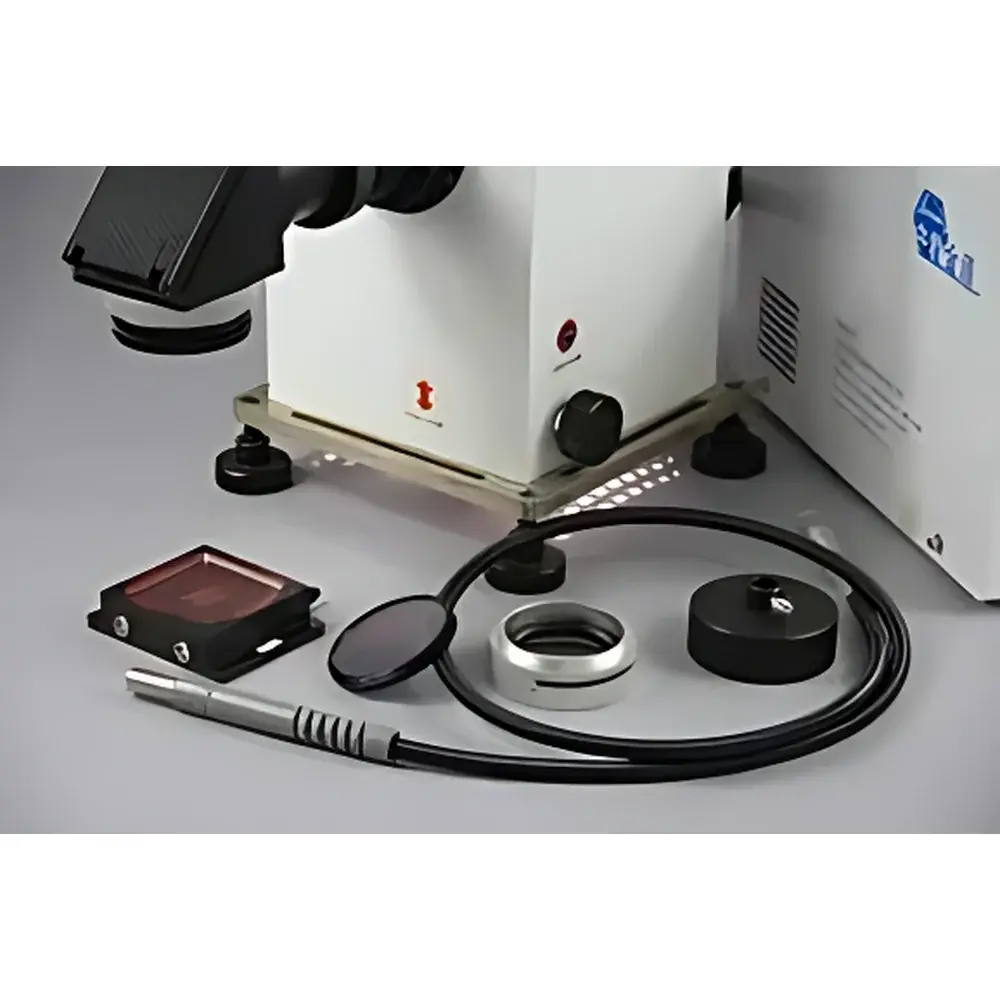
Zhongjiaojinyuan LC Fiber Optic Light Guide Assembly
| Brand | Zhongjiaojinyuan |
|---|---|
| Origin | Beijing, China |
| Manufacturer Type | OEM Manufacturer |
| Origin Category | Domestic (China) |
| Model | LC Fiber Optic |
| Price | USD 505 (approx. ¥3576) |
| Core Diameter Options | 1 mm, 3 mm, 4 mm, 5 mm |
| Length | 1.2 m |
| Light Source Integration | Integrated 5 mm LC-based broadband light source |
| Coupling Interface | Standard FC/PC or SMA-compatible coupling connector |
| Collimation | Equipped with aspheric collimating lens |
| Optical Attenuation | Adjustable iris diaphragm (variable aperture) for real-time intensity control |
| Filter Compatibility | Threaded M25×0.75 or SM1-mount filter holder integrated at collimated output |
Overview
The Zhongjiaojinyuan LC Fiber Optic Light Guide Assembly is a precision-engineered optical delivery system designed for controlled broadband illumination in laboratory-scale photonic applications. Unlike conventional silica or quartz fiber bundles, this assembly integrates a liquid crystal (LC)-based light-emitting element directly coupled to a high-numerical-aperture multimode fiber guide. The LC emitter functions as a spatially uniform, thermally stable, and spectrally broad (typically 400–700 nm) incoherent source—ideal for applications requiring low coherence, minimal etaloning, and absence of laser speckle. The system operates on the principle of electrically modulated birefringence in nematic LC layers, enabling consistent radiance without filament degradation or spectral drift common in halogen or LED-based alternatives. It is not a standalone light source but a complete optomechanical subassembly—including source, coupling optics, fiber guide, collimator, and adjustable attenuation—engineered for repeatable irradiance delivery in spectroscopy, photochemical reactor illumination, optical calibration, and thin-film characterization setups.
Key Features
- Integrated 5 mm active-area LC light source with stable luminance output (±2% over 8-hour continuous operation under constant drive conditions)
- Modular multimode fiber guide with selectable core diameters (1 mm, 3 mm, 4 mm, 5 mm) and NA ≥ 0.22 for optimized étendue matching
- Precision-coupled FC/PC or SMA interface ensuring >92% coupling efficiency between LC emitter and fiber input face
- Aspheric collimating lens (f = 25 mm, RMS wavefront error < λ/8 @ 550 nm) producing a collimated beam with divergence < 1.5 mrad
- Manually adjustable iris diaphragm (M25-threaded, 0.5–5 mm clear aperture) enabling real-time optical power regulation without thermal re-stabilization delay
- Integrated M25×0.75 or SM1-threaded filter mount located at the collimated output plane for seamless insertion of bandpass, ND, or polarizing filters
- All-metal housing (6061-T6 aluminum) with kinematic mounting tabs and thermal mass design to minimize radiometric drift during extended operation
Sample Compatibility & Compliance
This light guide assembly is compatible with standard optical breadboards, monochromator inputs, integrating spheres, and custom photoreactor chambers requiring uniform planar or collimated illumination. It supports ISO/IEC 17025-compliant calibration workflows when used with NIST-traceable photodiodes or spectroradiometers. While not certified to IEC 61000-6-3 (EMC) or UL 61010-1 out-of-the-box, its low-voltage DC drive architecture (<24 V, <1.2 A) and absence of RF-generating components facilitate integration into GLP/GMP environments where electromagnetic interference must be minimized. The mechanical design adheres to ISO 10110-7 surface quality standards for all optical interfaces, and fiber termination meets IEC 61300-3-35 end-face geometry specifications.
Software & Data Management
The LC Fiber Optic Assembly operates as a hardware-only subsystem and does not include embedded firmware or proprietary software. Intensity control is purely manual via the iris diaphragm; no digital communication interface (e.g., USB, RS-232, or TTL) is provided. However, it is fully interoperable with third-party DAQ systems (e.g., National Instruments PXI, Thorlabs Kinesis) when paired with external photodetectors and programmable attenuators. For audit-trail compliance in regulated labs, users may log iris position (via calibrated vernier scale), exposure time, and measured irradiance (using calibrated sensors) in accordance with FDA 21 CFR Part 11 requirements using validated LIMS or ELN platforms.
Applications
- Uniform illumination of photocatalytic reactors for kinetic studies under controlled spectral flux density
- Reference illumination source for spectrophotometer validation and stray-light characterization
- Collimated excitation in fluorescence lifetime imaging (FLIM) test benches requiring low-coherence, non-laser sources
- Calibration of CMOS/CCD sensor quantum efficiency across visible wavelengths
- Optical alignment verification in interferometric and holographic setups
- Photobiomodulation research requiring tunable irradiance without thermal load variation
FAQ
Is this product suitable for UV or NIR applications?
No. The LC emitter’s spectral output is limited to ~400–700 nm due to inherent absorption in the LC cell substrate and electrode layers. For UV or NIR work, quartz fiber bundles coupled to deuterium or tungsten-halogen sources are recommended.
Can the iris diaphragm be motorized or remotely actuated?
Not by default. The standard configuration features manual adjustment only. Custom OEM integration with stepper-motor-driven iris modules (e.g., Thorlabs LA300) is available upon request with lead-time extension.
What is the maximum permissible input power to the LC source?
The driver electronics are rated for continuous operation at 24 VDC / 1.2 A. Exceeding this may cause irreversible LC alignment degradation and reduced lifetime.
Does the fiber support high-power continuous illumination?
It is rated for ≤5 W total optical power at the input face. Higher powers risk thermal damage to the LC layer and polymer buffer coatings.
Are OEM labeling and mechanical redesign options available?
Yes. Zhongjiaojinyuan offers mechanical housing re-engineering, custom thread specifications, and private-label branding for volume orders (>50 units).



