
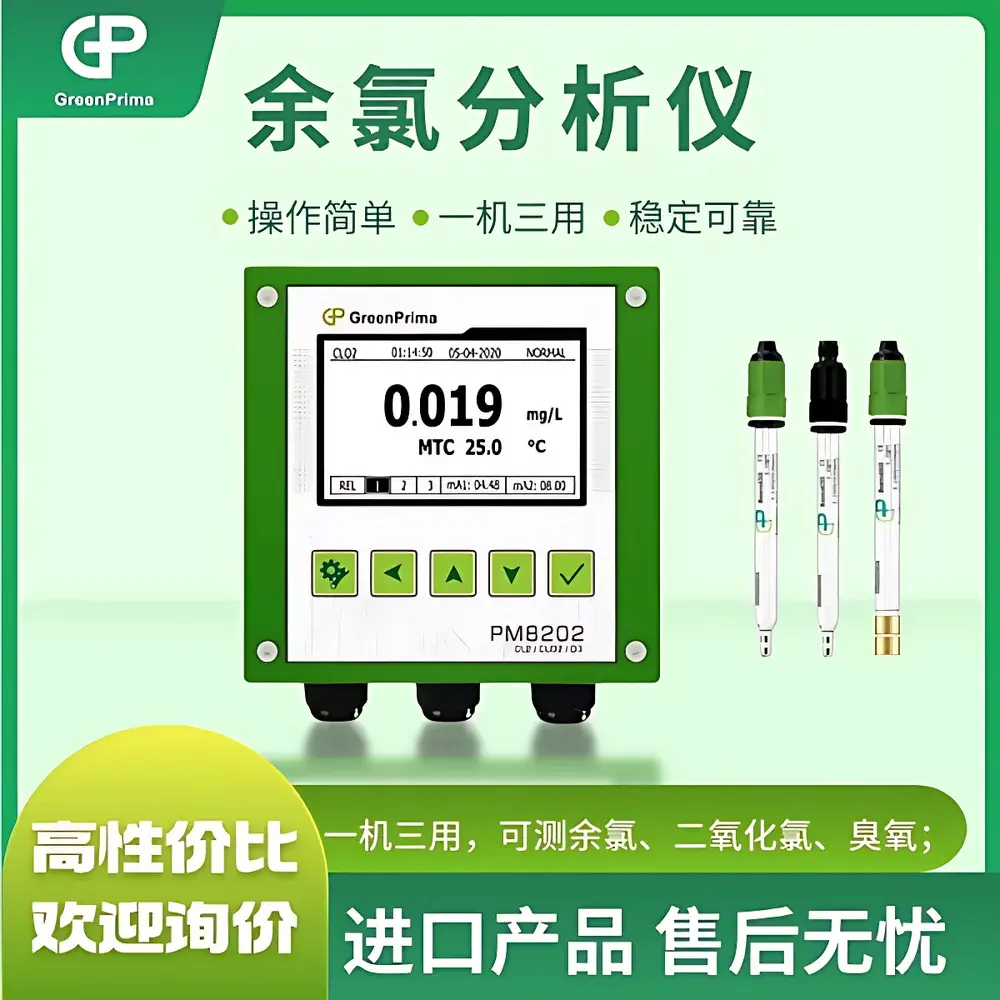
GreenPrima PM8202CL Online Residual Chlorine, Chlorine Dioxide & Ozone Analyzer
| Brand | GreenPrima |
|---|---|
| Origin | United Kingdom |
| Manufacturer Type | OEM Manufacturer |
| Product Category | Imported Instrument |
| Model | PM8202CL |
| Instrument Type | Online Analyzer |
| Measurement Principle | Amperometric Constant-Voltage (Three-Electrode System) |
| Measured Parameters | Free Chlorine, Combined Chlorine, Chlorine Dioxide, Ozone |
| Range | 0.00–20.00 ppm / 0.00–200.00 ppb |
| Accuracy | ±2% of Full Scale |
| Resolution | 0.001 ppm (low range), 0.01 ppm (high range) |
| Temperature Compensation | -10 to 130 °C (NTC10K or PT1000 selectable) |
| Operating Temperature | -10 to 70.0 °C |
| Storage Temperature | -20 to 70.0 °C |
| Display | Backlit Graphic LCD (Chinese/English Switchable) |
| Data Storage | 600,000 records |
| Power Supply | 90–260 VAC, 50/60 Hz or 24 VDC optional |
| Output | Dual isolated 4–20 mA (0.1% FS, max. loop resistance 500 Ω) |
| Cleaning Interval | 0.1–1000 h |
| Duration | 1–1000 s |
| Alarm | Two independent Hi/Lo setpoints with hysteresis |
| Enclosure Rating | IP65 |
| Dimensions (H×W×D) | 144 × 144 × 108 mm |
| Panel Cutout | 138 × 138 mm |
| Weight | 0.87 kg |
Overview
The GreenPrima PM8202CL is an online amperometric analyzer engineered for continuous, real-time monitoring of oxidant residuals in industrial water systems—specifically designed for demanding environments such as integrated steel plant water treatment facilities. It operates on a constant-voltage amperometric principle using a three-electrode configuration (working, counter, and reference), enabling selective and stable electrochemical detection of free chlorine, combined chlorine, chlorine dioxide, and ozone without chemical reagents. Unlike colorimetric or DPD-based methods, this sensor architecture eliminates interferences from turbidity, color, or manganese, ensuring high reproducibility across fluctuating feedwater conditions typical in cooling tower makeup, descaling rinse water, and closed-loop process circuits. The system integrates a dedicated BAF615 flow-controlled cell to maintain laminar, consistent sample velocity—critical for minimizing polarization drift and achieving long-term baseline stability under variable pressure and flow regimes.
Key Features
- Reagent-free, membrane-free operation: No consumables—including no replacement membranes, electrolyte refills, or colorimetric reagents—reducing total cost of ownership and maintenance frequency.
- Triple-oxidant capability: Single instrument measures free chlorine, chlorine dioxide, and ozone via electrode-specific calibration and voltage bias selection—optimized for multi-stage disinfection monitoring in sequential treatment trains.
- Dual-electrode sensor options: Bsens650 (platinum working electrode) for general-purpose residual chlorine; Bsens660 (gold working electrode) for enhanced selectivity in high-chloramine or low-ozone applications.
- Intelligent flow management: BAF615 constant-flow cell ensures hydraulic consistency (±2% flow variation) independent of upstream pressure fluctuations—essential for compliance with ISO 7888 and ASTM D1253 validation requirements.
- Robust human-machine interface: Backlit graphic LCD with dual-language (English/Chinese) navigation, password-protected configuration access, and intuitive menu hierarchy for field technicians with minimal training.
- Industrial-grade I/O architecture: Two isolated 4–20 mA analog outputs (configurable for measured value and temperature), RS485 Modbus RTU for SCADA integration, two programmable relays with hysteresis, and timed cleaning output compatible with solenoid valves or air-scour systems.
Sample Compatibility & Compliance
The PM8202CL is validated for use in raw, filtered, and recirculated waters encountered in metallurgical water networks—including high-conductivity cooling water (up to 5,000 µS/cm), mildly corrosive rinse effluents (pH 5.5–9.0), and low-turbidity service water (<5 NTU). Its electrode design complies with EN 27888 and ISO 10523 for electrochemical sensor performance in potable and industrial water matrices. The analyzer supports audit-ready data integrity through timestamped internal logging (600,000 records), non-volatile memory retention during power loss, and optional time-synchronized Modbus register mapping for third-party LIMS or MES platforms. While not intrinsically safe, its IP65-rated enclosure meets NEMA 4X equivalency for indoor panel-mount or wall-mount deployment in non-hazardous classified areas per IEC 60079-0.
Software & Data Management
Data acquisition and configuration are managed locally via the front-panel interface or remotely via Modbus RTU (slave ID configurable, baud rates 9.6–115.2 kbps). All calibration events, alarm triggers, relay state changes, and cleaning cycles are automatically logged with UTC timestamps. The 600,000-record buffer enables >30 days of minute-interval monitoring at full resolution—sufficient for weekly trend review and root-cause analysis of chlorine demand spikes following blast furnace slag quenching or rolling mill descaling operations. For regulatory reporting, exported CSV files include metadata headers compliant with EPA Method 334.0 documentation standards. Firmware updates are performed via USB port using signed binary packages, preserving configuration integrity and supporting version rollback.
Applications
This analyzer is deployed across critical water quality control points in integrated steelworks: upstream of activated carbon filters in reclaimed wastewater reuse lines; inline within chlorination contact tanks serving boiler feed pretreatment; post-ozonation in advanced oxidation units treating oily emulsion waste streams; and at final discharge points subject to local environmental permits (e.g., China’s GB 8978–1996, EU Industrial Emissions Directive 2010/75/EU). It is equally applicable in pharmaceutical purified water loops (meeting USP conductivity and oxidant limits), hospital sterilization effluent monitoring, and municipal secondary distribution networks where chlorine decay kinetics must be tracked across extended hydraulic residence times.
FAQ
What electrode materials are supported, and how do they differ in application?
The PM8202CL accepts either the Bsens650 (Pt/Pt) or Bsens660 (Au/Au) sensor modules. Platinum electrodes offer broad dynamic range for free chlorine in neutral-to-alkaline waters; gold electrodes provide superior sensitivity for low-level ClO₂ and reduced interference from bromide in saline-influenced cooling systems.
Is temperature compensation automatic, and which sensors are compatible?
Yes—automatic temperature compensation is enabled via integrated NTC10K or external PT1000 probes. The controller auto-detects probe type and applies the appropriate Callendar-Van Dusen or Steinhart-Hart algorithm per ISO 7888 Annex C.
Can the unit operate on DC power in remote plant locations?
Yes—24 VDC auxiliary power input is standard, supporting deployment in MCC rooms or field kiosks where AC infrastructure is unavailable or subject to harmonic distortion.
How is sensor fouling mitigated during continuous operation?
The built-in cleaning scheduler activates a user-defined purge cycle (1–1000 seconds) at intervals from 0.1 to 1000 hours. This drives clean water or compressed air through the BAF615 cell to remove biofilm or precipitate buildup without requiring manual intervention.
Does the device support FDA 21 CFR Part 11-compliant electronic records?
While the PM8202CL itself does not embed digital signature or audit trail encryption, its Modbus registers export all critical event logs (calibrations, alarms, configuration changes) in deterministic, time-stamped format—enabling downstream validation in validated SCADA or MES systems meeting Part 11 requirements.







