
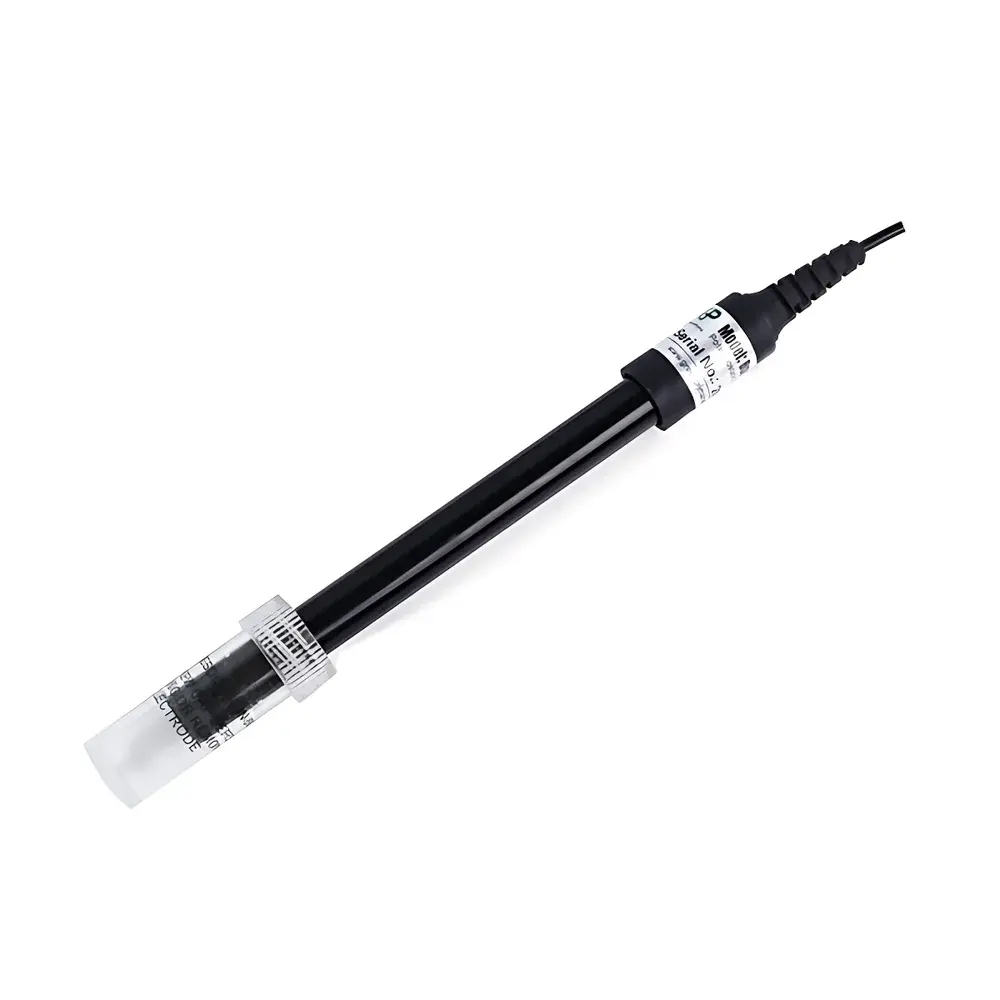
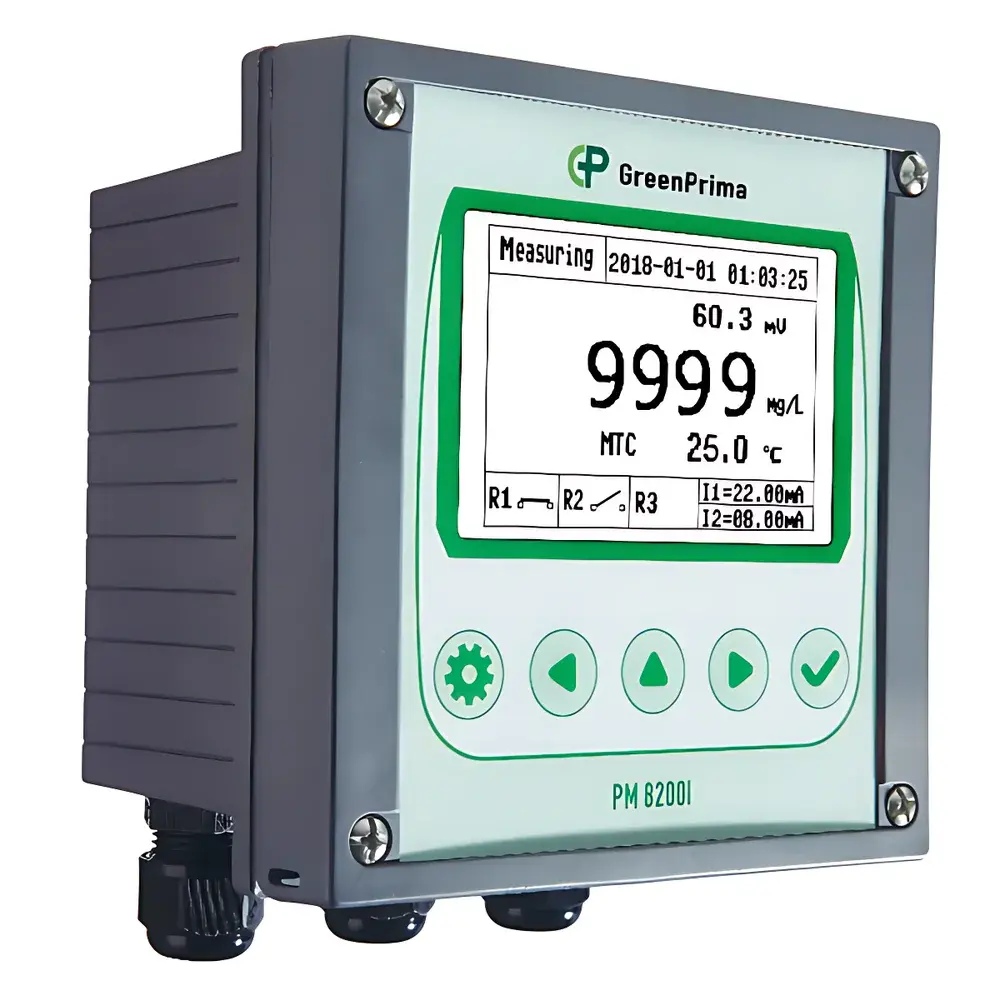
GreenPrima PM 8200I Online Water Hardness Analyzer
| Brand | GreenPrima |
|---|---|
| Origin | United Kingdom |
| Manufacturer Type | Original Equipment Manufacturer (OEM) |
| Product Category | Imported Instrument |
| Model | PM 8200I |
| Price Range | USD 1,400 – 7,000 (FOB UK) |
| Measurement Range | 0.00–20,000 ppm CaCO₃ equivalent |
| Resolution | 0.01 / 0.1 / 1 ppm |
| Accuracy | ±0.01 / ±0.1 / ±1 ppm (depending on range) |
| Temperature Compensation | −10 to 130 °C (manual/automatic |
| Operating Temperature | 0 to 70.0 °C |
| Storage Temperature | −20 to 70.0 °C |
| Display | Backlit graphic LCD (128 × 64 pixels) |
| Data Storage | 600,000 records with timestamped retrieval |
| Power Supply | 90–260 VAC, 50/60 Hz or optional 24 VDC |
| Enclosure Rating | IP65 |
| Communication | RS485, MODBUS RTU protocol |
| Analog Outputs | Two isolated 4–20 mA outputs (max. loop resistance 500 Ω, accuracy ±0.1% FS) |
| Relay Output | One multifunctional relay (configurable for cleaning control, periodic alarm, fault alarm) |
| Cleaning Control | Adjustable interval (0.1–1000 h) and duration (1–1000 s) |
| Electrode Model | Bsens740 |
| Electrode Range | 0–40,000 mg/L as CaCO₃ |
| Electrode Resolution | 0.01 mg/L |
| Electrode Accuracy | ±3% FS |
| Electrode Body Material | Polyphenylsulfone (PPS) |
| Electrode Max. Pressure | 3.5 bar |
| Electrode Temp. Range | −5 to 70.0 °C |
| Electrode Connection | PG13.5 threaded fitting |
| Cable Length | 5 m |
| Mounting Options | Wall-mount, pole-mount, panel-mount |
| Dimensions | 144 × 144 × 106 mm |
| Panel Cutout | 138 × 138 mm |
| Weight | 0.86 kg |
Overview
The GreenPrima PM 8200I Online Water Hardness Analyzer is a dedicated industrial process instrument engineered for continuous, real-time measurement of total water hardness—expressed as calcium carbonate (CaCO₃) equivalence—in recirculating cooling water systems. It operates on the principle of potentiometric ion-selective electrode (ISE) detection, utilizing a proprietary solid-state calcium/magnesium composite sensor (Bsens740) optimized for high ionic strength, variable pH, and thermally dynamic aqueous environments typical of HVAC chillers, steam boilers, power plant condensate loops, and industrial electroplating rinse lines. Unlike colorimetric or titrimetric benchtop methods, the PM 8200I delivers stable, drift-compensated readings without reagents, consumables, or optical path fouling—making it suitable for unattended operation over extended maintenance cycles. Its embedded temperature compensation (via integrated NTC10K or PT1000 probe) ensures traceable accuracy across operational temperatures from −10 °C to 130 °C, aligning with ASTM D1126 and ISO 6059 standard methodologies for hardness quantification in industrial water streams.
Key Features
- High-stability solid-state ISE sensor (Bsens740) with PPS chemical-resistant housing, rated for continuous exposure to chlorinated, oxidizing, and mildly acidic cooling water matrices
- IP65-rated sealed enclosure with corrosion-resistant front panel, certified for indoor and semi-outdoor deployment in mechanical rooms, boiler houses, and utility corridors
- Graphical backlit LCD interface supporting dual-language navigation (English/Chinese), intuitive menu hierarchy, and zero-keypad operation with auto-dimming after 3 minutes
- Dual isolated 4–20 mA analog outputs configurable per user-defined scaling (e.g., 0–2000 ppm → 4–20 mA), compliant with ISA-50.00.01 signal integrity requirements
- RS485 serial interface implementing MODBUS RTU protocol (slave ID 1–247), enabling seamless integration into SCADA, DCS, or PLC-based monitoring infrastructures
- Configurable multifunction relay supporting automated electrode cleaning cycles, system fault alerts, and scheduled maintenance notifications—logically decoupled from analog output channels
- Onboard non-volatile memory storing up to 600,000 timestamped hardness values with millisecond-resolution clock synchronization, supporting trend analysis and audit-ready data export via serial dump
Sample Compatibility & Compliance
The PM 8200I is validated for use in aqueous samples with conductivity ≤ 2,000 µS/cm, suspended solids < 50 mg/L, and free chlorine concentrations up to 2 ppm. It maintains metrological stability in applications including low-pressure boiler feedwater (ASME B31.1), pharmaceutical purified water (USP ), food-grade process cooling loops (FDA 21 CFR Part 11–compliant data logging when paired with validated software), and closed-loop HVAC systems governed by ASHRAE Guideline 12-2020. Sensor calibration follows a two-point procedure using NIST-traceable CaCO₃ standards (e.g., 100 ppm and 1000 ppm); calibration verification intervals are defined per site-specific risk assessment under ISO/IEC 17025 or GMP Annex 11 frameworks. The instrument’s electrical design complies with EN 61326-1 (EMC) and EN 61010-1 (safety).
Software & Data Management
Data acquisition and configuration are managed via the GreenPrima ConfigTool (Windows-based, USB-to-RS485 adapter required), which provides secure parameter editing, firmware updates, and raw data extraction in CSV format. All configuration changes—including range selection, temperature compensation mode, relay logic, and cleaning schedule—are logged with user ID, timestamp, and pre-/post-value entries—supporting ALCOA+ principles for data integrity. When deployed in regulated environments, the system supports 21 CFR Part 11 compliance through external validation of the ConfigTool workflow, including electronic signature enforcement, audit trail review, and role-based access control. Historical datasets are exportable for statistical process control (SPC) analysis in JMP or Minitab, and alarm events can trigger email/SMS notifications via compatible gateway devices.
Applications
- Real-time hardness trending in open- and closed-circuit cooling towers to prevent scale formation on heat exchanger surfaces (per CTI STD-201 guidelines)
- Continuous monitoring of softened makeup water in high-pressure steam boilers to ensure feedwater hardness remains below 0.1 ppm (ASME BPVC Section IV)
- Process water quality assurance in semiconductor wet benches and PCB electroplating lines where Ca²⁺/Mg²⁺ carryover compromises etch uniformity
- Automated blowdown control in district cooling plants using hardness-triggered valve actuation logic
- Regulatory reporting support for EPA Clean Water Act (CWA) Section 301 effluent limits where hardness impacts metal solubility and discharge toxicity profiles
FAQ
What hardness units does the PM 8200I report in?
The instrument reports total hardness exclusively as ppm (mg/L) CaCO₃ equivalent, consistent with global regulatory reporting conventions and ASTM D1126 Annex A1.
Can the Bsens740 electrode be used in seawater or brine solutions?
No—the sensor is not rated for salinities > 5,000 ppm TDS or chloride concentrations exceeding 1,000 mg/L. Use in such matrices will accelerate reference junction depletion and compromise long-term accuracy.
Is field calibration possible without removing the electrode from the pipe?
Yes—calibration may be performed in-situ using grab-sample calibration cups mounted directly onto the flow cell, provided flow velocity remains ≥ 0.3 m/s during calibration to ensure representative sampling.
How often should the electrode be cleaned mechanically?
Cleaning frequency depends on fouling rate; typical intervals range from 24 to 168 hours in moderately scaling systems. The relay-controlled ultrasonic or air-pulse cleaning function minimizes manual intervention.
Does the PM 8200I support HART communication?
No—it implements only RS485 MODBUS RTU. HART-capable variants (PM 8200H) are available upon request with separate part numbering and firmware.







