
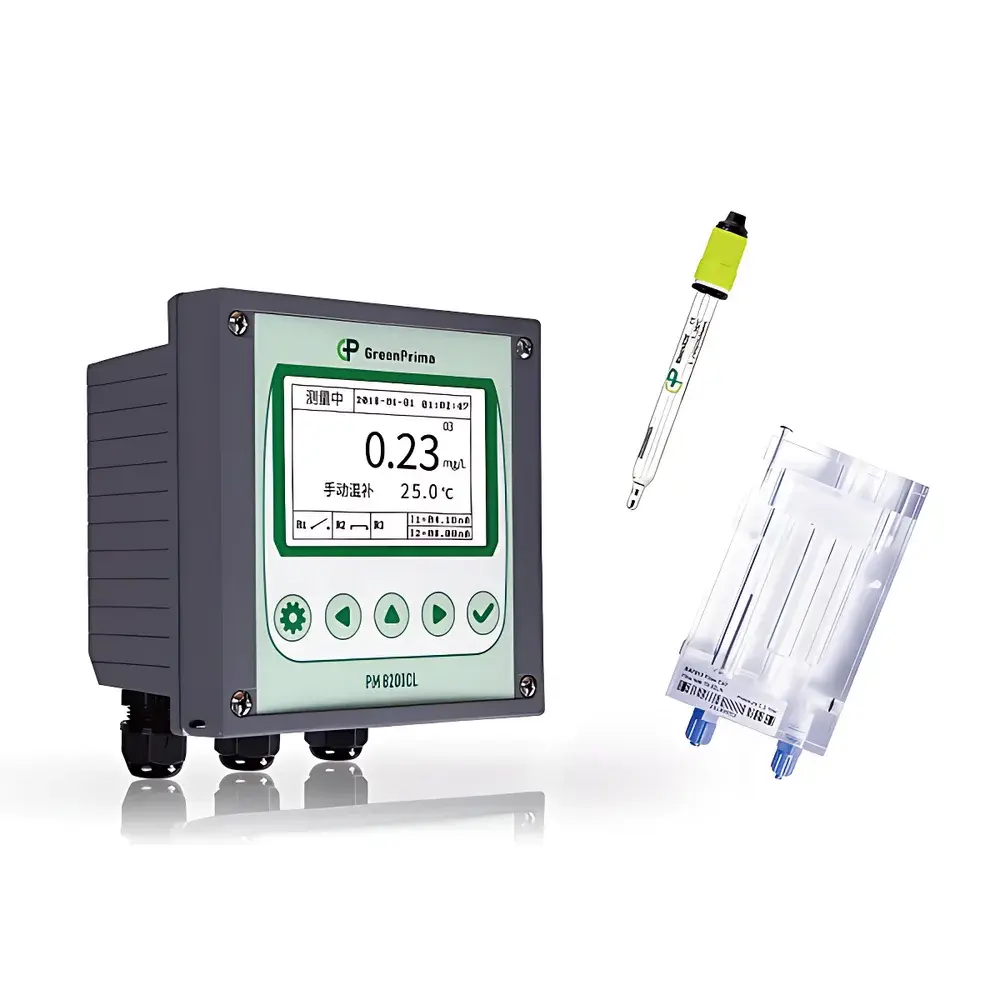
GreenPrima PM8200CL Online Residual Chlorine Analyzer
| Brand | GreenPrima |
|---|---|
| Origin | Switzerland |
| Manufacturer Type | Manufacturer |
| Origin Category | Imported |
| Model | PM8200CL |
| Instrument Type | Online Analyzer |
| Measurement Principle | Amperometric Electrochemical Sensor (Constant Voltage Method) |
| Measured Parameter | Free Residual Chlorine |
| Range | 0–2.000 ppm and 0–20.00 ppm |
| Accuracy | ≤ ±2% of Full Scale |
| Repeatability | ±0.001 ppm / ±0.01 ppm |
| Resolution | 0.001 ppm / 0.01 ppm |
| Detection Limit | 0.001 ppm / 0.01 ppm |
| Temperature Compensation | –10 to 130 °C (manual/automatic) |
| Operating Temperature | 0 to 70.0 °C |
| Storage Temperature | –20 to 70 °C |
| Display | Backlit Graphic LCD |
| Languages | English, Chinese |
| Data Storage | 600,000 records |
| Power Supply | 90–260 VAC, 50/60 Hz or 24 VDC optional |
| Analog Outputs | Dual 4–20 mA (residual chlorine & temperature), max. loop resistance 500 Ω, accuracy 0.1% FS |
| Cleaning Output | Adjustable interval (0.1–1000 h) and duration (1–1000 s) |
| Enclosure Rating | IP65 |
| Controller Dimensions | 144 × 144 × 106 mm |
| Electrode Dimensions | Ø12 × 120 mm |
| Controller Mounting | Wall-mount, panel-mount, or pole-mount |
| Electrode Connection | PG13.5 thread, compatible with BAF615 flow cell |
Overview
The GreenPrima PM8200CL Online Residual Chlorine Analyzer is a robust, field-deployable electrochemical measurement system engineered for continuous, real-time monitoring of free residual chlorine in potable water distribution systems, municipal drinking water plants, swimming pools, hospital effluent streams, and industrial process water loops. It operates on the amperometric constant-voltage principle: a stable polarizing potential is applied between a gold-ring working electrode (Bsens660 sensor) and an integrated reference electrode; free chlorine molecules undergo reduction at the electrode surface, generating a diffusion-controlled current proportional to analyte concentration. This method eliminates reliance on colorimetric reagents, optical path stability, or membrane-based electrolyte replenishment—offering inherent long-term drift resistance and minimal maintenance requirements. The system comprises three core components: the PM8200CL controller unit, the Bsens660 amperometric sensor (optimized for sub-ppm detection), and the BAF615 precision flow-through cell, which maintains laminar, consistent sample velocity to ensure hydrodynamic reproducibility across varying inlet pressures.
Key Features
- Amperometric gold-ring sensor (Bsens660) with proven stability in low-concentration (<0.1 ppm) chlorine environments
- No reagent consumption, no membrane replacement, no internal electrolyte refilling — reducing total cost of ownership and operational downtime
- Integrated temperature compensation (–10 to 130 °C) with dual-mode selection (manual or automatic) to correct for kinetic and solubility effects on sensor response
- Zero-point stability maintained via electrode polarization control and built-in drift diagnostics — validated under GLP-aligned verification protocols
- Dual isolated 4–20 mA analog outputs: one for residual chlorine concentration, one for measured temperature — each traceable to NIST-traceable calibration standards
- Configurable cleaning cycle (interval: 0.1–1000 hours; duration: 1–1000 seconds) to mitigate biofilm formation or particulate fouling without manual intervention
- IP65-rated enclosure suitable for indoor and sheltered outdoor installations; controller supports wall, panel, or pole mounting
- Graphic backlit LCD with dual-language interface (English/Chinese); intuitive menu navigation compliant with IEC 61000-4 electromagnetic immunity standards
Sample Compatibility & Compliance
The PM8200CL is validated for use with clarified, non-abrasive aqueous matrices typical of treated drinking water, recirculated pool water, and low-turbidity hospital wastewater effluents. It is not recommended for raw surface water with suspended solids >10 NTU or high organic load (>5 mg/L TOC) without upstream filtration. Sensor performance meets ASTM D1253-22 (Standard Test Method for Residual Chlorine in Water) and ISO 7393-2:2018 (Water quality — Determination of free and total chlorine — Part 2: Colorimetric method using N,N-diethyl-p-phenylenediamine — Small-scale method), with electrochemical correlation established against certified reference materials (CRMs) traceable to NIST SRM 2997. The controller’s data logging architecture supports audit-ready storage (600,000 timestamped records) and complies with basic electronic record integrity requirements per FDA 21 CFR Part 11 Annex A when deployed in GMP-regulated utilities.
Software & Data Management
Data acquisition is managed locally via the embedded microcontroller, with time-stamped values stored in non-volatile memory. The system supports Modbus RTU over RS485 for integration into SCADA or DCS platforms (e.g., Siemens Desigo, Honeywell Experion). No proprietary software installation is required; configuration is performed directly via front-panel keypad or optional USB-to-serial adapter. All calibration events (zero/span), cleaning logs, and sensor diagnostics are automatically recorded with timestamps and user IDs (where configured). Export is supported via SD card (optional accessory) in CSV format, enabling post-processing in Excel or statistical analysis tools compliant with ISO/IEC 17025 data handling guidelines.
Applications
- Real-time chlorine residual control at drinking water plant final clearwells and distribution pump stations
- Regulatory compliance monitoring in public swimming pools and spa facilities per CDC Model Aquatic Health Code (MAHC) Section 6.003
- Disinfection validation in healthcare facility wastewater pretreatment units prior to municipal sewer discharge
- Process optimization in food & beverage production lines where chlorine is used for equipment sanitization rinse monitoring
- Early-warning detection of chlorine decay in extended distribution networks to support hydraulic residence time modeling
FAQ
Does the PM8200CL require daily calibration or frequent zero adjustments?
No. The Bsens660 sensor exhibits <0.5% monthly drift under continuous operation in stable municipal water matrices. Zero verification is recommended weekly; full two-point calibration (zero + span) every 30 days or after sensor replacement.
Can the system operate reliably in chloraminated water?
The PM8200CL measures free chlorine selectively. Monochloramine contributes minimally (<5%) to the amperometric signal at the gold-ring electrode’s operating potential; for total chlorine or chloramine-specific applications, a separate differential measurement protocol is advised.
Is temperature compensation mandatory for accurate readings?
Yes. Chlorine solubility and electrode kinetics vary significantly with temperature. The integrated Pt1000 RTD ensures compensation across the full –10 to 130 °C range; omission results in ≥±8% error at extreme temperatures.
What flow rate is required in the BAF615 flow cell?
Optimal laminar flow is achieved at 150–300 mL/min. The cell includes a calibrated orifice and pressure-relief bypass to maintain consistency across inlet pressures from 0.1 to 6 bar.
How is sensor lifetime defined, and what indicates end-of-life?
Typical service life exceeds 24 months in clean, low-pH (±0.02 ppm, reduced sensitivity (<90% of initial slope), or failure to stabilize within 5 minutes after calibration — all logged automatically in the diagnostic history.
Related Products







