
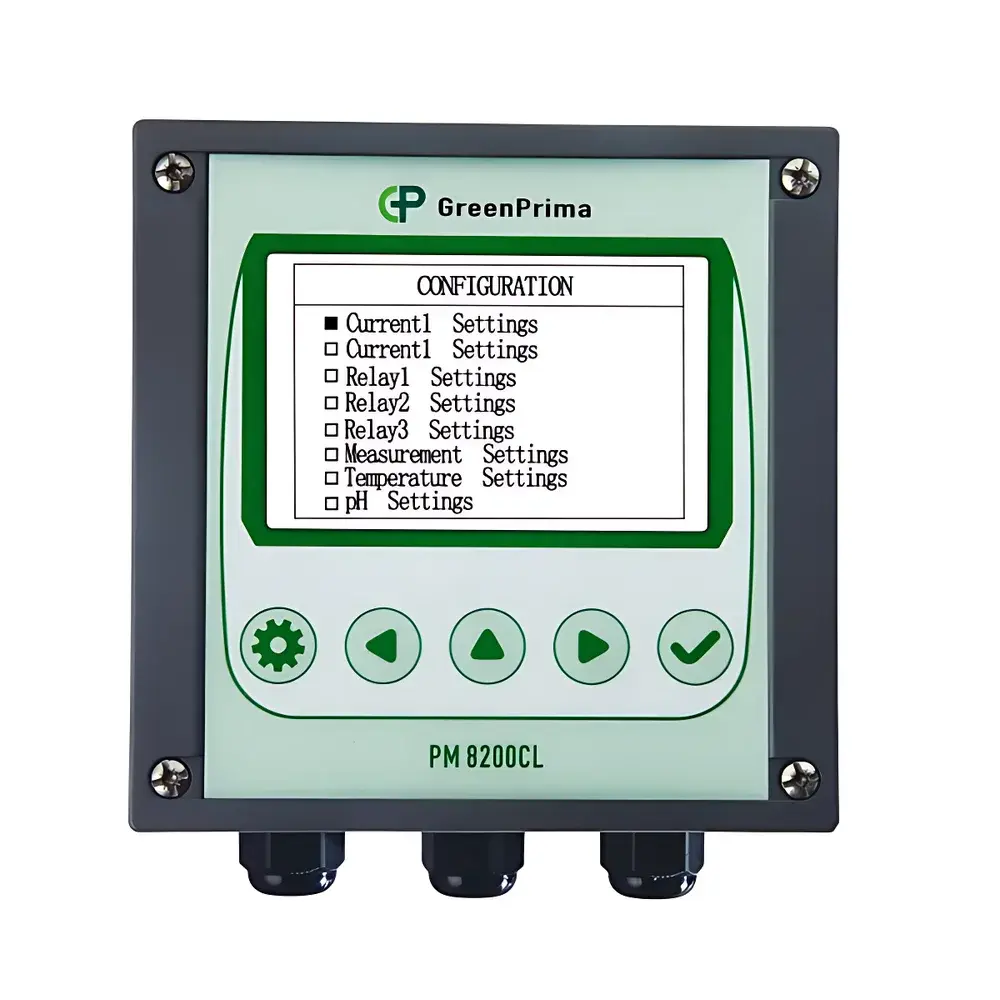
GreenPrima PM8200CL Online Chlorine Dioxide, Free Chlorine & Ozone Analyzer for Swimming Pool and Potable Water Systems
| Brand | GreenPrima |
|---|---|
| Origin | United Kingdom |
| Manufacturer Type | OEM Manufacturer |
| Origin Category | Imported |
| Model | PM8200CL |
| Instrument Type | Online Analyzer |
| Measurement Principle | Amperometric (Constant Potential) Electrochemical Sensor |
| Measured Parameters | Chlorine Dioxide (ClO₂), Free Chlorine (Cl₂), Ozone (O₃) |
| Range | 0–2.000 ppm / 0–20.00 ppm (dual-range auto-scaling) |
| Accuracy | ±0.001 ppm / ±0.01 ppm |
| Repeatability | ±0.001 ppm / ±0.01 ppm |
| Resolution | 0.001 ppm / 0.01 ppm |
| LOD | 0.001 ppm / 0.01 ppm |
| Temperature Compensation | –10 to 130 °C (NTC10K or PT1000, manual/auto) |
| Operating Temp. | 0–70.0 °C |
| Storage Temp. | –20 to 70.0 °C |
| Display | Backlit dot-matrix LCD with bilingual (English/Chinese) menu |
| Data Storage | 600,000 records |
| Power Supply | 90–260 VAC, 50/60 Hz or optional 24 VDC |
| Enclosure Rating | IP65 |
| Communications | RS485, MODBUS-RTU compliant |
| Analog Outputs | Two isolated 4–20 mA outputs (max. 500 Ω, ±0.1% FS) |
| Cleaning Output | Adjustable interval (0.1–1000 h) and duration (1–1000 s) |
| Mounting Options | Wall-mount, pole-mount, panel-mount |
| Dimensions | 144 × 144 × 106 mm |
| Panel Cutout | 138 × 138 mm |
| Weight | 0.86 kg |
| Electrode Model | Bsens650 |
| Electrode Range | 0–2.000 / 0–20.00 ppm |
| Electrode Accuracy | ±2% FS |
| Electrode Material | Glass body with dual-platinum ring sensing element |
| Max. Pressure Rating | 5 bar |
| Connection | PG13.5 threaded fitting |
| Cable Length | 3 m |
Overview
The GreenPrima PM8200CL is a dedicated online amperometric analyzer engineered for continuous, reagent-free measurement of chlorine dioxide (ClO₂), free chlorine (Cl₂), and ozone (O₃) in potable water distribution systems, swimming pools, hospital water circuits, and municipal water treatment processes. It operates on the constant-potential amperometric principle: a stable polarizing voltage is applied between a working electrode (dual-platinum ring) and a reference electrode; target oxidants undergo electrochemical reduction at this fixed potential, generating a diffusion-controlled current proportional to their aqueous concentration. This method eliminates optical interferences, avoids chemical reagents and membrane consumables, and delivers high reproducibility in turbid or colored waters where colorimetric methods fail. The system comprises three integrated modules—the PM8200CL controller, the Bsens650 amperometric sensor, and the BAF615 flow-through cell—designed to maintain laminar, pressure-stabilized sample flow under variable hydraulic conditions.
Key Features
- True reagent-free operation: No DPD, o-tolidine, or other colorimetric reagents required—reducing operational cost and chemical handling risk.
- Zero-maintenance sensor architecture: No replaceable membranes, electrolyte refills, or catalytic coatings—minimizing downtime and calibration drift.
- Dual-range auto-scaling measurement: Seamlessly switches between 0–2.000 ppm (high-resolution mode) and 0–20.00 ppm (broad-range mode) based on real-time signal amplitude.
- Robust temperature compensation: Supports both NTC10K and PT1000 sensors with configurable manual or automatic compensation across –10 to 130 °C.
- Industrial-grade communications: Dual isolated 4–20 mA analog outputs (±0.1% full-scale accuracy) and RS485 interface compliant with MODBUS-RTU protocol for SCADA and DCS integration.
- Programmable cleaning control: Output-triggered solenoid valve activation with user-defined cleaning interval (0.1–1000 hours) and duration (1–1000 seconds) to prevent biofilm accumulation on the electrode surface.
- Flexible mounting and ingress protection: IP65-rated enclosure compatible with wall, pole, or panel installation; compact 144 mm square form factor with standardized 138 mm cutout.
Sample Compatibility & Compliance
The PM8200CL is validated for use in chlorinated and chloraminated drinking water, chlorine dioxide–disinfected pool recirculation loops, ozone-treated hospital sterile water lines, and effluent streams from disinfection contact tanks. It meets mechanical and electrical requirements of IEC 61000-6-2 (immunity) and IEC 61000-6-4 (emissions). While not certified to ISO 9001 or ISO/IEC 17025 as a standalone test method, its measurement methodology aligns with the performance criteria outlined in ASTM D6503 (Standard Test Method for Determination of Residual Oxidants in Water by Amperometric Titration) and supports compliance with WHO Guidelines for Drinking-water Quality (4th ed., Annex 2) and U.S. EPA Guidance for Disinfectant Residual Monitoring (2021). The system supports audit-ready data logging (600,000 timestamped records) and may be configured for GLP/GMP environments when paired with validated data acquisition software.
Software & Data Management
The embedded firmware provides local configuration via intuitive bilingual (English/Chinese) menu navigation on the backlit dot-matrix LCD. All critical parameters—including range selection, temperature compensation type, analog output scaling, cleaning schedule, and alarm thresholds—are fully programmable without external tools. Data export is supported via RS485 to supervisory systems or third-party historian platforms. Optional GreenPrima DataLink software (Windows-based) enables remote parameter adjustment, real-time trend visualization, automated report generation (PDF/CSV), and secure backup of calibration logs and event histories. For regulated facilities, optional 21 CFR Part 11–compliant audit trail functionality (user login, electronic signature, change history) is available upon firmware upgrade and server-side validation.
Applications
- Real-time monitoring of chlorine dioxide residual at the outlet of ClO₂ generators in municipal water plants.
- Continuous verification of disinfectant concentration in swimming pool circulation systems per EN 15288-1 and CDC Model Aquatic Health Code requirements.
- Process control of ozone dose in pharmaceutical purified water (PW) and water-for-injection (WFI) loops, supporting USP and EU GMP Annex 1 compliance.
- In-line measurement at distribution network endpoints to ensure minimum residual oxidant levels per national drinking water regulations (e.g., UK DWI, German TrinkwV).
- Integration with automated dosing controllers for closed-loop feedback regulation of ClO₂, Cl₂, or O₃ injection systems.
- Monitoring of cooling tower make-up water and industrial process water where oxidative biocide efficacy must be verified continuously.
FAQ
Does the PM8200CL require daily calibration or zero-point adjustment?
No. The Bsens650 sensor exhibits exceptional zero stability due to its constant-potential design and dual-platinum ring geometry. Field calibration is recommended only after sensor replacement or if long-term drift exceeds ±2% FS over 30 days—verified using NIST-traceable standard solutions.
Can the same sensor measure ClO₂, Cl₂, and O₃ simultaneously?
No. While the PM8200CL hardware platform supports all three analytes, each measurement requires a dedicated sensor calibrated specifically for that oxidant. Cross-sensitivity between ClO₂ and Cl₂ is minimized but not eliminated; therefore, separate sensors are required for regulatory-grade multi-analyte monitoring.
Is the BAF615 flow cell compatible with pressurized pipe installations?
Yes. The BAF615 is rated for continuous operation up to 5 bar (72.5 psi) and includes integrated pressure-relief bypass and laminar flow conditioning vanes to ensure consistent sample velocity across varying inlet pressures.
What maintenance intervals are recommended for unattended operation?
Under typical swimming pool or municipal water conditions, scheduled inspection every 6 months is sufficient. Electrode surface cleaning with mild citric acid solution (1% w/v) is advised annually—or more frequently in high-hardness or high-organics environments—to maintain response time and baseline stability.
Does the system support Modbus TCP or only Modbus RTU?
The standard RS485 interface implements Modbus RTU exclusively. Modbus TCP is not natively supported; however, third-party protocol gateways (e.g., Moxa EDS-G205A) can bridge RTU to TCP/IP networks without compromising data integrity or timing resolution.
Related Products







