
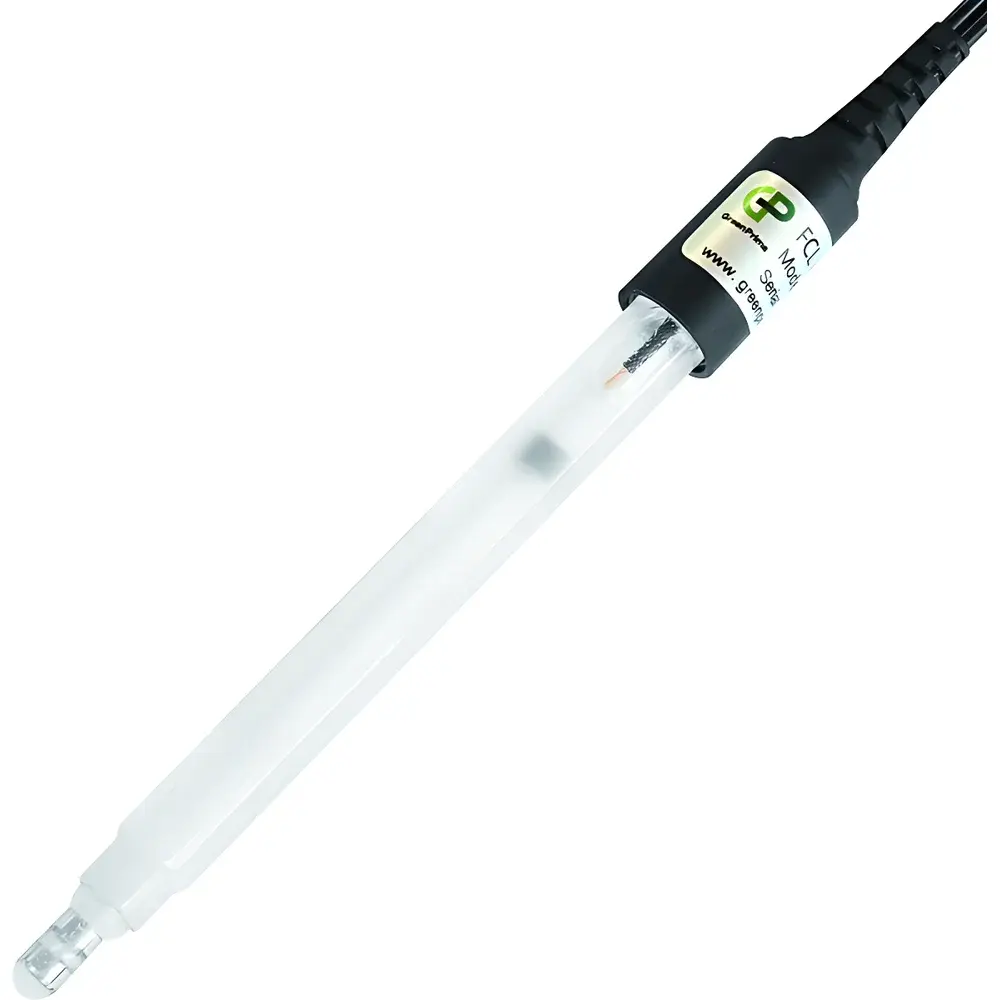
GreenPrima PM8200CL Online Chlorine Dioxide Analyzer
| Brand | GreenPrima |
|---|---|
| Origin | Switzerland |
| Manufacturer Type | OEM Manufacturer |
| Origin Category | Imported |
| Model | PM8200CL |
| Instrument Type | Online Analyzer |
| Measurement Principle | Amperometric Electrochemical Sensor (Constant Voltage Technique) |
| Measured Parameter | Residual Chlorine Dioxide (ClO₂) |
| Range | 0–2.000 ppm / 0–20.00 ppm |
| Accuracy | ≤ ±2% of Full Scale |
| Repeatability | ±0.001 ppm / ±0.01 ppm |
| Resolution | 0.001 ppm / 0.01 ppm |
| Detection Limit | 0.001 ppm / 0.01 ppm |
| Temperature Compensation | –10 to 130 °C (Manual/Automatic) |
| Operating Temperature | 0 to 70.0 °C |
| Storage Temperature | –20 to 70 °C |
| Display | Backlit Graphic LCD |
| Languages | English, Chinese |
| Data Storage Capacity | 600,000 records |
| Power Supply | 90–260 VAC, 50/60 Hz or Optional 24 VDC |
| Analog Outputs | Dual 4–20 mA (ClO₂ concentration & temperature |
| Cleaning Output | Adjustable interval (0.1–1000 h), duration (1–1000 s) |
| Enclosure Rating | IP65 |
| Controller Dimensions | 144 × 144 × 106 mm |
| Electrode Dimensions | Ø12 × 120 mm |
| Mounting Options | Wall-mount, panel-mount, pole-mount |
| Electrode Connection | PG13.5 thread |
| Flow Cell | BAF615 constant-flow chamber |
| Sensor Element | Bsens660 gold-ring amperometric electrode |
Overview
The GreenPrima PM8200CL Online Chlorine Dioxide Analyzer is a continuous, real-time monitoring system engineered for precise and stable measurement of residual chlorine dioxide (ClO₂) in potable water, distribution networks, swimming pools, hospital effluent, and aquaculture systems. It operates on the amperometric electrochemical principle—specifically the constant-voltage (potentiostatic) technique—in which a fixed potential is applied between a working electrode (gold ring) and a reference electrode. At this optimized polarization voltage, ClO₂ undergoes selective electrochemical reduction, generating a current linearly proportional to its aqueous concentration. Unlike colorimetric or titrimetric methods, this sensor-based approach eliminates reagent consumption, optical interferences, and membrane-related drift, delivering long-term baseline stability and minimal maintenance requirements.
Key Features
- Amperometric Bsens660 gold-ring electrode optimized for low-range ClO₂ detection (down to 0.001 ppm), with high selectivity against interfering oxidants such as free chlorine, chloramines, and ozone.
- Integrated BAF615 constant-flow cell ensures laminar, pressure-stabilized sample delivery—critical for reproducible mass transport to the electrode surface and elimination of flow-rate dependency.
- No chemical reagents, no replaceable membranes, and no electrolyte refills required—reducing total cost of ownership and operational downtime.
- Dual 4–20 mA analog outputs support independent transmission of ClO₂ concentration and temperature signals to PLCs, SCADA systems, or DCS platforms with full traceability.
- Configurable cleaning cycle (interval and duration) enables automated electrode surface maintenance—extending service intervals without manual intervention.
- IP65-rated controller enclosure suitable for indoor and semi-outdoor installation environments; compatible with wall, panel, or pole mounting.
- Onboard data logging stores up to 600,000 timestamped measurements—including ClO₂ value, temperature, sensor status, and calibration events—for GLP-compliant audit trails.
Sample Compatibility & Compliance
The PM8200CL is validated for use in clear, low-turbidity aqueous matrices typical of treated drinking water (pH 5.0–8.5), recirculated pool water, and disinfected hospital wastewater. It is not intended for highly turbid, viscous, or particulate-laden streams without upstream filtration. The system complies with key performance benchmarks referenced in ISO 7888 (water quality — determination of residual disinfectants), ASTM D1253 (standard test method for residual chlorine in water), and supports alignment with regulatory frameworks requiring continuous disinfectant monitoring per EPA Guidance Manual for Disinfection By-Products (DBP) control and WHO Guidelines for Drinking-water Quality. Its dual-channel analog outputs and event-logged data meet foundational requirements for 21 CFR Part 11–aligned systems when integrated with validated data acquisition software.
Software & Data Management
While the PM8200CL operates as a standalone analyzer with local display and configuration via keypad navigation, it is fully interoperable with industry-standard industrial communication protocols. RS485 Modbus RTU interface allows integration into centralized monitoring platforms for remote parameter adjustment, alarm threshold setting, and firmware updates. All stored data—including raw sensor current, compensated ClO₂ values, temperature readings, and diagnostic flags—are exportable via USB or serial interface in CSV format. Timestamped logs support trend analysis, compliance reporting, and root-cause investigation during QA/QC audits. Optional PC-based configuration utility provides advanced diagnostics, calibration history review, and sensor health assessment.
Applications
- Real-time ClO₂ monitoring at point-of-application in municipal water treatment plants—particularly post-contact tank and before distribution.
- Automated dosing control loops in swimming pool and spa disinfection systems, ensuring consistent biocidal efficacy while minimizing human exposure risk.
- Regulatory compliance verification in healthcare facilities where ClO₂ is used for sterilization of medical devices or wastewater decontamination.
- Process validation in pharmaceutical water-for-injection (WFI) systems where oxidative residuals must be verified prior to final filtration.
- Environmental monitoring of effluent discharge points subject to local ClO₂ emission limits under national water protection statutes.
FAQ
Does the PM8200CL measure both free chlorine and chlorine dioxide simultaneously?
No. The Bsens660 electrode is specifically tuned for ClO₂ detection and exhibits negligible cross-sensitivity to free chlorine below 0.5 ppm. For concurrent multi-analyte monitoring, separate dedicated sensors are required.
Is temperature compensation automatic or manually configured?
Both options are supported: the built-in Pt1000 RTD sensor enables fully automatic compensation across –10 to 130 °C, or users may apply fixed-offset correction if external temperature input is unavailable.
What is the recommended calibration frequency?
Initial calibration is performed using NIST-traceable ClO₂ standard solutions. Under stable operating conditions, quarterly verification is sufficient; however, calibration interval should be adjusted based on application criticality, regulatory requirements, and observed drift trends.
Can the system operate on 24 VDC power only?
Yes—24 VDC is an optional power configuration, enabling deployment in explosion-proof enclosures or battery-backed backup scenarios where AC mains are unavailable.
How does the BAF615 flow cell maintain constant flow without moving parts?
It utilizes a precision-machined orifice plate and calibrated bypass geometry to deliver laminar, pressure-independent flow rates (typically 150–300 mL/min) under standard line pressures (0.1–6 bar), eliminating need for pumps or flow controllers.
Related Products







