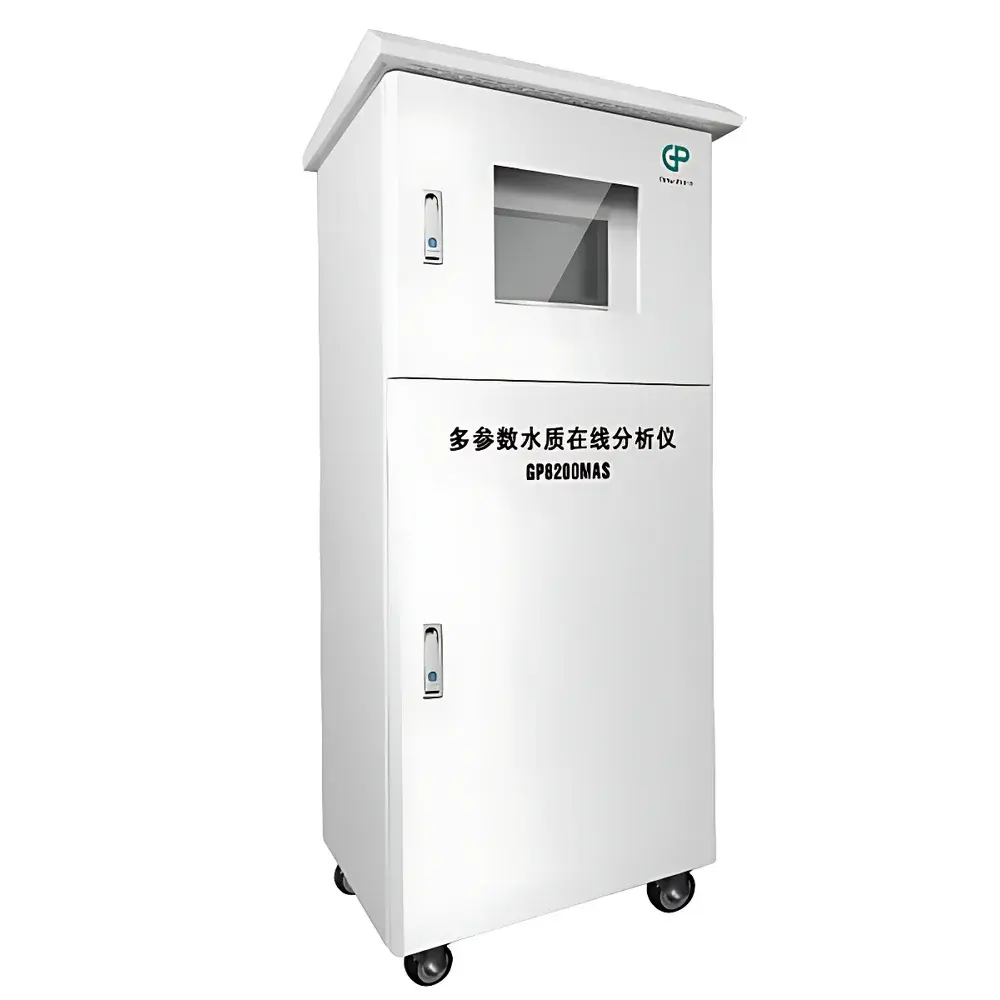
GreenPrima GP8200MAS Multi-Parameter Online Water Quality Analyzer for Rural Drinking Water
| Brand | GreenPrima |
|---|---|
| Origin | Shanghai, China |
| Manufacturer Type | Manufacturer |
| Country of Origin | Domestic (China) |
| Model | GP8200MAS |
| Price | ¥80,000 CNY |
| Display | 10-inch LCD touchscreen (Chinese UI) |
| Enclosure Rating | IP65 |
| Dimensions | 1300 × 600 × 400 mm (customizable) |
| Power Supply | AC 200 V / 20 W or DC 24 V / 15 W (solar-compatible) |
| Sample Handling | Optional integrated sampling unit |
| Data Connectivity | RS485 (Modbus RTU), optional 4–20 mA (up to 8 channels), GPRS (China Mobile/Unicom/Telecom), Wi-Fi, Ethernet |
| Relay Outputs | 8 × SPST (5 A / 250 VAC or 5 A / 30 VDC) |
| Cloud Integration | GoPu Cloud Platform (web, WeChat Mini Program, mobile app, SMS/email alerts) |
Overview
The GreenPrima GP8200MAS is an industrial-grade, multi-parameter online water quality analyzer engineered specifically for continuous monitoring of rural drinking water supply systems. It operates on a modular, channel-isolated architecture—each sensor operates within its own dedicated measurement circuit to eliminate cross-parameter interference and ensure metrological independence. Designed for unattended, long-term deployment in decentralized water infrastructure—including village water stations, small-scale distribution networks, and source protection zones—the GP8200MAS delivers real-time, laboratory-grade data without reagents, consumables, or chemical waste, thereby eliminating secondary contamination risks inherent in wet-chemistry analyzers. Its core measurement principles include potentiometric pH/ORP detection, amperometric free chlorine sensing, nephelometric turbidity quantification (90° scattered light), four-electrode conductivity measurement with temperature compensation (NTC10K or PT1000), and optical luminescence-based dissolved oxygen (DO) determination. All sensors are calibrated traceably to NIST-traceable reference standards and support automated electrode diagnostics and drift compensation across operational temperature ranges.
Key Features
- Modular sensor architecture: Fully independent analog signal paths per parameter—no shared electronics or signal crosstalk.
- Reagent-free operation: Eliminates hazardous chemical storage, disposal liabilities, and maintenance downtime associated with colorimetric or titrimetric methods.
- Intelligent auto-compensation: Adaptive temperature compensation for pH, ORP, conductivity, and DO; configurable pH compensation for free chlorine measurement.
- High-resolution embedded HMI: 10-inch capacitive touchscreen with intuitive Chinese-language interface, local data logging (≥30 days at 1-min intervals), and real-time trend visualization.
- Flexible I/O expansion: Standard RS485 Modbus RTU interface; optional 4–20 mA outputs (up to 8 channels), dual-band GPRS (CMCC/China Unicom/China Telecom), Wi-Fi 802.11 b/g/n, and 10/100 Mbps Ethernet.
- Robust field deployment: IP65-rated enclosure; operating ambient temperature range: −20 °C to +60 °C; solar-ready DC24 V power input with low-power sleep mode (<1.2 W standby).
- Configurable alarm logic: Eight programmable SPST relays (5 A @ 250 VAC) support pump control, valve actuation, audible/visual warning triggers, and fail-safe shutdown sequences.
Sample Compatibility & Compliance
The GP8200MAS is validated for direct immersion or flow-through installation in potable water matrices compliant with China’s GB 5749–2022 “Hygienic Standard for Drinking Water”. It meets mechanical and electrical safety requirements per GB 4793.1–2019 (IEC 61010-1) and electromagnetic compatibility per GB/T 18268.1–2010 (IEC 61326-1). While not certified to ISO/IEC 17025 for accredited testing, its measurement uncertainty profiles align with routine monitoring requirements under WHO Guidelines for Drinking-water Quality (4th ed.) and EU Council Directive 98/83/EC Annex I parameters. Sensor calibration protocols follow ASTM D1293 (pH), ASTM D3370 (turbidity), ASTM D511 (conductivity), and APHA 4500-Cl G (free chlorine)—with documented traceability to national metrology institutes.
Software & Data Management
Data acquisition and remote supervision are enabled via the GoPu Cloud Monitoring Platform—a secure, role-based SaaS system accessible through web browsers, iOS/Android native applications, and WeChat Mini Programs. The platform supports time-synchronized multi-device aggregation, configurable alarm thresholds (instantaneous, rate-of-change, duration-based), audit-trail logging (user actions, calibration events, relay state changes), and exportable CSV/PDF reports compliant with GLP documentation practices. Optional DTU modules provide TLS 1.2-encrypted MQTT or HTTP(S) transmission to third-party SCADA systems or municipal water management dashboards. All cloud interactions adhere to China’s Cybersecurity Law (CSL) and PIPL-compliant data residency policies—data is stored exclusively in mainland China AWS or Alibaba Cloud facilities.
Applications
- Real-time compliance monitoring at rural waterworks intake, filtration effluent, and distribution network endpoints.
- Early-warning detection of contamination events (e.g., chlorine decay, turbidity spikes, pH excursions) in gravity-fed or solar-pumped systems.
- Performance validation of point-of-use (POU) treatment units (e.g., UV reactors, activated carbon filters, electrochemical disinfection modules).
- Long-term water quality trend analysis for watershed management and climate-resilience planning in arid or flood-prone regions.
- Integration into provincial-level rural drinking water information platforms mandated under China’s “Rural Revitalization Strategy” and “Digital Village Development Plan”.
FAQ
Does the GP8200MAS require regular reagent replacement or wet chemistry?
No. All measurements are performed using solid-state or optical sensors—no liquid reagents, buffers, or consumable cartridges are required.
Can sensor modules be added or replaced in the field without system recalibration?
Yes. Hot-swappable sensor bays support plug-and-play module exchange; factory calibration coefficients are stored in each sensor’s EEPROM and auto-loaded upon insertion.
Is the GoPu Cloud platform compatible with existing municipal SCADA systems?
Yes. The platform supports Modbus TCP, MQTT, and RESTful API integration, enabling bidirectional data exchange with Siemens Desigo, Honeywell Experion, or Schneider EcoStruxure architectures.
What is the recommended calibration frequency for regulatory reporting?
For GB 5749–2022 compliance, quarterly verification against certified reference standards is recommended; daily zero/span checks are supported via built-in calibration routines.
How is data integrity ensured during intermittent cellular connectivity?
Local edge storage retains ≥30 days of high-frequency data (1-minute resolution); transmissions resume automatically upon connection restoration with sequence-verified packet recovery.
Related Products