
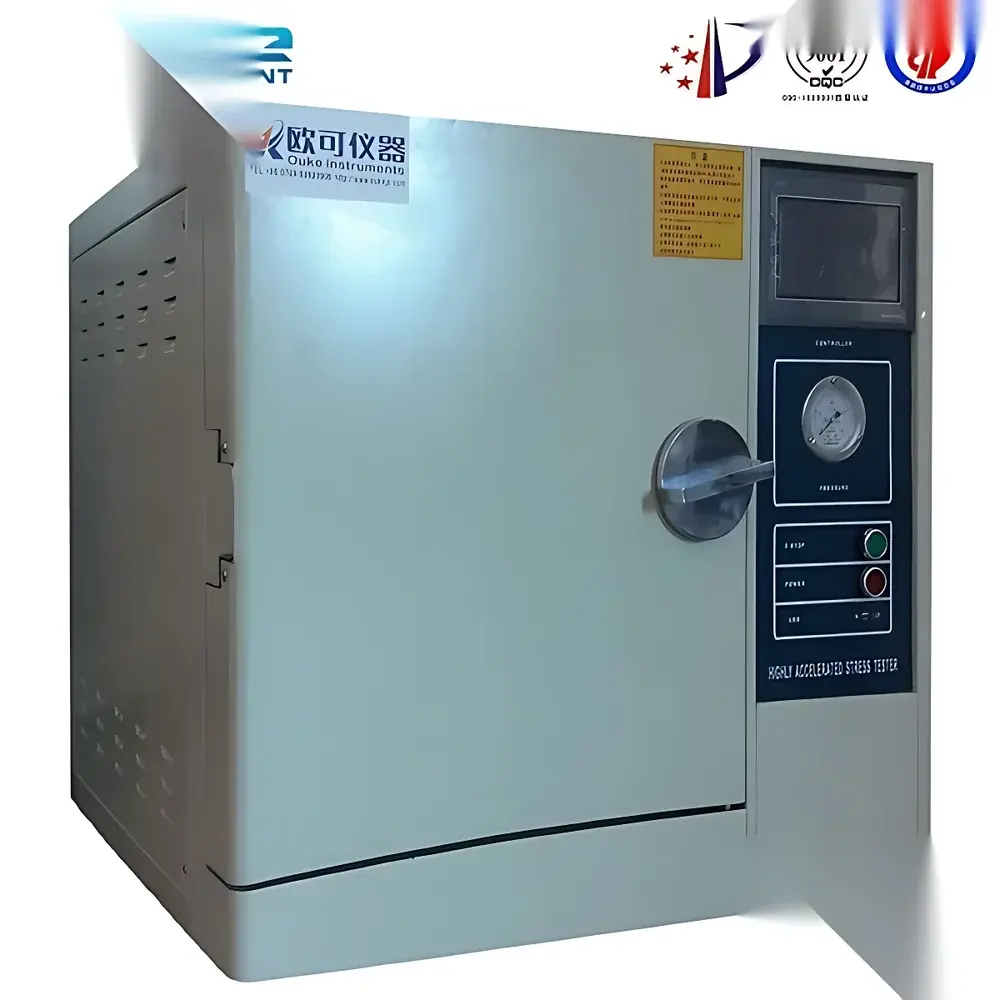
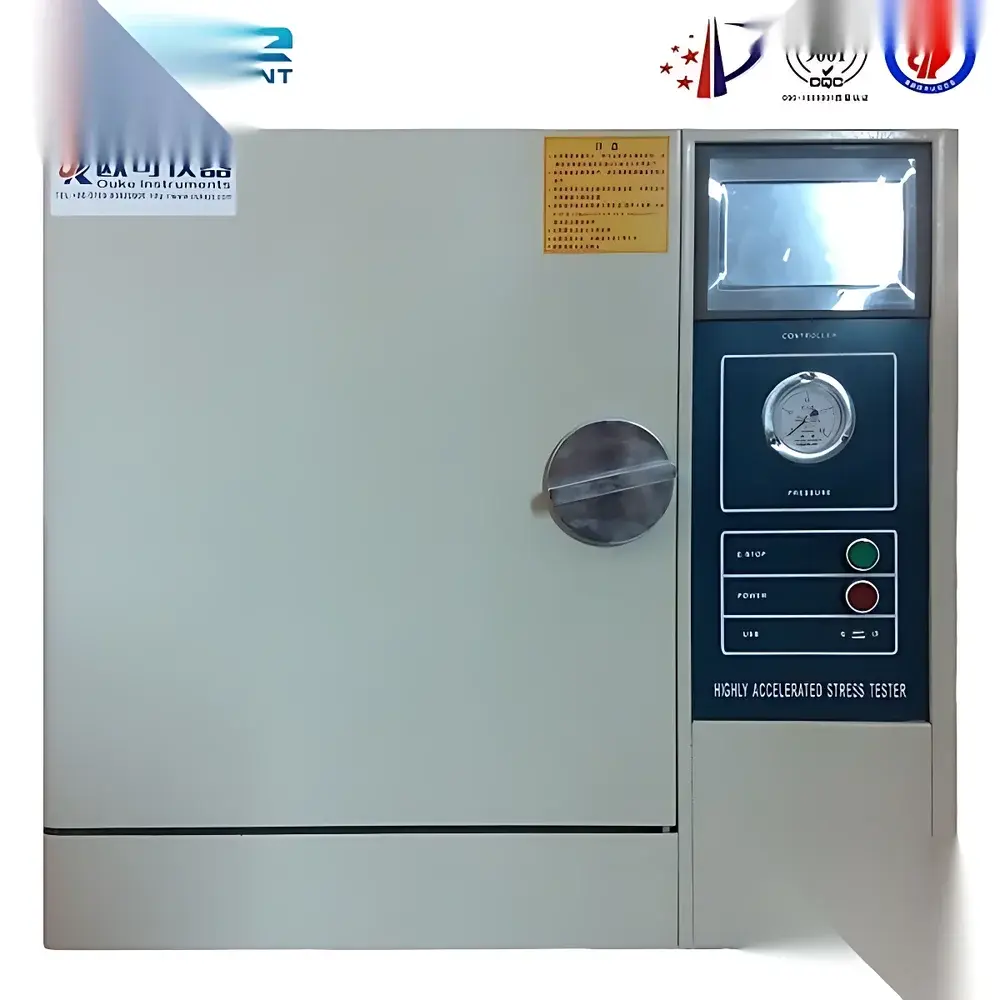
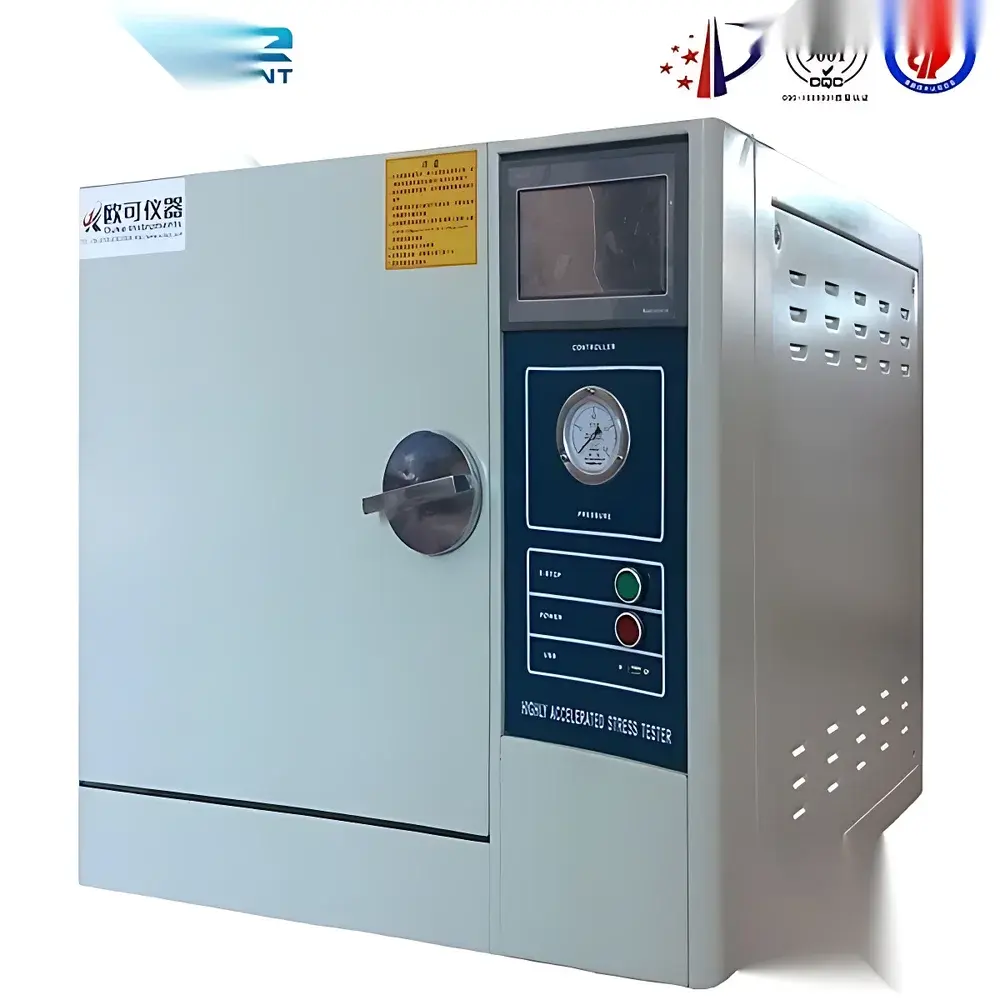
HAST High-Accelerated Stress Test Chamber
| Brand | OEM |
|---|---|
| Origin | Imported |
| Manufacturer Type | Authorized Distributor |
| Price | USD 14,000 (FOB) |
| Internal Dimensions (Ø × H) | Φ250×300 mm to Φ650×600 mm |
| External Dimensions (W×H×D) | 500×500×700 mm to 950×900×1100 mm |
| Operating Temperature Range | 105–135 °C (143 °C optional) |
| Relative Humidity Range | 70–100 % RH |
| Saturation Pressure Range | 0.0–2.0 kg/cm² (gauge) — up to 3.0 kg/cm² on request |
| Power Supply | AC 220 V / 380 V, 50/60 Hz |
| Safety Systems | Low-water cutoff, overpressure relief, auto/manual water replenishment, automatic steam venting |
| Standard Accessories | Two stainless-steel shelves |
Overview
The HAST High-Accelerated Stress Test Chamber is an engineered environmental stress screening system designed for reliability qualification and failure-mode acceleration of microelectronic components, printed circuit boards (PCBs), LED modules, photovoltaic cells, permanent magnets, and other moisture-sensitive electronic assemblies. Unlike conventional temperature-humidity testing (e.g., 85 °C/85 % RH), the HAST chamber operates under elevated saturated steam pressure and controlled temperature—enabling accelerated moisture diffusion into package interfaces and dielectric layers. This methodology conforms to industry-standard accelerated life test protocols including JEDEC JESD22-A110 (HAST) and JESD22-A118 (uHAST), as well as IEC 60749-26 and MIL-STD-750 Method 1082. The chamber utilizes a closed-loop saturated steam environment with precise thermodynamic control, eliminating air pockets and ensuring uniform vapor-phase exposure across all sample surfaces.
Key Features
- Automated water replenishment system with real-time liquid-level monitoring and low-water interlock shutdown to prevent dry-heating and thermal runaway.
- Digital LED temperature controller with ±0.5 °C accuracy and programmable ramp-soak profiles; integrated PID algorithm ensures stable setpoint maintenance during extended test cycles.
- Microprocessor-based digital timer activated only after chamber reaches target temperature—eliminating premature accumulation of test time during heat-up phases.
- Calibrated dual-scale pressure/temperature gauge displaying both absolute pressure (kg/cm²) and corresponding saturation temperature (°C) in real time—critical for verifying thermodynamic equilibrium per IEC 60749-26 Annex A.
- Steam conditioning module with continuous uncondensed vapor purge to maintain >99.5 % saturation quality—ensuring reproducible moisture ingress kinetics across test batches.
- Monolithic silicone door gasket with compression-set resistance and >10,000-cycle sealing integrity—validated per ASTM D1418 and ISO 3601-1 for long-term leak-tight performance at elevated pressure.
Sample Compatibility & Compliance
The chamber accommodates diverse sample geometries—from bare die and wafer-level packages to assembled PCBs and encapsulated power modules—via customizable internal dimensions (Φ250×300 mm to Φ650×600 mm). All models comply with safety requirements outlined in IEC 61010-1 (Electrical Equipment for Measurement, Control, and Laboratory Use) and incorporate dual-redundant pressure relief mechanisms certified to ASME BPVC Section VIII Div. 1. Optional traceability features support GLP/GMP environments: audit-trail-enabled data logging, user-access controls, and electronic signature capability aligned with FDA 21 CFR Part 11 Annex 11 requirements. Calibration certificates traceable to NIST standards are available upon request.
Software & Data Management
Standard operation is conducted via front-panel interface with password-protected parameter configuration. Optional PC-based software (Windows-compatible) provides remote monitoring, real-time graphing of T/P/RH trends, automated report generation (PDF/CSV), and event-triggered alerts (email/SMS). All logged data include timestamp, operator ID, chamber ID, and environmental setpoints—structured to meet ISO/IEC 17025 clause 7.5.2 for test record integrity. Historical data archives are encrypted and support version-controlled backups compliant with EU GDPR Article 32 security obligations.
Applications
- Qualification of plastic-encapsulated microcircuits (PEMs) per JEDEC J-STD-020 and JESD22-A110.
- Failure analysis of wire-bond lift-off, mold compound delamination, and solder joint corrosion under high-humidity stress.
- Reliability screening of automotive-grade electronics (AEC-Q200) and industrial IoT sensors exposed to humid tropical climates.
- Process validation for conformal coating efficacy and underfill material performance in flip-chip assemblies.
- Accelerated aging of PV module edge seals and backsheet polymers under combined thermal-moisture stress.
FAQ
What is the difference between HAST and uHAST testing?
uHAST (Unbiased HAST) eliminates DC bias voltage during testing to isolate moisture-induced failure mechanisms, whereas standard HAST may include biasing per JEDEC JESD22-A118. Our chamber supports both modes via optional biasing interface modules.
Can the chamber operate continuously for 96+ hours?
Yes—designed for uninterrupted operation up to 168 hours (7 days) with scheduled maintenance intervals; validated by 500-hour MTBF testing per Telcordia SR-332.
Is third-party calibration support available?
Yes—certified calibration services with NIST-traceable pressure transducers and PT100 sensors are offered globally through authorized metrology partners.
Does the system meet CE or UKCA marking requirements?
All units shipped to EEA/UK markets include CE/UKCA declarations of conformity, incorporating EN 61000-6-2 (immunity) and EN 61000-6-4 (emissions) compliance documentation.
How is steam saturation quality verified during operation?
Via continuous differential-pressure measurement across the steam conditioning orifice and correlation with real-time saturation temperature—verified against IAPWS-IF97 steam tables embedded in firmware.



