
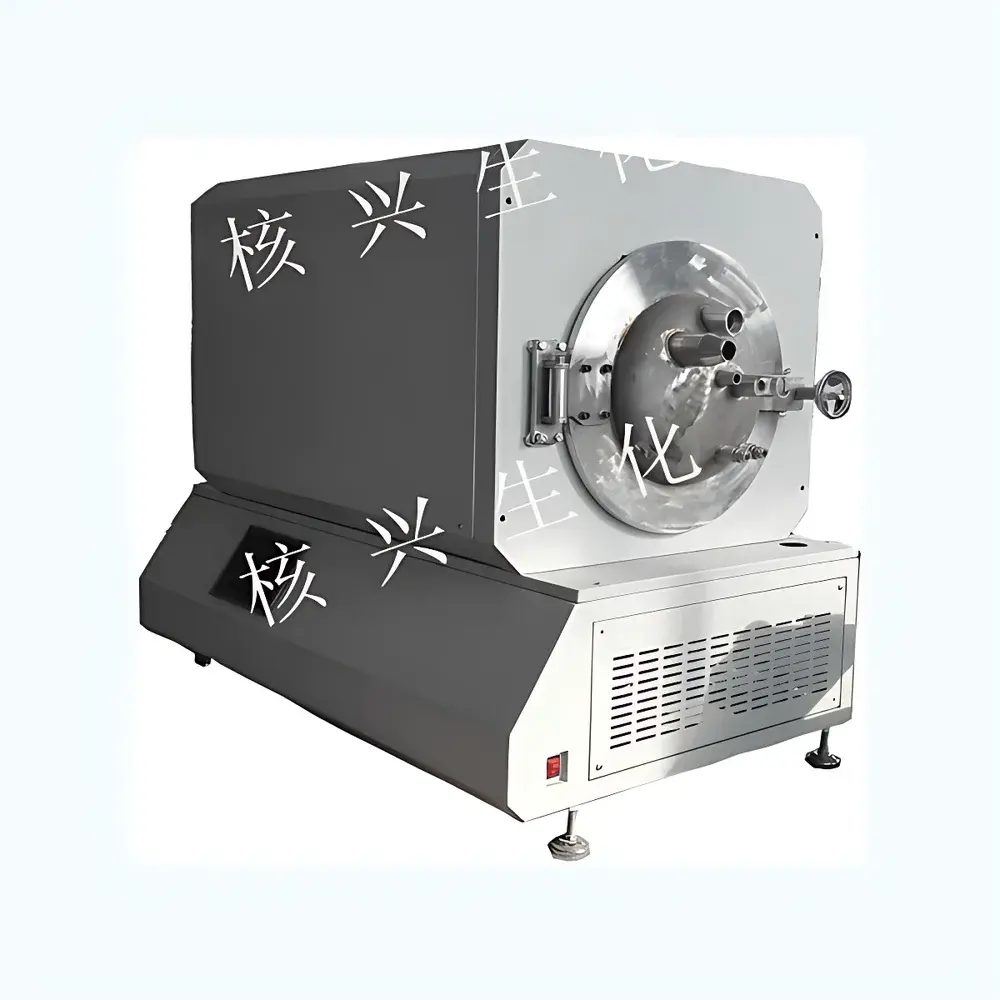
HEXING BIOCHEMICAL HXH-G Series High-Throughput Multi-Environment Microwave Ashing System
| Key | Brand: HEXING BIOCHEMICAL |
|---|---|
| Model | HXH-G3A / HXH-G6B / HXH-G9B |
| Microwave Power | 0–4.8 kW / 0–9.6 kW / 0–14.4 kW (2450 MHz, continuously adjustable) |
| Cavity Volume | 65 L (single-tube) / 2×65 L (dual-tube) / 3×65 L (triple-tube) |
| Sample Capacity | 3×2 L crucibles (single-environment) / 6×2 L crucibles (dual-environment) / 9×2 L crucibles (tri-environment) |
| Temperature Range | 0–1200 °C (thermocouple feedback) |
| Safety Compliance | GB 4706.21-2008, GB 5959.6-2008 |
| Operating Atmosphere | Air or user-defined gas inlet with adjustable positive/negative pressure control |
| Exhaust | Integrated Venturi-based negative-pressure exhaust system |
| Control System | PLC-based intelligent controller with color touchscreen, multi-step programmable protocols, real-time temperature/time curve logging, USB data export |
| Surface Temp | <50 °C |
| Microwave Leakage | <5 mW/cm² (per national standard) |
Overview
The HEXING BIOCHEMICAL HXH-G Series High-Throughput Multi-Environment Microwave Ashing System is an engineered solution for radioanalytical sample preparation in nuclear environmental monitoring and radiological health laboratories. Unlike conventional resistive muffle furnaces or sequential drying-carbonization-ashing workflows, this system employs volumetric microwave dielectric heating at 2450 MHz to achieve rapid, uniform thermal processing of biological matrices—including animal tissues, plant matter, cereals, seafood, dairy products, soil suspensions, and airborne particulate filters. Its core design principle centers on simultaneous, independent thermal treatment of multiple heterogeneous samples under precisely controlled atmospheric and thermal conditions—enabling full compliance with time-critical batch processing requirements in regulatory radiation monitoring programs. The system integrates three classical pretreatment stages—moisture removal, organic carbonization, and mineral ashing—into a single sealed quartz-lined cavity, minimizing radionuclide volatilization losses (e.g., 137Cs, 90Sr, 210Po) through internal condensate reflux and secondary pyrolysis pathways.
Key Features
- Patented microwave ashing architecture (ZL201721881531.1), combining microwave-assisted drying, carbonization, and ashing with integrated fume management
- Modular multi-environment configuration: HXH-G3A (3 crucibles, single-zone), HXH-G6B (6 crucibles, dual-zone), HXH-G9B (9 crucibles, triple-zone)—each zone independently controllable for temperature, atmosphere, and ramp rate
- Sealed high-purity fused quartz reaction chamber (low intrinsic radioactivity background) with internal vapor reflux geometry to retain volatile organics and reduce isotopic loss during charring
- PLC-driven precision thermal control (0–1200 °C, ±5 °C accuracy) with multi-segment programmable profiles and real-time thermocouple feedback
- Venturi-based centralized negative-pressure exhaust system compatible with optional catalytic oxidation or activated carbon filtration modules for odor and VOC abatement
- Full-spectrum safety architecture: interlocked door mechanism, stainless steel welded pressure-rated cavity, microwave leakage <5 mW/cm² (GB 5959.6-2008 compliant), surface temperature <50 °C, explosion-proof enclosure rating
- Intuitive 7-inch color touchscreen interface supporting ≥20 preloaded method templates, time-temperature curve visualization, and USB-exportable audit trails
Sample Compatibility & Compliance
The HXH-G Series accommodates diverse biological and environmental matrices requiring radiochemical analysis per Chinese national standards including GB/T 14883.1-2016 (General Principles for Radioactivity Testing in Foods), GB 16145-1995 (γ-Spectrometric Analysis of Radionuclides in Biological Samples), and GB 5749-2006 (Hygienic Standard for Drinking Water). Its modular crucible layout supports parallel processing of heterogeneous samples—e.g., meat homogenates alongside leafy vegetables or sediment slurries—without cross-contamination or thermal interference. Each environment zone maintains independent airflow, pressure, and thermal setpoints, ensuring optimal decomposition kinetics for lipid-rich versus cellulose-dominant substrates. The system meets electrical and microwave safety requirements outlined in GB 4706.21-2008 and GB 5959.6-2008, and its data logging functionality supports GLP-aligned record retention for regulatory audits.
Software & Data Management
The embedded PLC controller provides deterministic, repeatable operation via customizable multi-step protocols. Users define target temperatures, dwell times, ramp rates, and gas flow parameters for each zone. All operational parameters—including actual cavity temperature, microwave power output, elapsed time, and door status—are timestamped and stored locally. Data export is supported via USB flash drive in CSV format, enabling integration with LIMS platforms. Audit trail functionality records operator ID (if enabled), method selection, start/stop timestamps, and any parameter overrides—supporting traceability requirements aligned with ISO/IEC 17025 and FDA 21 CFR Part 11 principles for electronic records.
Applications
- Routine ashing of foodstuffs (rice, wheat, vegetables, fish, milk powder) prior to gamma spectrometry or alpha/beta counting
- High-volume processing of air filter papers, soil cores, and vegetation samples in regional radiation surveillance campaigns
- Preparation of bioassay specimens (urine, feces, blood ash) for internal dosimetry assessments
- Decomposition of iodine-impregnated charcoal cartridges used in nuclear facility stack monitoring
- Accelerated ashing of marine biota for 239+240Pu and 241Am determination by ICP-MS
- Method development for low-level radionuclide recovery optimization in complex organic matrices
FAQ
What types of biological samples are compatible with the HXH-G system?
The system is validated for solid and semi-solid biological matrices including animal tissues, plant materials, grains, seafood, dairy powders, soil, and air particulate filters. Liquid samples must be pre-concentrated or absorbed onto ash-resistant substrates prior to loading.
How does the multi-environment design improve analytical accuracy?
Independent thermal and atmospheric control per zone prevents thermal overshoot in heat-sensitive samples (e.g., iodine-rich seaweed) while maintaining sufficient residence time for refractory organics (e.g., bone collagen), thereby reducing isotopic fractionation and improving reproducibility across heterogeneous batches.
Is the system suitable for regulated environments requiring audit-ready documentation?
Yes. All process parameters are logged with timestamps and exportable in CSV format. Optional user authentication and electronic signature modules can be integrated to meet 21 CFR Part 11 requirements for electronic records and signatures.
Can the system operate under inert or oxidizing atmospheres?
Yes. The system features configurable gas inlets supporting ambient air, oxygen-enriched, or nitrogen-purged environments. Pressure mode (micro-positive or negative) is selectable per run to optimize combustion efficiency or minimize volatile loss.
What maintenance is required for long-term reliability?
Routine inspection includes quartz chamber integrity verification, thermocouple calibration (recommended annually), microwave waveguide coupling check, and exhaust filter replacement (frequency depends on sample load and optional purification module usage). No consumable parts beyond crucibles and filters are required.



