
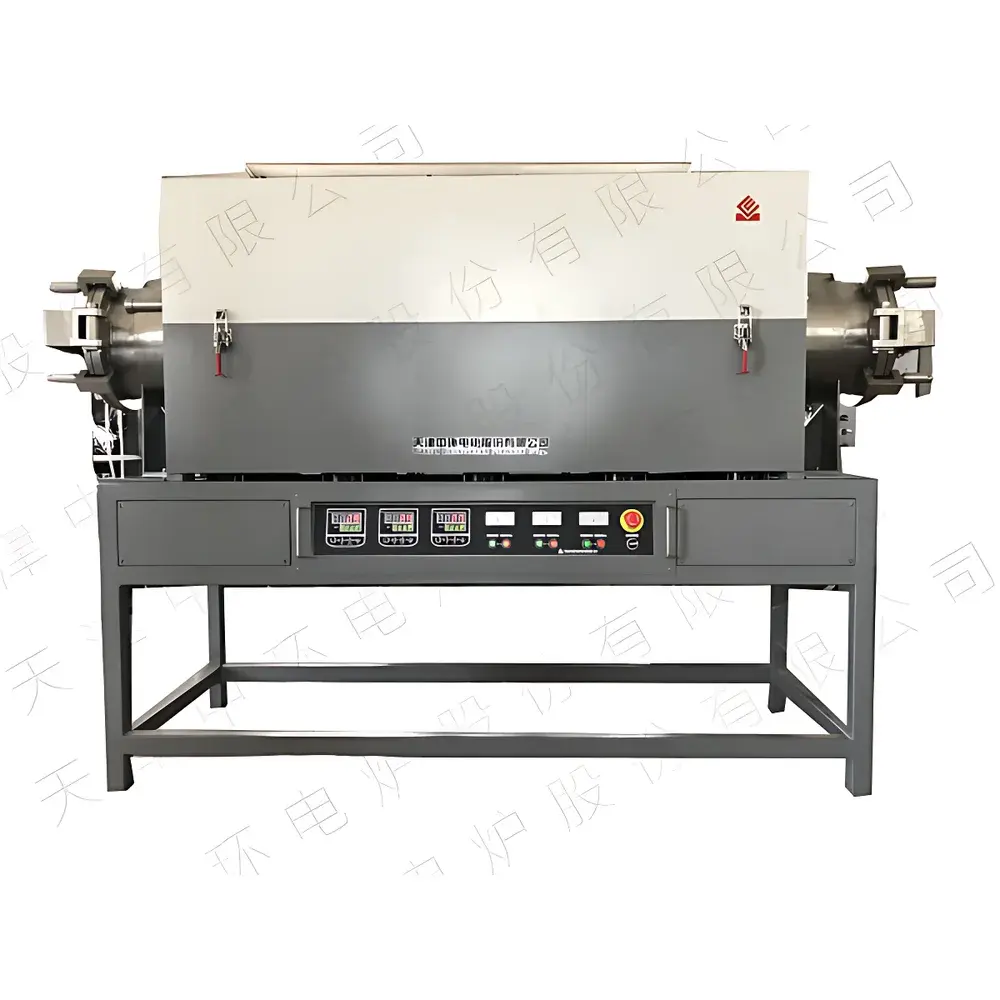
ZHONGHUAN FURNACE Custom-Built 320 mm ID Horizontal Tube Furnace
| Brand | ZHONGHUAN FURNACE |
|---|---|
| Origin | Tianjin, China |
| Manufacturer Type | Authorized Distributor |
| Country of Origin | China |
| Model | Custom-Built 320 mm ID Horizontal Tube Furnace |
| Pricing | Available Upon Request |
Overview
The ZHONGHUAN FURNACE Custom-Built 320 mm ID Horizontal Tube Furnace is a high-precision, industrial-grade thermal processing system engineered for demanding atmosphere-controlled applications requiring large-diameter sample handling. Designed around a horizontal cylindrical configuration with a nominal internal diameter of 320 mm, this furnace integrates robust thermal architecture with advanced sealing and thermal management subsystems to support continuous or batch thermal treatments—including annealing, sintering, carburizing, oxidation, reduction, and CVD/PVD precursor reactions—under inert, reducing, oxidizing, or vacuum environments. Its core heating principle relies on resistive Joule heating via high-density Kanthal A1 or SiC heating elements embedded in a multi-zone refractory assembly, enabling precise axial and radial temperature uniformity across extended work zones (up to 1200 mm heated length, configurable). The furnace operates within a standard maximum temperature range of 1200 °C (with optional 1400 °C SiC-element configuration), and is rated for long-term stability at ±1 °C under closed-loop PID control.
Key Features
- Modular Dual-Section Insulated Chamber: The furnace chamber is divided into upper and lower halves; the upper section pivots rearward for rapid access, minimizing thermal soak time during loading/unloading. The hot zone lining employs vacuum-formed polycrystalline mullite fiber modules (ASTM C892 Class 1600), delivering >50% energy savings versus conventional ceramic fiber designs while maintaining ≤±3 °C axial uniformity over 600 mm.
- Dual-Stage Cooling Sealing System: Each end flange incorporates a dual-ring water-cooled seal integrated with auxiliary forced-air convection channels. This hybrid cooling strategy maintains gasket interface temperatures below 80 °C during operation at 1200 °C, mitigating elastomer degradation and ensuring leak rates <1×10⁻⁷ mbar·L/s (He) per ISO 10816-3 verification protocols.
- Thermally Adaptive Enclosure: The outer shell utilizes layered air-gap insulation combined with real-time surface temperature monitoring (Type K thermocouples embedded in casing). When external skin temperature exceeds 50 °C, an interlocked axial exhaust fan activates automatically—reducing surface temperature to <45 °C within 90 seconds per IEC 60519-1 safety compliance requirements.
- Intelligent Programmable Temperature Controller: Equipped with a 10-inch touchscreen HMI running embedded Linux firmware, the system supports up to 30 segment ramp-hold programs, auto-tuning PID with fuzzy logic compensation, and real-time deviation alarm logging. All setpoints and profiles are stored with timestamped audit trails compliant with GLP/GMP Annex 11 data integrity expectations.
- Cryogenic Flange Cooling Integration: Optional chiller-coupled circulation (−10 °C to +25 °C, ±0.3 °C stability) interfaces directly with stainless-steel flange manifolds, suppressing conductive heat transfer from the hot zone to static seals—extending O-ring service life by ≥3× compared to air-cooled equivalents.
Sample Compatibility & Compliance
The furnace accommodates cylindrical samples, crucibles, or reactor tubes up to 315 mm OD × 1200 mm L, compatible with quartz, alumina, silicon carbide, and high-nickel alloy substrates. It meets mechanical design standards per ASME BPVC Section VIII Div. 1 (for pressure-rated configurations), electrical safety per UL 61010-1 / IEC 61010-1, and electromagnetic compatibility per EN 61326-1. Optional vacuum compatibility extends to 10⁻³ mbar (mechanical pump) or 10⁻⁵ mbar (turbomolecular configuration), validated per ISO 20483 leakage testing methodology.
Software & Data Management
Furnace operation is managed via ZHONGHUAN’s proprietary FurnaceControl Suite v4.2, supporting local HMI interaction or remote Ethernet/Wi-Fi connectivity (Modbus TCP, OPC UA). All temperature logs, alarm events, program executions, and user authentication actions are recorded in encrypted SQLite databases with SHA-256 hashing. Export formats include CSV, PDF reports, and XML metadata bundles suitable for LIMS integration. Full 21 CFR Part 11 compliance is achievable with optional electronic signature module and role-based access control (RBAC) configuration.
Applications
This system serves R&D and production-scale processes in materials science (e.g., graphene growth on Cu/Ni foils), battery cathode calcination (NMC, LFP), catalyst activation (Pt/Al₂O₃, Ni/MgO), semiconductor substrate annealing, and metallurgical phase transformation studies. Its large bore enables uniform heating of multi-sample carriers or custom-designed reaction boats—critical for reproducible kinetics validation per ASTM E2070 and ISO 11358 thermal analysis guidelines.
FAQ
What maximum operating temperature is certified for continuous use?
Continuous operation is certified to 1200 °C using Kanthal A1 heating elements; 1400 °C capability requires SiC element upgrade and modified insulation package.
Is vacuum-tight configuration available as standard?
Standard configuration achieves 10⁻² mbar base pressure; high-vacuum options (10⁻⁵ mbar) require turbomolecular pumping station integration and metal-sealed CF flanges.
Can the furnace be integrated into an automated process line?
Yes—digital I/O ports (8 DI/DO), analog 4–20 mA outputs, and full Modbus TCP support enable seamless PLC-level synchronization with conveyors, gas cabinets, or mass flow controllers.
What maintenance intervals are recommended for the water cooling system?
Closed-loop chiller circuits require biannual deionized water replacement and filter inspection; open-loop systems demand quarterly descaling per ASTM D4582 guidelines.
Are calibration certificates traceable to NIST or CNAS standards provided?
Factory calibration reports (as-shipped) include NIST-traceable thermocouple verification; CNAS-accredited on-site calibration is available upon request.



