
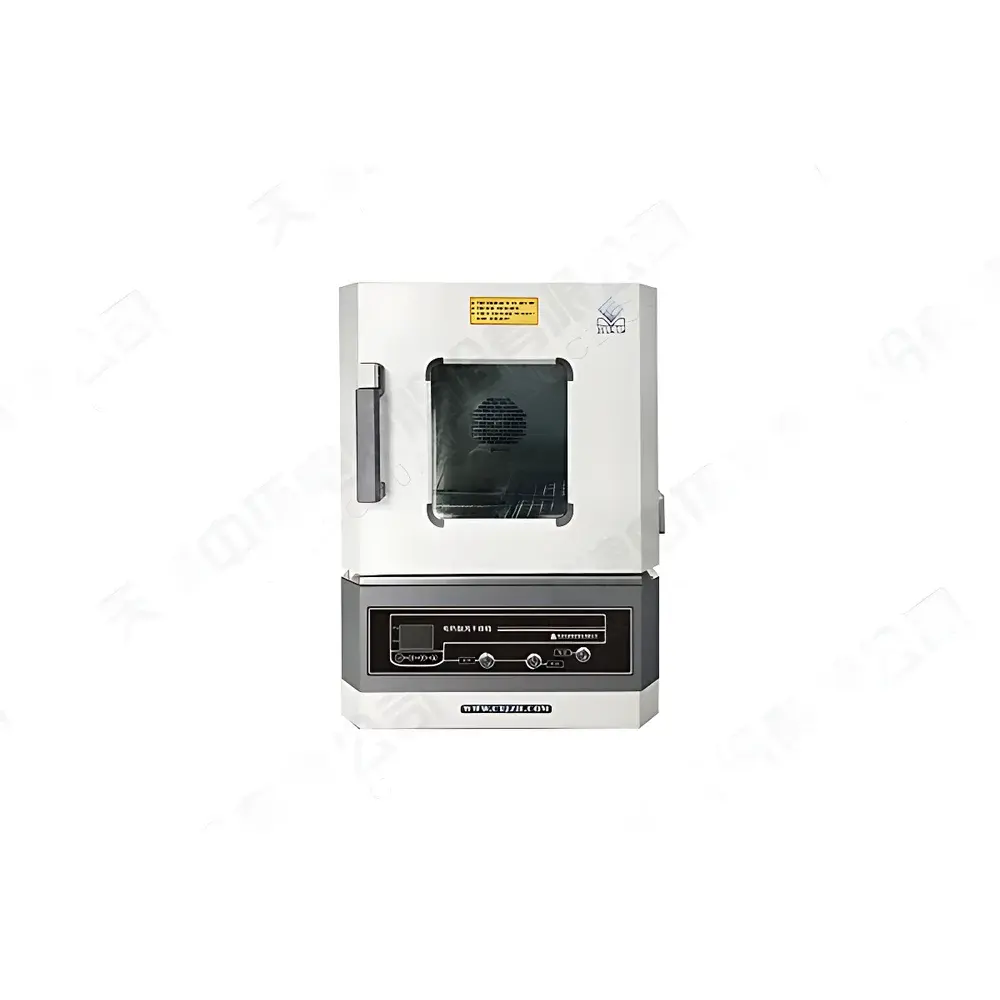
Zhonghuan Furnace DHG Series Forced-Air Drying Oven
| Brand | Zhonghuan Furnace |
|---|---|
| Origin | Tianjin, China |
| Model | DHG Series |
| Temperature Range | +10–250 °C |
| Temperature Uniformity | ≤ ±1 °C (at 100 °C, steady state) |
| Chamber Dimensions (W×D×H) | 350 × 350 × 350 mm |
| External Dimensions (W×D×H) | 508 × 530 × 785 mm |
| Interior Material | 304 Stainless Steel |
| Heating Method | Electric Resistive Heating with Axial Fan Circulation |
| Application Class | General-Purpose Laboratory Drying & Thermal Stabilization Oven |
Overview
The Zhonghuan Furnace DHG Series Forced-Air Drying Oven is a precision-engineered laboratory thermal processing instrument designed for reliable, repeatable drying, preheating, moisture removal, thermal stabilization, and low-temperature sterilization applications. It operates on the principle of convective heat transfer enhanced by a high-efficiency axial fan that continuously circulates heated air throughout the chamber—ensuring rapid thermal equilibration and minimizing spatial temperature gradients. Unlike natural convection ovens, the forced-air architecture delivers superior temperature uniformity (≤ ±1 °C at 100 °C under steady-state conditions), making it suitable for applications where thermal consistency across sample batches is critical—such as gravimetric moisture analysis per ASTM D2231, residual solvent determination in pharmaceutical intermediates (USP ), or thermal aging of polymer specimens (ISO 188). The oven’s operational range spans from ambient +10 °C to a maximum of 250 °C, supporting both routine QC workflows and extended thermal conditioning protocols.
Key Features
- Forced-air convection system: Integrated rear-mounted axial fan with adjustable airflow rate ensures homogeneous temperature distribution and reduces chamber recovery time after door opening.
- 304 stainless steel interior chamber: Corrosion-resistant, non-porous surface resists oxidation, facilitates cleaning, and eliminates particulate shedding—critical for ISO/IEC 17025-compliant laboratories.
- Dual-sensor temperature control: Independent Pt100 RTD sensors for process monitoring and over-temperature safety cutoff (settable up to 270 °C), compliant with IEC 61010-1 safety requirements.
- Microprocessor-based PID controller: Enables precise setpoint programming, ramp/soak profiles, and real-time deviation tracking with 0.1 °C resolution.
- Robust mechanical construction: Double-wall insulated cabinet with mineral wool insulation minimizes external surface temperature rise and improves energy efficiency.
- Standard safety certifications: CE-marked; conforms to EN 61000-6-3 (EMC) and EN 61000-6-2 (immunity); optional factory-installed data logger available for 21 CFR Part 11–compliant audit trails.
Sample Compatibility & Compliance
The DHG Series accommodates standard laboratory glassware (e.g., weighing bottles, Petri dishes, crucibles), metal trays, and ceramic sample holders within its 350 × 350 × 350 mm working volume. Its design supports compliance with multiple international testing standards—including ASTM E145 (standard specification for gravity-convection and forced-ventilation ovens), ISO 12100 (risk assessment for machinery), and GLP/GMP Annex 15 requirements for equipment qualification (IQ/OQ/PQ). When used for moisture content determination per AOAC 950.46 or USP , the oven meets repeatability criteria for weight-loss-on-drying (WLOD) assays. Optional calibration certificates traceable to NIST standards are available upon request.
Software & Data Management
The DHG Series operates via an embedded touch-interface controller with local data logging capability (up to 10,000 timestamped records, including setpoint, actual temperature, elapsed time, and alarm events). For integrated laboratory informatics, RS485 Modbus RTU output enables connection to LIMS or SCADA systems. An optional USB data export module allows CSV-formatted reports compatible with Excel, JMP, or Python-based statistical analysis pipelines. All logged data include operator ID fields, event timestamps with millisecond resolution, and configurable digital signatures—supporting ALCOA+ data integrity principles required under FDA and EMA regulatory frameworks.
Applications
- Drying of soil, sediment, and plant tissue samples prior to elemental analysis (EPA Method 3050B, ISO 11464)
- Moisture content determination in food, feed, and pharmaceutical raw materials (AOAC, USP, Ph. Eur.)
- Thermal conditioning of electronic components and PCB substrates before solderability testing (IPC-TM-650 2.6.25)
- Pre-baking of filter membranes and chromatography media to remove adsorbed volatiles
- Low-temperature depyrogenation of glassware in non-sterile manufacturing environments
- Aging studies of elastomers and thermoplastics per ASTM D573 and ISO 188
FAQ
Is this oven suitable for sterilization at 180 °C?
It is not validated for microbial sterilization per ISO 17665; however, it may be used for dry-heat depyrogenation of glassware when operated at ≥ 180 °C for ≥ 3 hours, subject to user-defined validation.
Can the temperature uniformity be verified independently?
Yes—chamber mapping per ASTM E2297 is supported using up to 9 calibrated thermocouples; the controller accepts external input for real-time multi-point monitoring.
What maintenance intervals are recommended?
Fan lubrication every 12 months, door gasket inspection quarterly, and annual calibration verification using a NIST-traceable reference thermometer.
Does the oven support programmable ramp-and-soak cycles?
Yes—the standard controller includes 8-segment ramp/soak functionality with independent time/temperature parameters per segment.
Is remote monitoring possible without third-party hardware?
Not natively; however, Modbus RTU integration enables seamless connectivity to existing building management or lab automation platforms.



