
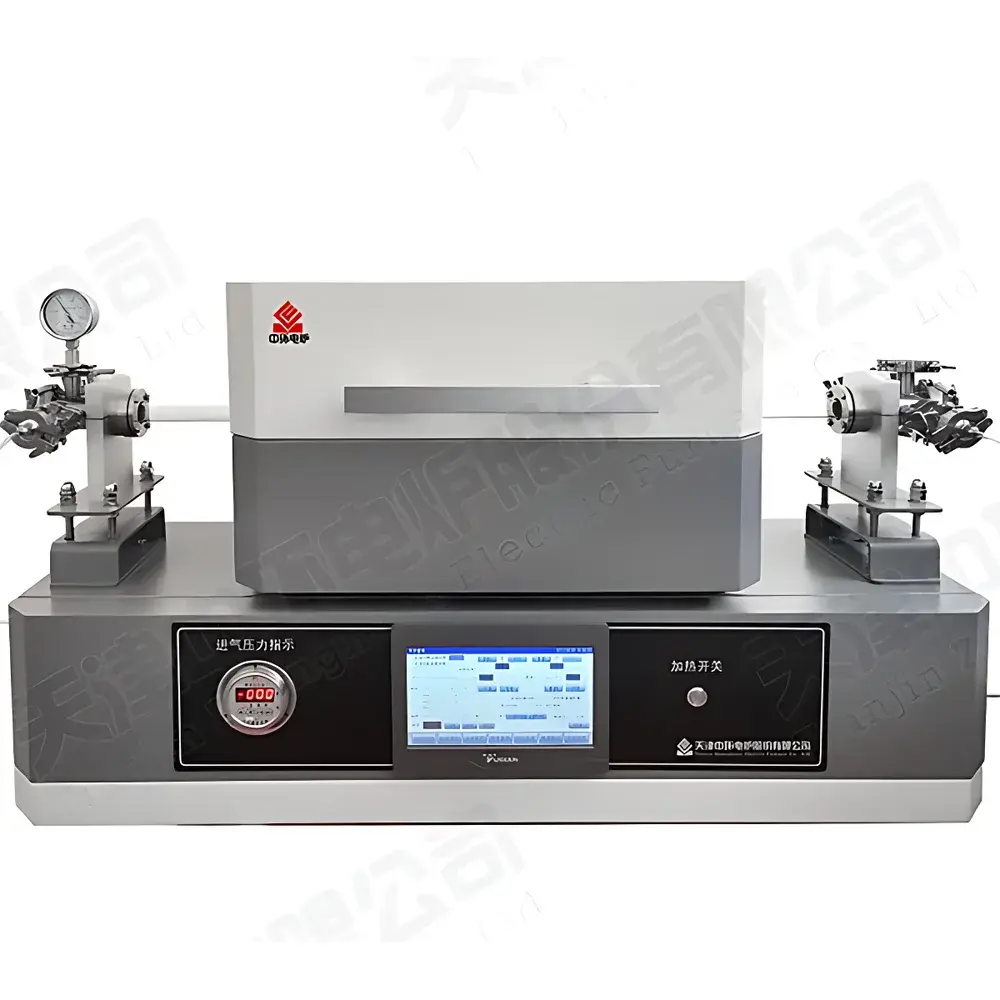
Zhonghuan Furnace ZHK-G02126K-ZL2 Bidirectional Gas-Flow Synthesis System for 2D Materials
| Brand | Zhonghuan Furnace |
|---|---|
| Origin | Tianjin, China |
| Model | ZHK-G02126K-ZL2 |
| Quartz Tube Diameter | Φ25 mm or Φ50 mm |
| Heating Zone Length | 420 mm |
| Uniform Temperature Zone Length | 200 mm |
| Furnace Dimensions | 580 × 1120 × 650 mm |
| Power | 2 kW (Heating Section: 1.5 kW) |
| Voltage | 220 V |
| Temperature Zone | Single-zone |
| Maximum Rated Temperature | 1200 °C |
| Operating Temperature Range | ≤1100 °C |
| Heating Element | 0Cr27Al7Mo2 High-Resistance Alloy Wire |
| Furnace Liner | Vacuum-formed Fibrous Insulation |
| Chamber Structure | Split-type (Top/Bottom Opening) |
| Temperature Control | 9-inch Touchscreen with 30-Stage Programmable Ramp/Soak Profiles |
| Control Accuracy | ±1.0 °C |
| Recommended Heating Rate | ≤10 °C/min (0–1000 °C), ≤5 °C/min (1000–1200 °C) |
| Thermocouple | K-type (1 unit) |
| Sealing | Dual-ring Flange with Quick-Clamp Coupling |
| Exhaust & Cooling | Thermal-sensing Fan Activation at Surface Temperature ≥50 °C |
| Standard Gas Train | 1× Mass Flow Controller, 4× Manual Ball Valves, 4× Solenoid Valves, 1× Pressure Relief Valve, 1× Custom Dual-Flange Assembly, 1× Quartz Tube, 1× Quartz Boat, 2× Quartz Plugs, 1× High-Temperature Glove, 1× Handling Hook |
Overview
The Zhonghuan Furnace ZHK-G02126K-ZL2 Bidirectional Gas-Flow Synthesis System is an engineered platform designed for the controlled, reproducible synthesis of transition metal dichalcogenide (TMD) monolayers and few-layer thin films—including WS₂, WSe₂, MoS₂, and related 2D compounds—via a dual-directional gas delivery architecture. Unlike conventional horizontal tube furnaces employing unidirectional carrier gas flow, this system implements synchronized, counter-directed gas streams: one delivering precursor vapors from the source zone toward the substrate, and another introducing inert or reactive auxiliary gas from the opposite end to modulate local partial pressure, residence time, and thermal gradient at the growth interface. This hydrodynamic control enables precise regulation of nucleation onset, lateral domain expansion kinetics, and defect suppression—critical parameters governing crystallographic orientation, stoichiometric fidelity, and interlayer registry in van der Waals heterostructures.
Key Features
- Split-chamber furnace design with top/bottom hinged access for rapid loading/unloading of substrates and precursors without thermal cycling interruption.
- Dual-ring flanged quartz tube assembly with quick-clamp coupling ensures leak-tight vacuum integrity (<10⁻² mbar achievable with optional pump) and repeatable mechanical alignment across runs.
- Programmable 30-stage temperature profile controller (9-inch touchscreen HMI) supports complex ramp-hold-cool sequences with independent setpoint resolution of 1 °C and temporal resolution of 1 second.
- Thermally adaptive exhaust system activates cooling fans only when external furnace surface reaches ≥50 °C, minimizing energy waste while maintaining operator safety and ambient thermal stability.
- Integrated gas train includes calibrated mass flow controller (MFC) with ±1% full-scale accuracy, four solenoid valves for automated gas switching, and redundant manual ball valves for maintenance-safe isolation.
- Fibrous vacuum-formed insulation delivers uniform radial thermal distribution, achieving ±1.5 °C axial uniformity over the 200 mm isothermal zone at 1000 °C.
Sample Compatibility & Compliance
The system accommodates standard 10–25 mm diameter wafers (SiO₂/Si, sapphire, quartz) and flexible substrates up to 50 mm length. Quartz tube options (Φ25 mm and Φ50 mm) allow scalability from R&D-scale monolayer screening to small-batch heterostructure fabrication. All wetted components—including quartz boat, plugs, and tubing—are ASTM F75 compliant for semiconductor-grade purity. The furnace control firmware logs timestamped temperature, valve state, and MFC output data with audit-trail capability, supporting GLP-compliant record retention per ISO/IEC 17025 requirements. Optional integration with LabVIEW or Python-based SCADA enables 21 CFR Part 11–compliant electronic signatures and user-access-level permissions.
Software & Data Management
Local operation is managed via embedded Linux-based controller with real-time graphical display of thermocouple feedback, MFC setpoints, and valve actuation status. System-generated log files (CSV format) include columnar timestamps, actual vs. target temperatures, flow rates, and alarm events—exportable via USB or Ethernet. Remote monitoring is supported through Modbus TCP protocol for integration into centralized facility management systems. Firmware updates are delivered via signed OTA packages; configuration backups can be stored on removable SD card with SHA-256 hash verification to ensure traceability.
Applications
- Growth optimization studies of TMD monolayers under varied sulfur/selenium partial pressures and temperature gradients.
- Investigation of edge-controlled nucleation mechanisms using spatially resolved precursor injection.
- Co-evaporation synthesis of vertical TMD/MXene or TMD/h-BN heterostructures requiring sequential, non-interfering gas environments.
- Process qualification for transfer-free device fabrication on insulating substrates compatible with back-gated FET metrology.
- Accelerated materials discovery workflows integrating in situ optical monitoring (Raman/PL coupling ports available upon request).
FAQ
What substrates are compatible with this system?
Standard rigid substrates including SiO₂(300 nm)/Si, c-plane sapphire, and fused quartz wafers (10–25 mm diameter) are fully supported. Flexible polyimide or PET substrates require custom boat fixtures and reduced ramp rates to avoid thermal delamination.
Can the system operate under vacuum or low-pressure conditions?
Yes—the dual-ring flange design achieves reliable sealing down to 10⁻² mbar with appropriate vacuum pumping (turbo-molecular pump recommended for sub-10⁻³ mbar operation). Vacuum compatibility is validated per ISO 2859-1 sampling plans.
Is remote software support available for process troubleshooting?
Zhonghuan Furnace provides Tier-2 remote diagnostics via TeamViewer-assisted session (subject to NDA), with priority response within 4 business hours during EST working days.
How is temperature uniformity verified across the heating zone?
Uniformity mapping is performed during factory acceptance testing using a 5-point NIST-traceable thermocouple array; calibration certificates are shipped with each unit.
Are consumables such as quartz tubes and boats available as spares?
Yes—quartz components are stocked globally via authorized distributors; lead time for custom-dimensioned parts is typically 4–6 weeks from order confirmation.



