
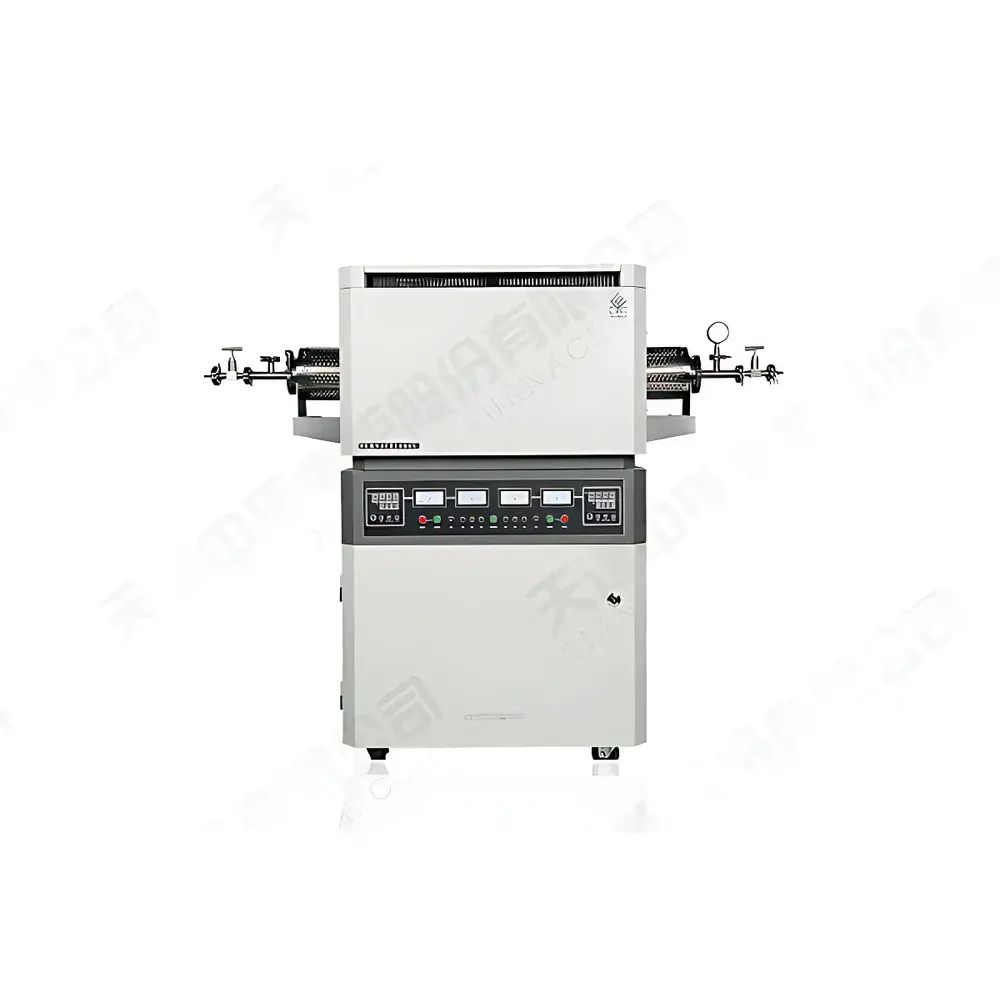
ZHONGHUAN FURNACE 1600°C Triple-Zone Vacuum & Atmosphere Tube Furnace
| Brand | ZHONGHUAN FURNACE |
|---|---|
| Origin | Tianjin, China |
| Model | 1600°C Triple-Zone Vacuum & Atmosphere Tube Furnace |
| Maximum Temperature | 1600°C |
| Temperature Control Accuracy | ±1°C |
| Rated Power | 8 kW |
| Heating Rate (to max temp) | ≤5°C/min below 500°C |
| Heating Element | Silicon Molybdenum (MoSi₂) Rods |
| Internal Chamber Dimensions | 530 × 835 × 1425 mm (W × H × L) |
| Furnace Type | Horizontal Tube Furnace |
| Vacuum & Atmosphere Compatibility | Yes |
| Control Interface | RS-485 for PC connectivity |
| Programmable Stages | 50 segments (domestic controller), 40 segments (imported controller) |
| Safety Features | Over-temperature cutoff, earth-leakage protection |
| Insulation Material | Polycrystalline mullite fiber vacuum-formed board |
Overview
The ZHONGHUAN FURNACE 1600°C Triple-Zone Vacuum & Atmosphere Tube Furnace is a precision-engineered horizontal resistance furnace designed for high-temperature thermal processing under controlled vacuum or reactive/inert gas environments. It employs three independently controlled heating zones—each with dedicated MoSi₂ heating elements and thermocouple feedback—to establish highly uniform axial temperature profiles across the 1425 mm tube length. This architecture enables precise thermal gradient control, critical for processes such as crystal growth, sintering of advanced ceramics, annealing of semiconductor wafers, and synthesis of carbon nanomaterials. The furnace operates on the principle of resistive Joule heating within a sealed quartz or high-purity alumina tube, where heat transfer occurs via conduction through the tube wall and radiation/convection within the chamber. Its design conforms to fundamental thermal engineering requirements for reproducible high-temperature experimentation in R&D and pilot-scale materials development.
Key Features
- Triple-zone independent temperature control ensures axial thermal uniformity (±2°C over 300 mm zone length at 1600°C) and programmable thermal gradients.
- Quick-connect dual-ring flange system eliminates conventional bolted法兰 assembly—reducing installation time by >70% and minimizing mechanical stress on fragile quartz or ceramic tubes.
- Vacuum-tight sealing rated to ≤1×10⁻³ Pa (with optional turbomolecular pump) and compatible with continuous gas flow (N₂, Ar, H₂, forming gas, NH₃) via mass flow controllers (MFCs) or precision needle valves.
- Polycrystalline mullite fiber insulation reduces standby heat loss by ~50% versus traditional ceramic fiber, improving energy efficiency and surface safety.
- Intelligent PID + fuzzy logic temperature controller with auto-tuning, 50-segment programmable ramp/soak profiles, and real-time deviation monitoring.
- Integrated safety architecture includes dual redundant over-temperature cutoff (hardware limit switch + software trip), Class I earth-leakage circuit breaker, and automatic surface-cooling fan activation at ≥50°C external skin temperature.
Sample Compatibility & Compliance
The furnace accommodates standard OD 60–120 mm quartz or high-purity alumina tubes (custom lengths up to 1500 mm). Sample holders include graphite, molybdenum, or ceramic crucibles rated to 1600°C. Gas inlet/outlet ports support ISO-KF25 or CF35 vacuum fittings. The system meets structural and electrical safety requirements per IEC 61000-6-3 (EMC) and IEC 61000-6-4, and complies with general laboratory equipment provisions under ISO/IEC 17025:2017 for method validation contexts. When configured with validated data logging (via RS-485 + compliant SCADA software), it supports GLP/GMP-aligned process documentation for materials qualification under ASTM C1171 (carbon fiber), ISO 11507 (UV/weathering simulation pre-treatment), or USP sterile material thermal sterilization protocol development.
Software & Data Management
Equipped with RS-485 Modbus RTU interface, the furnace integrates with industry-standard SCADA platforms (e.g., Ignition, WinCC, LabVIEW) for centralized monitoring of up to 200 units. Local control options include optional 7-inch color TFT touchscreen with multilingual UI (English default), displaying real-time curves, historical trend overlays, alarm logs with timestamps, and exportable CSV reports. All temperature setpoints, actual readings, ramp rates, and fault events are timestamped with millisecond resolution. Audit trail functionality satisfies FDA 21 CFR Part 11 requirements when paired with validated electronic signature modules and role-based access controls.
Applications
This furnace serves core thermal processing needs in academic and industrial laboratories: solid-state synthesis of perovskite oxides and battery cathode precursors (e.g., NMC, LiFePO₄); graphitization and purification of carbon nanotubes/fibers; diffusion bonding of SiC composites; low-pressure chemical vapor deposition (LPCVD) precursor pyrolysis; annealing of thin-film photovoltaic stacks (CIGS, CZTS); and controlled oxidation/reduction studies of metal-organic frameworks (MOFs). Its triple-zone capability is particularly valuable for zone refining, directional solidification, and multi-step thermal protocols requiring sequential atmosphere switching (e.g., carburizing → quenching → tempering simulation).
FAQ
What vacuum level can this furnace achieve?
With standard mechanical pump: ≤5×10⁻² Pa. With optional two-stage rotary vane + turbomolecular pump package: ≤1×10⁻⁴ Pa.
Is the furnace compatible with hydrogen atmospheres?
Yes—when equipped with leak-tested stainless-steel gas lines, explosion-proof solenoid valves, and H₂-compatible seals (Viton not recommended; Kalrez or metal-CF gaskets required).
Can I replace the heating elements myself?
MoSi₂ rods are field-replaceable using standard torque tools; full replacement procedure and calibration verification steps are documented in the technical manual.
Does the system support remote diagnostics?
Yes—via Modbus TCP gateway integration, enabling live parameter readout, firmware update push, and predictive maintenance alerts based on heater resistance drift trends.
What tube materials are certified for use at 1600°C?
High-purity fused quartz (up to 1100°C), recrystallized alumina (up to 1650°C), and silicon carbide (up to 1700°C) tubes—each requiring matching flange gasket material and thermal expansion compensation.



