
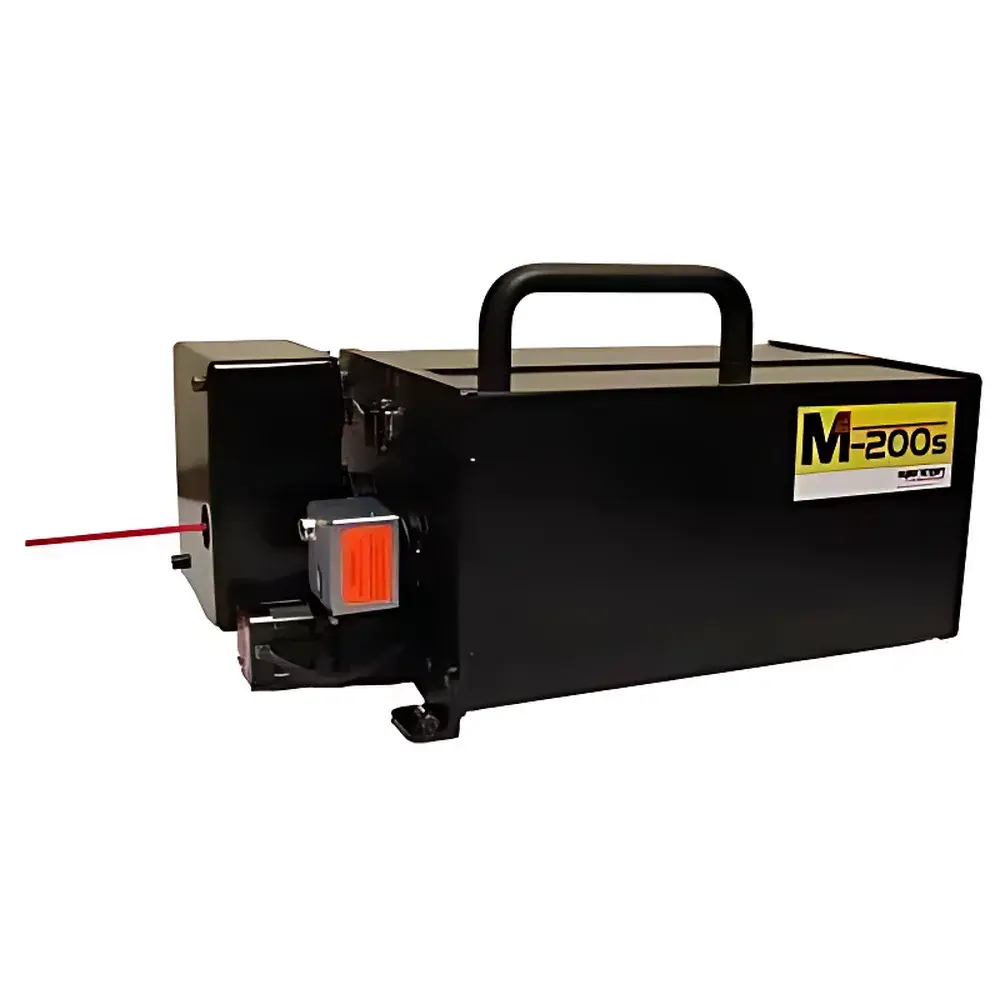
Spiricon M2-200 and M2-200s Automated Laser Beam Propagation Analyzer
| Brand | Spiricon |
|---|---|
| Origin | USA |
| Model | M2-200 / M2-200s |
| Compliance | ISO 11146-1:2005 & ISO 11146-2:2005 |
| Measurement Principle | ISO-compliant beam propagation analysis via variable-plane beam profiling |
| Calibration Technology | Ultracal™ baseline correction |
| Beam Type Support | CW and pulsed lasers |
| Acquisition Speed | Full M² measurement in ≤120 seconds |
| Optical Architecture | Fixed focusing lens + dual motorized mirror scanning on precision linear rail |
| Data Output | M² factor, beam waist diameter (d₀), Rayleigh range (zᵣ), divergence angle (θ), beam parameter product (BPP), kurtosis (M⁴), centroid trajectory |
Overview
The Spiricon M2-200 and M2-200s Automated Laser Beam Propagation Analyzers are engineered for rigorous, standards-based characterization of laser beam quality in industrial, scientific, and defense-grade optical systems. These instruments implement the ISO 11146-1:2005 and ISO 11146-2:2005 methodology—defining M² as the ratio of a real beam’s beam parameter product (BPP) to that of an ideal diffraction-limited TEM₀₀ Gaussian beam. Unlike manual or semi-automated approaches, the M2-200 series employs a fixed-lens, dual-mirror scanning architecture: a collimated input beam passes through a stationary focusing lens, while two high-precision motorized mirrors translate along a calibrated optical rail to position the imaging sensor at discrete axial locations between near-field (z ≈ z₀) and far-field (z ≥ 2zᵣ). This enables acquisition of ≥30 beam profiles across the propagation axis without mechanical repositioning of the lens or camera—ensuring spatial repeatability and minimizing alignment drift.
Key Features
- ISO 11146-compliant automated M² measurement cycle completed in ≤120 seconds, including profile acquisition, power normalization, and full Gaussian fit analysis
- Ultracal™ patented baseline correction algorithm—dynamically subtracts thermal, electronic, and ambient noise from each frame prior to centroid and second-moment calculation, improving measurement reproducibility to ±0.03 M² (typ.) under controlled lab conditions
- Integrated neutral density wheel with motorized attenuation control—auto-adjusts optical density based on incident power level to maintain sensor linearity and avoid saturation across power ranges from 10 µW to >5 W (with optional accessories)
- Dual configuration support: M2-200 optimized for CW lasers; M2-200s enhanced with synchronized external trigger input for precise pulse-to-pulse profiling of Q-switched and mode-locked sources (repetition rates 1 Hz–10 kHz)
- Rugged aluminum optical bench with kinematic mirror mounts and temperature-stabilized rail drive—designed for long-term stability in production environments subject to vibration and ambient thermal fluctuation
Sample Compatibility & Compliance
The M2-200/M2-200s supports laser sources operating from UV (193 nm) to FIR (10.6 µm), provided appropriate sensor options (Si, InGaAs, or pyroelectric array) are selected. It accommodates beam diameters from 100 µm to 12 mm at the focus plane and divergence angles from 0.1 to 20 mrad. All firmware and analysis routines adhere to ISO/IEC 17025 traceability requirements when used with NIST-traceable calibration artifacts. The system is validated for use in FDA-regulated laser manufacturing workflows requiring documented audit trails, and its software architecture supports GLP/GMP-aligned data integrity protocols—including user access control, electronic signatures, and 21 CFR Part 11–compliant metadata logging (when deployed with Spiricon BeamGage Professional v6.5+).
Software & Data Management
Controlled exclusively via Spiricon BeamGage Professional software (v6.5 or later), the M2-200 series delivers fully automated workflow execution: auto-exposure optimization, real-time beam centroid tracking, iterative Gaussian fitting using second-moment (D₄σ) and knife-edge equivalent algorithms, and ISO-conforming M² calculation per Annex B of ISO 11146-1. Raw image stacks, calibrated intensity matrices, and full parameter history (.bga files) are stored with embedded metadata (timestamp, lens focal length, wavelength, ND filter position, ambient temperature). Export formats include CSV, HDF5, and XML for integration into LIMS or MATLAB-based optical modeling pipelines. Batch processing mode enables unattended qualification of multi-laser arrays or diode bar stacks.
Applications
- Qualification of fiber-coupled and direct-diode laser sources for materials processing (welding, cladding, additive manufacturing)
- Verification of ultrafast amplifier output stability during commissioning and preventive maintenance
- Beam quality benchmarking in laser resonator design iterations and cavity alignment optimization
- Compliance testing for Class 4 laser safety documentation (IEC 60825-1) and OEM delivery acceptance criteria
- Research-grade propagation analysis of structured light beams (e.g., Bessel, vortex, and Hermite-Gaussian modes) when paired with optional beam-shaping optics
FAQ
Does the M2-200 require recalibration after shipping or relocation?
Yes—mechanical shock or thermal cycling may affect mirror rail zero-point alignment. A full Ultracal™ baseline and ISO reference beam validation using the included HeNe laser alignment tool is recommended before first use and after any physical transport.
Can the M2-200 measure beams with non-Gaussian intensity distributions?
Yes—the D₄σ (second-moment) method used is mathematically defined for any integrable irradiance distribution. However, reported M² values assume paraxial propagation and negligible higher-order mode coupling; strongly multimode or turbulent beams require supplementary M⁴ analysis, which is supported in BeamGage Professional.
Is third-party software integration possible?
Native API support (C/C++, .NET, LabVIEW) is provided for custom automation. Raw frame buffers and calculated parameters can be streamed via TCP/IP or shared memory—enabling integration with PLC-controlled laser workstations or in-line QC systems.




