
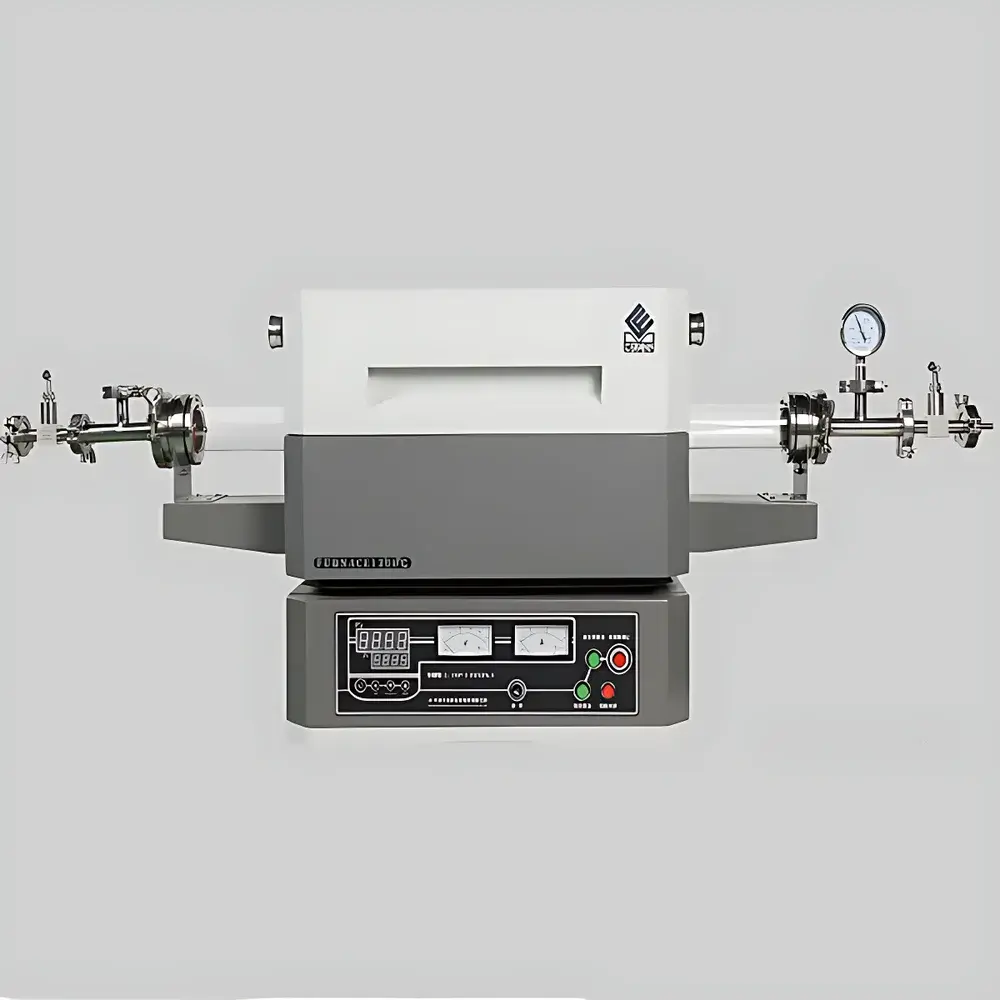
ZHONGHUAN FURNACE 1200℃ Triple-Zone Vacuum & Atmosphere Tube Furnace
| Brand | ZHONGHUAN FURNACE |
|---|---|
| Origin | Tianjin, China |
| Model | Triple-Zone Tube Furnace (1200℃) |
| Max Temperature | 1200℃ |
| Temperature Control Accuracy | ±1℃ |
| Max Power | 4.8 kW |
| Heating Rate | ≤10℃/min (0–1000℃), ≤5℃/min (1000–1200℃) |
| Heating Element | OCr27Al7Mo2 High-Resistance Alloy Wire |
| Internal Chamber Dimensions | 360 × 815 × 555 mm (W × L × H) |
| Configuration | Three Independent Heating Zones |
| Vacuum Compatibility | Yes |
| Atmosphere Control | Dual-gas inlet/outlet with micro-adjustable flow |
| Safety Features | Auto-Power-Off on Door Opening, Over-Temperature Cut-Off, Leakage Protection |
| Control System | AI-based PID + Fuzzy Logic + Self-Tuning |
| Communication Interface | RS-485 for PC connectivity and multi-furnace network control (up to 200 units) |
Overview
The ZHONGHUAN FURNACE 1200℃ Triple-Zone Vacuum & Atmosphere Tube Furnace is a precision-engineered high-temperature thermal processing system designed for controlled-atmosphere synthesis, annealing, sintering, and heat treatment under vacuum or reactive/inert gas environments. Its triple-zone architecture enables independent thermal profiling across the furnace length—critical for establishing precise axial temperature gradients in materials science applications such as crystal growth, CVD precursor decomposition, and graded thermal treatments of ceramic precursors or carbon nanomaterials. The furnace operates on the principle of resistive heating via OCr27Al7Mo2 alloy wire elements embedded in high-purity polycrystalline mullite fiber insulation, delivering uniform radial and axial temperature distribution (±1℃ stability at setpoint) and minimizing thermal lag during dynamic ramp cycles. Designed for laboratory-scale R&D and pilot-scale process development, it supports repeatable, traceable thermal protocols compliant with GLP and pre-GMP workflows.
Key Features
- Triple independent heating zones with fully decoupled PID control—enabling programmable thermal gradients up to 100℃/cm along the 815 mm hot zone.
- Quick-connect dual-flange gas interface with dual O-ring sealing (double-circuit design) ensures leak rates <1×10⁻³ mbar·L/s under vacuum and maintains atmosphere integrity during long-duration holds (e.g., 48+ hr N₂ purges).
- Modular hinged right-section furnace body rotates 110° rearward—providing unobstructed access to the entire tube interior without disassembly, reducing mechanical stress on quartz or alumina tubes.
- Intelligent surface-cooling system: integrated thermal sensors trigger variable-speed exhaust fans when external casing exceeds 50℃, maintaining operator-safe surface temperatures (<60℃) even at 1200℃ internal operation.
- Comprehensive safety architecture: hardware-interlocked door switch (instant power cutoff), redundant over-temperature limiters (independent thermocouple + digital cut-off), and Class I earth-leakage detection per IEC 61000-4-5.
- RS-485 Modbus RTU interface supports centralized monitoring and control of up to 200 furnaces via SCADA or custom LabVIEW/Python-based platforms—with full audit trail logging of setpoints, actual temperatures, alarms, and power states.
Sample Compatibility & Compliance
The furnace accommodates standard OD 60–100 mm quartz, alumina, or silicon carbide tubes (max 800 mm usable length). Its internal chamber (360 × 815 × 555 mm W × L × H) permits horizontal placement of crucibles, boats, or substrate holders with ample clearance for gas flow uniformity. Vacuum compatibility extends from rough vacuum (10⁻² mbar) to high vacuum (10⁻⁴ mbar) when paired with optional turbomolecular pumping systems. Atmosphere control supports inert (Ar, N₂), reducing (H₂/N₂ mixtures), oxidizing (O₂-diluted air), and corrosive (NH₃, CO) gases—compatible with ASTM E29-23 for thermal calibration traceability and ISO 17025-compliant uncertainty budgets when used with NIST-traceable Type S or K thermocouples. All electrical components meet CE/EMC Directive 2014/30/EU and RoHS 2011/65/EU requirements.
Software & Data Management
The embedded controller firmware supports 50-segment programmable ramp-soak profiles (domestic version) or 40-segment profiles (imported controller option), with dwell times configurable from 1 second to 999 hours and rate limits adjustable in 0.1℃/min increments. Real-time data—including zone temperatures, power %, alarm status, and gas flow readings (when interfaced with MFCs)—is streamed via RS-485 to host software. Optional ZHONGHUAN DataBridge™ software provides FDA 21 CFR Part 11-compliant electronic records: user-level access control, immutable audit trails, digital signature capture, and PDF/CSV report generation for IQ/OQ documentation. Historical logs are stored locally (SD card) and remotely synchronized to network drives with SHA-256 hash verification.
Applications
- Controlled-atmosphere annealing of semiconductor wafers (SiC, GaN) and thin-film solar absorbers (CIGS, perovskites).
- Vacuum pyrolysis of polymer precursors for carbon fiber or ceramic matrix composites.
- Atmospheric CVD of graphene, MoS₂, and other 2D materials on catalytic substrates.
- Thermal reduction of metal oxides (e.g., NiO → Ni, Co₃O₄ → Co) under H₂/N₂ atmospheres.
- High-temperature phase transformation studies in battery cathode materials (NMC, LFP) under argon or oxygen-controlled environments.
- Calibration of thermocouples and reference materials per ASTM E230/E220 standards.
FAQ
What vacuum level can this furnace achieve without additional pumping equipment?
The base configuration includes a mechanical rotary vane pump capable of reaching ≤5×10⁻² mbar. For high-vacuum applications (≤1×10⁻⁴ mbar), optional turbomolecular pump integration is supported via standard KF-40 flanges.
Is the furnace compatible with hydrogen gas atmospheres?
Yes—equipped with leak-tested dual-seal flanges and H₂-rated mass flow controllers (optional), it meets EN 13445-3 requirements for low-pressure hydrogen service up to 0.1 MPa partial pressure.
Can temperature uniformity be validated across all three zones?
Yes—each zone includes dedicated Type K thermocouples with independent calibration offsets; uniformity mapping (per ASTM E220) is achievable using a 5-point traversing thermocouple probe kit (sold separately).
Does the control system support remote diagnostics and firmware updates?
Yes—the RS-485 interface enables secure remote access via industrial Ethernet gateways; firmware updates are performed via signed .bin files with CRC-32 validation to prevent unauthorized modification.



