
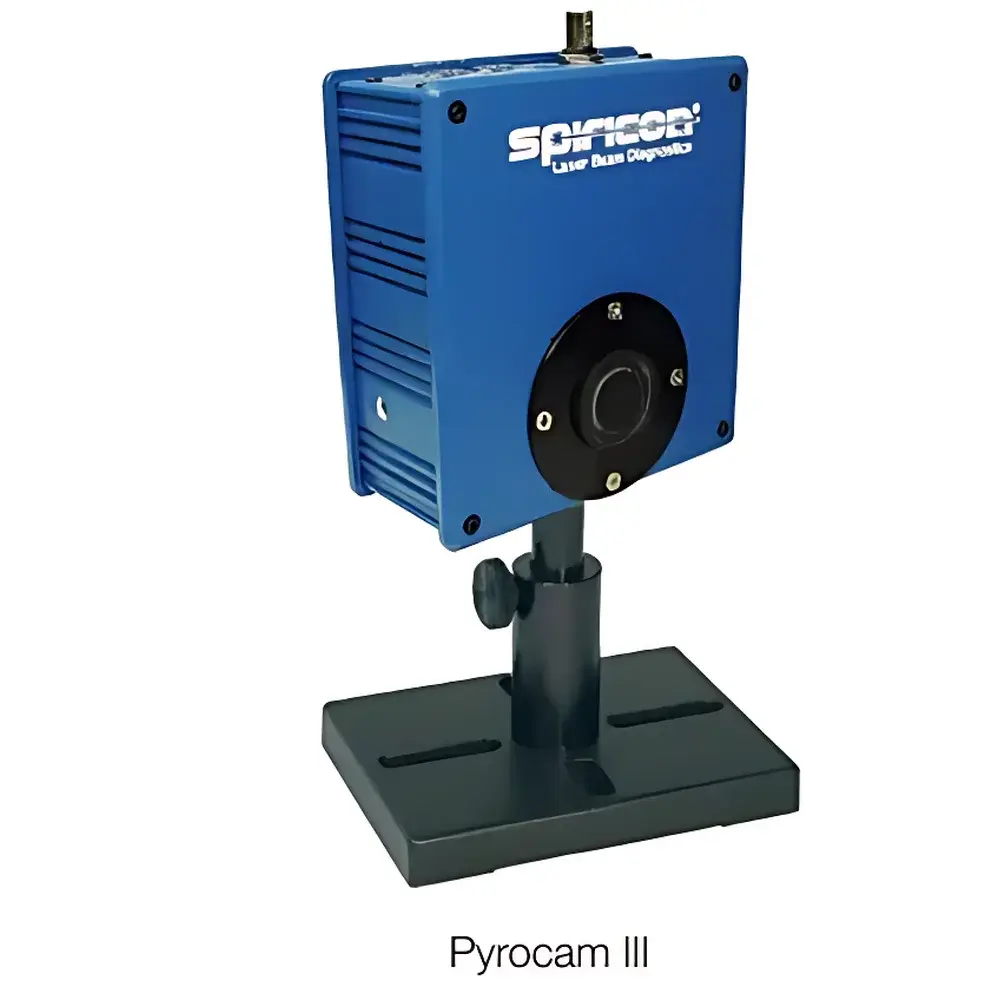
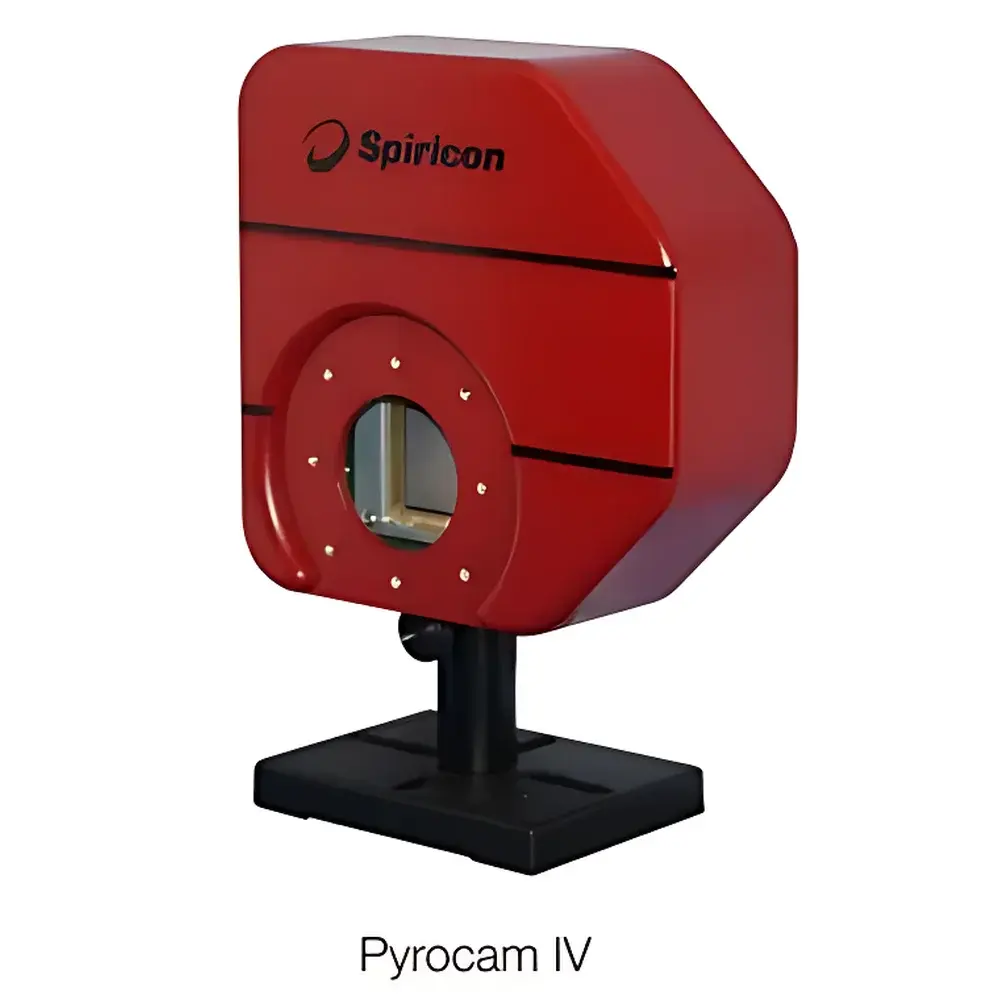
Ophir Pyrocam III / Pyrocam IV Thermopile Array Camera
| Brand | Ophir |
|---|---|
| Origin | Israel |
| Model | Pyrocam III / Pyrocam IV |
| Wavelength Range | 13–355 nm & 1.06–3000 µm |
| Detector Type | Thermopile-based 2D array |
| Interface | USB 2.0 or GigE (model-dependent) |
| Active Area | Up to 12.5 × 12.5 mm² |
| Pixel Resolution | 128 × 128 (Pyrocam III), 320 × 320 (Pyrocam IV) |
| Damage Threshold | ≥500 MW/cm² (ns pulses), ≥10 kW/cm² (CW, with optional attenuators) |
| Compliance | CE, RoHS, ISO 17025 traceable calibration available |
Overview
The Ophir Pyrocam III and Pyrocam IV are thermopile-based 2D beam profiling cameras engineered for high-dynamic-range, wavelength-agnostic spatial characterization of pulsed and continuous-wave (CW) laser sources. Unlike silicon- or InGaAs-based sensors, thermopile arrays operate on the principle of thermal absorption and Seebeck voltage generation across micro-fabricated junctions—enabling uniform responsivity across an exceptionally broad spectral range from deep ultraviolet (13 nm) through soft X-ray, vacuum UV, visible, near- and mid-infrared, up to far-infrared and THz (3000 µm). This intrinsic broadband response eliminates the need for sensor swapping or calibration recalibration when switching between CO₂ lasers (10.6 µm), excimer lasers (193–351 nm), free-electron laser (FEL) output, telecom-band sources (1310/1550 nm), and sub-millimeter THz radiation. The camera’s passive detection architecture ensures no saturation-induced nonlinearity, no quantum-efficiency roll-off, and immunity to photodiode-style damage mechanisms—making it suitable for high-peak-power nanosecond pulses and multi-kilowatt CW beams when used with calibrated neutral-density or reflective attenuators.
Key Features
- True broadband detection: Simultaneous coverage from 13 nm (EUV/XUV) to 3000 µm (THz), validated per ISO 11554 and NIST-traceable reference standards.
- High damage threshold: With appropriate attenuation, supports peak irradiances exceeding 500 MW/cm² (10 ns pulses) and average power densities up to 10 kW/cm² (CW), enabling integration into industrial laser processing lines and synchrotron/FEL beamlines.
- Two resolution tiers: Pyrocam III delivers 128 × 128 active pixels over a 12.5 × 12.5 mm² aperture; Pyrocam IV upgrades to 320 × 320 pixels with improved SNR and sub-pixel centroiding accuracy for M² and beam propagation analysis.
- Real-time frame rates: Up to 60 Hz full-frame acquisition (Pyrocam IV) with hardware-triggered synchronization for time-resolved beam diagnostics in Q-switched or mode-locked systems.
- Integrated thermal stabilization: On-board temperature regulation maintains responsivity drift < ±0.5% over 8-hour operation, critical for GLP-compliant long-duration measurements.
Sample Compatibility & Compliance
The Pyrocam series is compatible with collimated, focused, and divergent beams from gas, solid-state, fiber, and semiconductor lasers—including but not limited to CO₂, Nd:YAG, Ti:sapphire, quantum cascade, and photoconductive THz emitters. Beam diameters from 50 µm to >10 mm are accommodated via optional magnifying or reducing telescopes. All units ship with factory-applied ISO/IEC 17025-accredited calibration certificates (wavelength-specific responsivity maps and pixel non-uniformity corrections). The system meets CE marking requirements for electromagnetic compatibility (EN 61326-1) and safety (EN 61010-1). When operated with Ophir’s StarLab or BeamGage software under controlled IT infrastructure, data acquisition workflows support FDA 21 CFR Part 11 compliance—including electronic signatures, audit trails, and role-based access control.
Software & Data Management
Ophir’s BeamGage PRO and StarLab v4.x software provide full support for Pyrocam III/IV acquisition, real-time beam parameter calculation (beam width per ISO 11146, ellipticity, centroid position, kurtosis, peak-to-average ratio), and automated M² measurement when integrated with motorized translation stages and beam-expanding optics. Raw frame data is stored in HDF5 format with embedded metadata (timestamp, exposure, attenuation factor, calibration ID), ensuring FAIR (Findable, Accessible, Interoperable, Reusable) data principles. Batch processing scripts (Python API included) enable integration into automated test benches and LIMS environments. Export options include CSV, TIFF (16-bit linear), and industry-standard .LAS (Lightwave Analysis Standard) files for cross-platform optical design tool interoperability (e.g., Zemax OpticStudio, CODE V).
Applications
- Quantitative M² characterization of high-power CO₂ and FEL systems per ISO 11146-1/2, including near-field/far-field capture and iterative propagation modeling.
- THz beam profiling in time-domain spectroscopy (TDS) setups, where conventional detectors lack sensitivity or bandwidth.
- UV lithography source monitoring: Spatial uniformity assessment of excimer laser output at 193 nm and 248 nm for semiconductor mask alignment systems.
- Free-space optical communications: Mode shape verification of multimode fiber-coupled transceivers operating at 850/1310/1550 nm.
- Plasma diagnostics: Spatial mapping of EUV emission (13.5 nm) from laser-produced plasmas in next-generation lithography R&D.
FAQ
Does the Pyrocam require external cooling or water chillers?
No. The thermopile array operates at ambient temperature with integrated Peltier stabilization; no cryogenic or liquid cooling is required.
Can it measure ultrafast femtosecond pulses?
Yes—provided pulse energy is within the detector’s single-shot damage limit and temporal profile is not resolved (thermopile response is integrating, ~10 ms time constant); for temporal pulse characterization, use with autocorrelators or streak cameras is recommended.
Is NIST-traceable calibration included standard?
A base-level factory calibration certificate is included; full ISO/IEC 17025-accredited calibration with uncertainty budgets is available as an optional service.
How is beam alignment performed without visible guidance?
BeamGage includes IR-visible overlay mode using auxiliary alignment diodes (635 nm) co-aligned with the thermopile aperture; optional IR viewer accessories are also supported.
What stage compatibility exists for automated M² scans?
Ophir-certified Zaber and Newport motorized translation stages are natively supported; custom stage integration is enabled via ASCII command protocol over USB or RS-232.




