
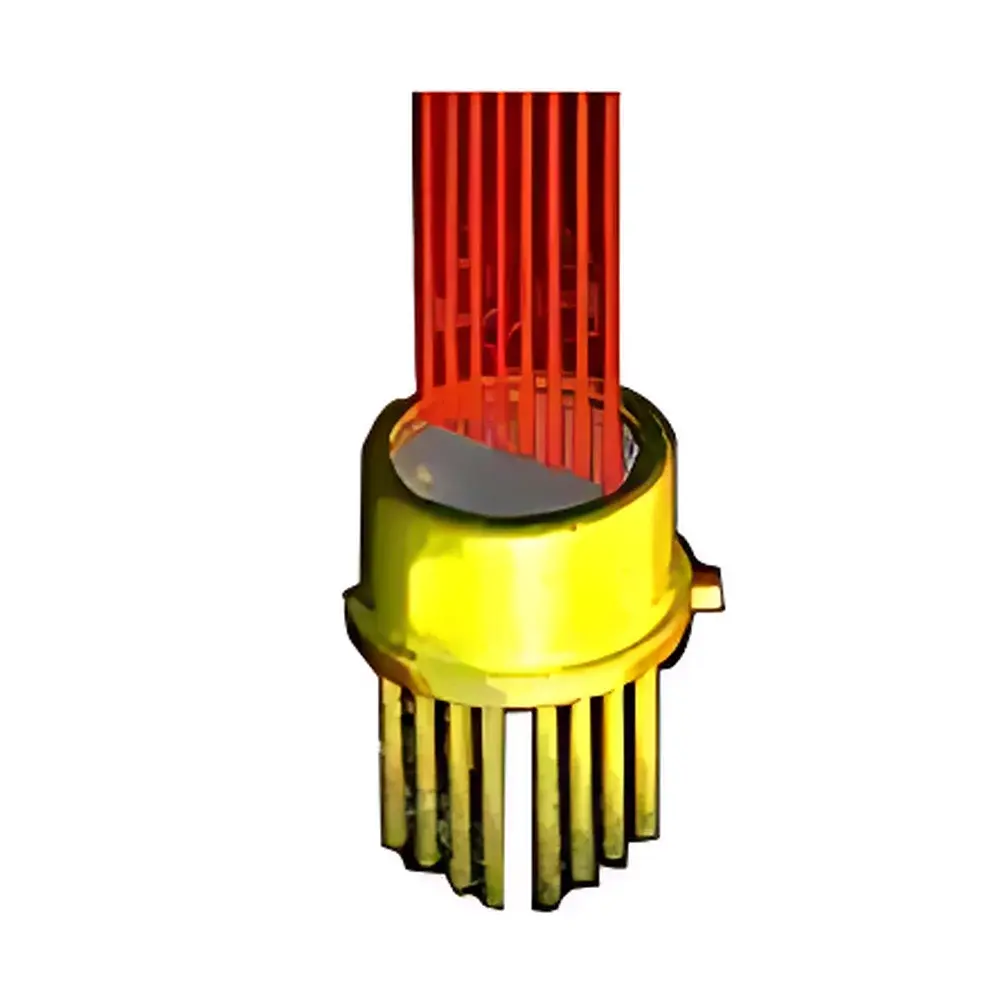
FLC PL Series Single-Mode 8-Channel Laser Diode Array
| Brand | FLC |
|---|---|
| Model | PL |
| Type | Single-Mode, Independently Addressable Laser Diode Array |
| Wavelength Options | 675 nm, 830 nm |
| Output Power | 5 mW (675 nm), 50 mW (830 nm) |
| Beam Count | 8 |
| Emitter Architecture | Monolithic Array with Individual Anode/Cathode Access |
| Construction | Hermetically Sealed TO-Can or Butterfly Package (Configurable) |
| Operating Temperature Range | −10 °C to +50 °C |
| Storage Temperature | −40 °C to +85 °C |
| Compliance | RoHS 2011/65/EU, REACH (EC) No. 1907/2006, IEC 60825-1:2014 Class 3B Laser Safety |
Overview
The FLC PL Series is a precision-engineered, single-mode 8-channel laser diode array designed for high-stability multi-point optical excitation, parallel sensing, and time-resolved spectroscopic applications. Unlike conventional broad-area or multimode arrays, the PL Series employs monolithically integrated, independently addressable emitters fabricated on a single semiconductor substrate—ensuring exceptional channel-to-channel wavelength uniformity (< ±1.5 nm), spatial coherence, and polarization consistency. Each emitter operates under discrete electrical control, enabling true temporal multiplexing without mechanical switching or external beam combiners. The device leverages edge-emitting InGaAlP (675 nm) and InGaAs (830 nm) quantum-well heterostructures, optimized for low threshold current, high slope efficiency, and long-term reliability under continuous-wave (CW) operation. Its compact hermetic packaging—available in industry-standard TO-56, TO-9, or butterfly configurations—supports direct fiber coupling (FC/PC or SMA905) and integration into OEM instrumentation platforms requiring stable, low-noise optical sources with sub-millisecond channel switching.
Key Features
- Eight individually addressable single-mode laser emitters on a single chip, eliminating inter-channel crosstalk and enabling true parallel or sequential excitation protocols.
- Two wavelength variants: 675 nm (±3 nm tolerance, 5 mW nominal output) optimized for fluorescence excitation of red-shifted dyes (e.g., Cy5, Alexa Fluor 647); and 830 nm (±5 nm, 50 mW nominal) suited for near-infrared spectroscopy, tissue penetration studies, and photothermal actuation.
- High spectral purity with side-mode suppression ratio (SMSR) >35 dB and linewidth <2 nm (FWHM), ensuring compatibility with narrowband interference filters and grating-based detection systems.
- Integrated thermistor and monitor photodiode per channel (optional configuration) support closed-loop temperature and power stabilization via external driver feedback.
- Robust architecture rated for >10,000 hours MTTF at 25 °C case temperature under rated drive conditions, validated per Telcordia GR-468-CORE reliability standards.
- Compliant with IEC 60825-1:2014 Class 3B laser safety requirements; includes integrated shutter-compatible enable/disable logic and interlock pin for system-level safety integration.
Sample Compatibility & Compliance
The PL Series is engineered for integration into analytical and industrial platforms where regulatory traceability and operational repeatability are critical. Its optical output meets ISO 13694:2022 requirements for laser beam parameter measurement and is compatible with ASTM E275–22 (standard practices for UV–visible–NIR spectrophotometry). When deployed in medical or pharmaceutical instrumentation, the array supports GLP-compliant calibration workflows through programmable power ramping and real-time intensity logging. Device-level documentation includes full RoHS 2011/65/EU and REACH (EC) No. 1907/2006 declarations, as well as CE marking per the EU Laser Products Directive 2014/35/EU. For FDA-regulated applications, the PL Series can be supplied with 21 CFR Part 11–compliant firmware logs (when paired with FLC’s LDC-8000 series drivers) and audit-trail-enabled configuration records.
Software & Data Management
FLC provides the LDA Control Suite—a cross-platform (Windows/macOS/Linux) SDK supporting USB 2.0 and RS-485 interfaces—for low-level register access, channel sequencing, and thermal compensation profiling. The suite includes pre-validated LabVIEW VIs, Python bindings (PyLDA), and C/C++ libraries with thread-safe API calls. All drivers implement non-volatile memory storage for user-defined power tables, dwell times, and thermal setpoints—enabling reproducible experiment replication across instruments. Data export adheres to HDF5 v1.12 format with embedded metadata fields compliant with the FAIR (Findable, Accessible, Interoperable, Reusable) principles. Optional integration with third-party platforms (e.g., National Instruments DIAdem, MATLAB Instrument Control Toolbox) enables automated alignment routines and real-time spectral correlation analysis.
Applications
- Multi-wavelength flow cytometry systems requiring simultaneous excitation of ≥4 fluorophores without spectral bleed-through.
- Time-of-flight (ToF) LiDAR modules for autonomous mobile robotics, leveraging synchronized 8-beam emission for rapid field-of-view scanning.
- In-line process monitoring in pharmaceutical manufacturing, where discrete wavelengths interrogate multiple absorption bands in liquid fill-level or concentration assays.
- Confocal microscopy illumination engines supporting structured illumination (SIM) and multi-color super-resolution modalities.
- Calibration sources for hyperspectral imaging sensors, providing NIST-traceable reference lines across visible and NIR bands.
- Optogenetics research platforms requiring millisecond-scale, spatially resolved neural stimulation with minimal thermal load.
FAQ
What is the maximum allowable drive current per emitter at 830 nm?
The absolute maximum forward current is 120 mA per channel at 25 °C heatsink temperature. Derating curves are provided in the datasheet for operation above 35 °C.
Can the PL array be operated in pulsed mode?
Yes—pulse widths from 10 ns to continuous wave are supported, with rise/fall times <5 ns when driven by FLC’s LDP-8000 pulse generator. Duty cycle must remain ≤10% for peak powers exceeding 100 mW.
Is fiber coupling included in the standard package?
No. Fiber pigtailing is a configurable option; standard packages include free-space collimated output with 0.55 NA and 2.5 mm beam diameter (1/e²). SMF-28 or HI1060 fiber coupling requires custom alignment and epoxy-free permanent bonding.
How is wavelength stability maintained across temperature drift?
Each emitter exhibits a typical wavelength shift of 0.28 nm/°C. Integrated thermistors allow active TEC control within ±0.1 °C, limiting drift to <0.5 nm over the full operating range.
Does FLC provide application-specific optical design support?
Yes—FLC’s Applications Engineering team offers free feasibility assessments, including ray-tracing simulations (Zemax OpticStudio), thermal modeling (ANSYS Icepak), and prototype-level optical path validation for OEM integrators.





