
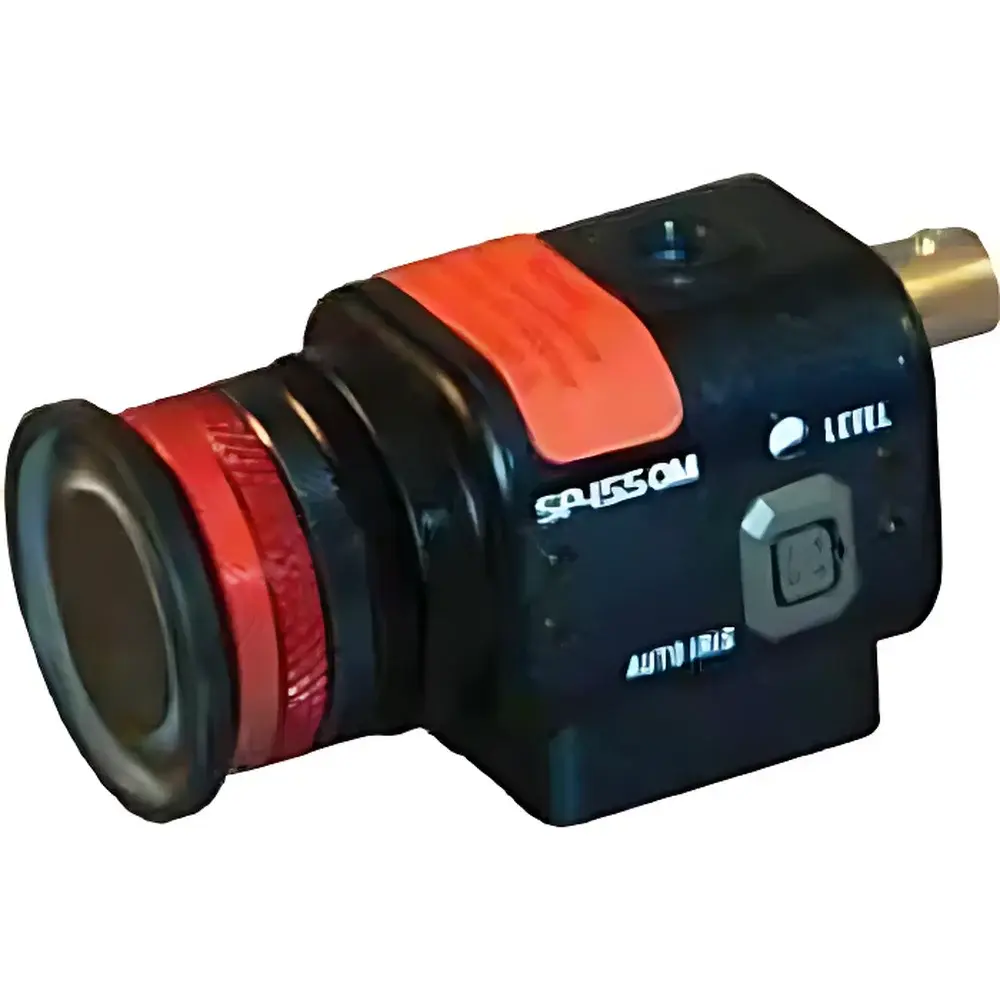
Spiricon SP503-1550 / SP620-1550 / SP-1550MG / GRAS20-1550 Phosphor-Coated Silicon CCD Infrared Beam Profiling Camera
| Brand | Spiricon |
|---|---|
| Origin | USA |
| Detector Type | Phosphor-Coated Silicon CCD |
| Spectral Response Range | 1440–1605 nm |
| Pixel Size | 9.9 × 9.9 µm (SP503-1550), 4.4 × 4.4 µm (SP620-1550 & GRAS20-1550), 8.4 × 9.8 µm (SP-1550MG) |
| Resolution | 640 × 480 (SP503-1550 & SP-1550MG), 1600 × 1200 (SP620-1550 & GRAS20-1550) |
| Active Area | 6.3 × 4.7 mm (SP503-1550), 7.1 × 5.4 mm (SP620-1550 & GRAS20-1550), 4.7 × 5.4 mm (SP-1550MG) |
| Dynamic Range | 30 dB |
| Minimum Detectable Irradiance | 70 nW/cm² |
| Interface | USB 2.0 (SP503-1550), USB 2.0 (SP620-1550), Frame Grabber (SP-1550MG), FireWire 1394b (GRAS20-1550) |
Overview
The Spiricon SP503-1550, SP620-1550, SP-1550MG, and GRAS20-1550 are phosphor-coated silicon-based CCD cameras engineered specifically for quantitative laser beam profiling in the near-infrared (NIR) spectral band. Unlike conventional silicon detectors—whose native cutoff lies near 1100 nm—these instruments incorporate a thin, optically matched phosphor down-conversion layer that absorbs photons in the 1440–1605 nm range and re-emits visible light detectable by standard silicon CCD sensors. This architecture enables high-fidelity spatial intensity mapping of telecom-grade lasers (e.g., 1550 nm DFB/DBR diodes), optical parametric oscillator (OPO) outputs, fiber-amplified sources, and other NIR emitters without requiring costly InGaAs sensor technology. The cameras operate on the principle of direct irradiance-to-charge conversion followed by pixel-wise digitization, supporting both pulsed and CW beam characterization with sub-microradian angular resolution when coupled to calibrated optics.
Key Features
- Phosphor-conversion detection mechanism optimized for 1440–1605 nm wavelength band, enabling silicon-based cost-efficiency with NIR performance
- Multiple resolution and pixel pitch configurations: SP503-1550 (640 × 480, 9.9 µm), SP620-1550 (1600 × 1200, 4.4 µm), SP-1550MG (640 × 480, 8.4 × 9.8 µm), GRAS20-1550 (1600 × 1200, 4.4 µm)
- Uniform quantum efficiency across operational band via spectrally tailored phosphor coating and anti-reflection coatings
- 30 dB dynamic range supports simultaneous capture of beam centroid, width (D4σ, knife-edge), divergence, and hot-spot analysis
- Minimum detectable irradiance of 70 nW/cm² at 1550 nm enables profiling of low-power alignment beams and leakage radiation
- Dedicated interface options: USB 2.0 (SP503-1550, SP620-1550), Camera Link frame grabber (SP-1550MG), and IEEE 1394b FireWire (GRAS20-1550) for synchronization-critical applications
Sample Compatibility & Compliance
These cameras are compatible with free-space and fiber-coupled NIR sources emitting within ±5 nm of 1550 nm center wavelength, including EDFAs, Raman lasers, and tunable OPOs operating between 1440 nm and 1605 nm. Each model is designed to meet mechanical and thermal stability requirements for integration into ISO-standard optical tables and OEM laser enclosures. While not certified as medical or industrial safety devices per se, their optical design complies with IEC 60825-1:2014 Class 1M/3B measurement system guidelines when used with appropriate neutral density attenuation. Data acquisition workflows support GLP/GMP-aligned documentation when paired with compliant software (e.g., Ophir BeamGage), including audit-trail-enabled parameter logging and timestamped image metadata export per FDA 21 CFR Part 11 requirements.
Software & Data Management
All models integrate seamlessly with Ophir’s BeamGage Professional software (v6.0+), providing real-time beam parameter computation—including M² estimation (when used with motorized translation stages), beam propagation analysis, and ISO 11146-compliant second-moment calculations. Raw 16-bit TIFF and proprietary .BMP formats preserve full dynamic range for post-acquisition reprocessing. Software supports automated batch analysis across multi-frame sequences, ROI masking for clipped or clipped-beam scenarios, and export to CSV, MATLAB (.mat), and HDF5 for traceable metrology pipelines. Calibration files—including pixel response non-uniformity (PRNU) correction maps and wavelength-specific responsivity curves—are stored in NIST-traceable XML format and applied during acquisition.
Applications
- Characterization of 1550 nm telecom transceivers and photonic integrated circuits (PICs)
- M² and BPP validation of fiber-coupled erbium-doped fiber amplifiers (EDFAs)
- Alignment and mode-matching verification in quantum optics setups using 1550 nm pump/probe beams
- OPO cavity optimization through near-field and far-field beam profile correlation
- QC testing of IR laser diodes in manufacturing environments under ASTM F2793-22 optical test protocols
- Beam quality assessment for LIDAR transmitter modules operating in eye-safe NIR bands
FAQ
Why use a phosphor-coated silicon CCD instead of an InGaAs camera?
Phosphor-coated silicon detectors offer significantly lower dark current, higher spatial uniformity, and superior linearity compared to uncooled InGaAs arrays—critical for quantitative beam profiling where pixel-to-pixel gain variation must be <0.5% across the active area.
Can these cameras measure pulsed lasers?
Yes—provided pulse repetition rates exceed the camera’s frame rate and single-pulse energy remains within the detector’s damage threshold (typically ≤100 µJ/cm² for nanosecond pulses); external triggering via TTL sync input is supported on all models except SP503-1550.
Is NIST-traceable calibration available?
Ophir/Spiricon provides optional factory calibration certificates traceable to NIST SRM 2211 for irradiance responsivity at 1550 nm, including uncertainty budgets per ISO/IEC 17025:2017.
What is the typical saturation irradiance?
Saturation occurs at approximately 1 mW/cm² for CW operation, depending on exposure time and binning mode; users should apply calibrated ND filters for high-power sources to avoid blooming and nonlinearity.
Are drivers and SDKs provided for custom integration?
Yes—C++ and Python APIs (including NumPy-compatible array access), Windows/Linux drivers, and LabVIEW VIs are included with each system for OEM and automated test integration.





