
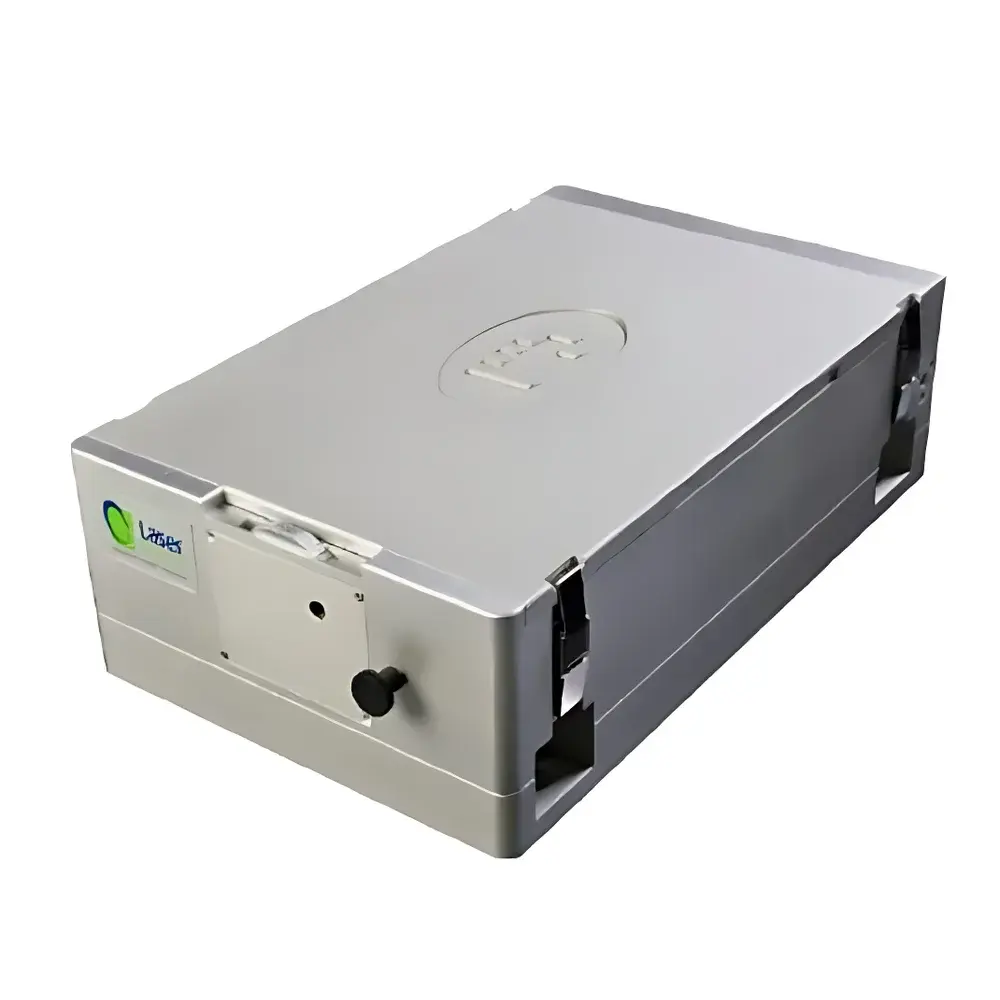
Laser Quantum GigaJet Series Ti:Sapphire Femtosecond Oscillator
| Brand | Laser Quantum |
|---|---|
| Origin | United Kingdom |
| Model | GigaJet Series |
| Type | Solid-State Femtosecond Oscillator |
| Repetition Rate | 500 MHz or 1 GHz |
| Central Wavelength | 800 ± 20 nm (GigaJet & GigaJet Ultra), 750–850 nm tunable (GigaJet Tune) |
| Pulse Duration | ≤30 fs (GigaJet), ≤50 fs (GigaJet Tune), ≤15 fs (GigaJet Ultra) |
| Average Power | 0.8–1.8 W (GigaJet), 0.7–1.4 W (GigaJet Tune), 0.75–1.5 W (GigaJet Ultra) |
| Pulse Energy | 0.8–3.6 nJ (GigaJet), 0.7–1.4 nJ (GigaJet Tune), 0.75–1.5 nJ (GigaJet Ultra) |
| Beam Diameter (FWHM) | 0.8 ± 0.3 mm |
| Spatial Mode | Near TEM₀₀ |
| Beam Divergence | 2.0 ± 0.5 mrad |
| Polarization Ratio | >100:1, horizontal |
| Pump Requirement | 5 W, 532 nm, TEM₀₀, vertically polarized |
| Operating Temperature | 21 ± 5 °C |
Overview
The Laser Quantum GigaJet Series is a family of high-repetition-rate, mode-locked titanium:sapphire (Ti:Sa) femtosecond oscillators engineered for demanding applications in optical frequency comb generation, ultrafast metrology, and time-resolved spectroscopy. Based on the well-established Kerr-lens mode-locking (KLM) principle, each GigaJet oscillator delivers transform-limited pulses directly from the cavity without external compression—enabling intrinsic temporal coherence and exceptional amplitude stability. With repetition rates selectable at either 500 MHz or 1 GHz, the series bridges the gap between conventional ~80 MHz oscillators and fully stabilized frequency combs requiring high pulse density for efficient nonlinear broadening and low-noise heterodyne detection. Its robust monolithic cavity design minimizes sensitivity to environmental perturbations, while active thermal stabilization ensures long-term power and spectral stability under laboratory conditions.
Key Features
- Three optimized variants: GigaJet (broadband fixed-center), GigaJet Tune (widely tunable 750–850 nm), and GigaJet Ultra (sub-15 fs pulses with enhanced dispersion control)
- Direct cavity output with no external pulse compressors required—reducing alignment complexity and nonlinear phase accumulation
- High average power output (up to 1.8 W) combined with low timing jitter (<100 fs RMS integrated from 10 kHz to 10 MHz) suitable for asynchronous optical sampling (ASOPS)
- Diffraction-limited beam quality (M² ≤ 1.2 in sagittal plane; ≤1.6 max in tangential plane) and linear horizontal polarization (>100:1 extinction ratio)
- Integrated thermal management system maintaining cavity temperature within ±0.1 °C of setpoint, ensuring <0.5% RMS power fluctuation over 8-hour operation
- Compatible with standard 5 W, 532 nm DPSS pump lasers (TEM₀₀, vertical polarization)—no custom pumping optics required
Sample Compatibility & Compliance
The GigaJet Series is designed for integration into metrology-grade optical setups where traceability and regulatory compliance are critical. Its stable carrier-envelope offset (fCEO) behavior—when coupled with appropriate f–2f interferometry—supports full frequency comb stabilization per ITU-T G.698.2 and IEEE Std 1139 recommendations for optical clock distribution. The oscillator’s mechanical housing meets ISO 10110-7 surface quality standards for optical mounts, and its electromagnetic emissions conform to EN 61326-1:2013 for laboratory measurement equipment. While not a medical device, its performance characteristics align with requirements for GLP-compliant ultrafast spectroscopy workflows, including those referenced in ASTM E2940–21 (Standard Guide for Ultrafast Spectroscopic Measurements).
Software & Data Management
Laser Quantum provides the GigaJet Control Suite—a cross-platform (Windows/macOS/Linux) application enabling real-time monitoring of output power, cavity alignment status, and pump coupling efficiency via integrated photodiodes and piezo feedback signals. All operational parameters—including repetition rate selection, cavity dispersion tuning (for GigaJet Tune/Ultra), and thermal setpoint—are accessible through a secure, password-protected GUI. Audit logs record configuration changes with timestamps and user IDs, supporting 21 CFR Part 11 compliance when deployed in regulated environments. Exported datasets include timestamped power traces, spectral centroid shifts, and pulse duration estimates derived from autocorrelation measurements—formatted as CSV or HDF5 for interoperability with Python-based analysis pipelines (e.g., SciPy, Lumerical INTERCONNECT, or custom FFT-based comb line extraction scripts).
Applications
- Optical Frequency Combs: High-repetition-rate operation enables efficient octave-spanning supercontinuum generation in highly nonlinear fibers (HNLF) or silicon nitride waveguides—facilitating self-referenced f–2f detection without amplification stages
- Precision Metrology: Used in direct optical-to-microwave division for atomic clock comparisons and length standard dissemination (e.g., in NIST-type cavity-stabilized interferometers)
- Ultrafast THz Time-Domain Spectroscopy (THz-TDS): Enables high-SNR, rapid-scan acquisition via ASOPS with sub-100 fs temporal resolution and <1 ps delay line jitter
- Nonlinear Spectroscopy: Supports broadband CARS, SRS, and transient absorption measurements with shot-noise-limited sensitivity due to high pulse repetition and low amplitude noise
- Fourier Transform Infrared (FTIR) Enhancement: Acts as a coherent broadband source for upconversion-based mid-IR FTIR systems, improving spectral resolution and dynamic range beyond thermal source limitations
FAQ
Is the GigaJet Series compatible with commercial frequency comb stabilization systems?
Yes—the oscillator exhibits intrinsic fCEO detectability and supports active stabilization using standard f–2f interferometers and fast piezo-driven cavity length actuators.
What pump laser specifications are mandatory for reliable mode-locking?
A 5 W, TEM₀₀, vertically polarized 532 nm solid-state laser with beam pointing stability <5 µrad and power stability <0.5% RMS over 1 hour is required.
Can the GigaJet Tune model be wavelength-scanned during operation?
Yes—continuous tuning across 750–850 nm is achieved via motorized birefringent filter adjustment, with real-time wavelength verification using an integrated grating spectrometer module.
Does the system include beam delivery optics for downstream experiments?
No—beam collimation and steering optics must be selected separately based on application-specific requirements (e.g., vacuum feedthroughs, harmonic generation crystals, or fiber coupling stages).
What maintenance intervals are recommended for long-term reliability?
Annual inspection of cavity mirrors’ coating integrity and recalibration of thermal sensors is advised; no consumables or periodic alignments are required under normal lab conditions.




