
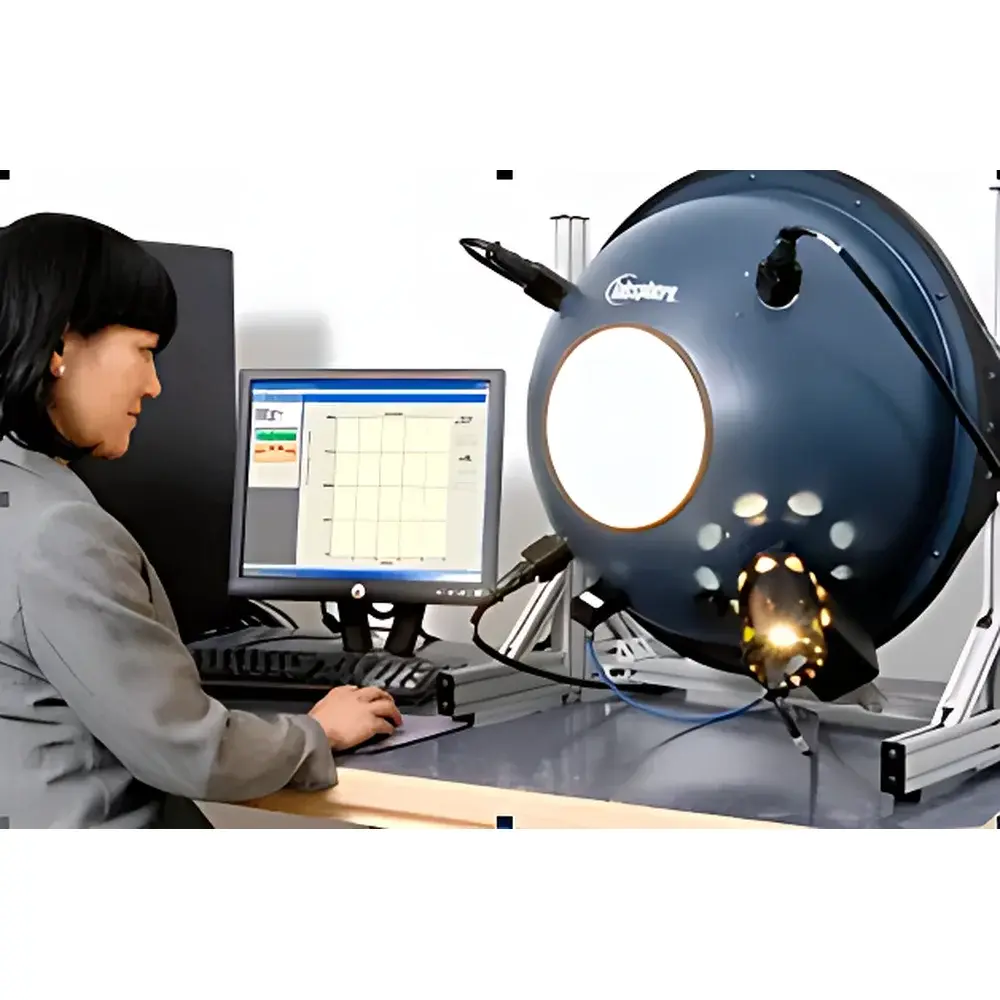
LabSphere USS-2000C Universal Uniform Source System
| Brand | LabSphere |
|---|---|
| Origin | USA |
| Manufacturer Type | Authorized Distributor |
| Import Status | Imported |
| Model | USS-2000C |
| Calibration | NIST-traceable certificate included |
| Output Control | 0–100% continuous electronic dimming |
| Configurable Aperture Sizes | 2", 4", 6", 8", 12" (standard options) |
| Spectral Monitoring Options | Integrated Si, InGaAs, and UV-enhanced photodiode detectors for broadband radiometric coverage (200–1700 nm) |
Overview
The LabSphere USS-2000C Universal Uniform Source System is a precision-engineered optical calibration platform designed to deliver spatially uniform, spectrally stable, and radiometrically traceable output across visible, near-UV, and near-infrared spectral regions. Based on LabSphere’s proprietary integrating sphere technology with high-reflectance Spectralon® coating (>99% reflectance, 250–2500 nm), the USS-2000C generates Lambertian illumination with <±0.2% spatial non-uniformity over its defined output port—meeting stringent requirements for camera MTF testing, sensor responsivity mapping, and radiometric instrument validation. Its core architecture employs a stabilized tungsten-halogen lamp coupled with active thermal management and closed-loop intensity feedback, enabling repeatable irradiance control from 0% to full output without spectral shift. All systems ship with a NIST-traceable calibration report documenting absolute irradiance (W/m²/nm) and uniformity at multiple wavelengths and drive levels, satisfying ISO/IEC 17025-compliant metrology workflows.
Key Features
- High-spatial uniformity: <±0.2% variation across defined field of view (FOV), verified per ISO 14880-2 and ASTM E308-22 Annex A3 protocols
- Electronic dimming: 0–100% continuous output control via analog voltage or digital RS-232/USB interface; no mechanical attenuation required
- Modular port configuration: Standard aperture diameters include 2″, 4″, 6″, 8″, and 12″; custom ports available upon request for integration into automated test benches
- Broadband spectral monitoring: Optional integrated detector suite supports simultaneous real-time monitoring in UV-VIS (200–400 nm), VIS-NIR (400–1000 nm), and SWIR (1000–1700 nm) bands
- Thermal stability: Active air-cooling and thermal shielding maintain lamp color temperature drift <±15 K over 4-hour operation at rated output
- Compliance-ready design: Fully compatible with GLP/GMP documentation frameworks; calibration certificates include uncertainty budgets per GUM (JCGM 100:2008)
Sample Compatibility & Compliance
The USS-2000C accommodates a wide range of optical devices under test (DUTs), including monochrome and RGB CMOS/CCD imagers, scientific-grade sCMOS cameras, photodiode arrays, spectroradiometers, and luminance meters. Its uniform exit port enables direct coupling to collimators, relay optics, or fiber-optic input adapters—supporting both telecentric and non-telecentric configurations. The system complies with radiometric measurement standards referenced in ISO/CIE 19476 (imaging sensor characterization), ASTM E1310 (uniform source verification), and USP (optical sensor qualification for pharmaceutical manufacturing). All delivered calibrations are traceable to NIST Standard Reference Materials (SRMs) 2020, 2030, and 2065, with documented chain-of-custody and measurement uncertainty analysis.
Software & Data Management
LabSphere provides the optional USS Control Suite—a Windows-based application supporting instrument configuration, intensity ramping profiles, multi-channel detector synchronization, and automated data logging in CSV and HDF5 formats. The software implements audit-trail functionality compliant with FDA 21 CFR Part 11, including user authentication, electronic signatures, and immutable event logs for calibration and operational history. Raw radiometric data can be exported for post-processing in MATLAB, Python (via NumPy/Pandas), or third-party metrology platforms such as Keysight PathWave or NI TestStand. Firmware updates are delivered via secure HTTPS portal with version-controlled release notes and compatibility matrices.
Applications
- Radiometric and photometric calibration of imaging systems used in machine vision, autonomous vehicle perception, and satellite remote sensing
- Responsivity verification of scientific detectors prior to deployment in synchrotron beamlines or astronomical observatories
- Uniformity validation for display backlight units (BLUs), micro-LED arrays, and AR/VR waveguide illuminators
- Reference source in inter-laboratory comparison studies organized under BIPM CCPR key comparisons
- Stability testing of optical sensors under accelerated aging conditions per MIL-STD-810H Method 502.7
FAQ
Is the NIST-traceable calibration report included with every unit?
Yes—each USS-2000C ships with a factory-issued, NIST-traceable calibration certificate covering absolute irradiance, spatial uniformity, and spectral radiance at three intensity levels (20%, 50%, and 100%) across 350–1050 nm.
Can the system be integrated into an automated production test line?
Absolutely—the USS-2000C supports Modbus TCP, RS-232, and USB CDC protocols for seamless integration with PLCs, SCADA systems, and custom test executive software.
What is the recommended recalibration interval?
LabSphere recommends annual recalibration under normal laboratory use; extended intervals (up to 24 months) may be justified with documented in-house verification using transfer standards per ISO/IEC 17025 Clause 7.7.
Does the system support custom spectral filters or bandpass configurations?
Yes—custom interference filter wheels or dichroic mounts can be installed at the output port; LabSphere offers engineering consultation for application-specific spectral shaping.
How is thermal drift mitigated during long-duration exposure tests?
The USS-2000C incorporates dual-stage thermal regulation: (1) forced-air heat extraction from the lamp housing and (2) thermally isolated integrating sphere mounting with low-conductivity structural interfaces—ensuring <0.1% irradiance drift over 30-minute dwell periods.





