
Teledyne Judson MCT (HgCdTe) Photovoltaic and Photoconductive Infrared Detector
| Brand | Teledyne Judson |
|---|---|
| Type | Mercury Cadmium Telluride (HgCdTe) Detector |
| Detector Architecture | Photovoltaic (PV) and Photoconductive (PC) |
| Spectral Range (PV) | 0.5–5.5 µm (cutoff options: 2.8 µm, 5.0 µm, 5.5 µm) |
| Spectral Range (PC) | 2–26 µm (cutoff options: 5 µm, 12 µm, 26 µm) |
| Cooling Requirement | Liquid nitrogen (77 K) or thermoelectric (TE) stabilization |
| Active Area Options | 0.1 × 0.1 mm to 2 × 2 mm |
| ROIC Compatibility | Available with integrated preamplifiers and hybridized readout ICs for focal plane array (FPA) integration |
| Compliance | RoHS-compliant packaging |
Overview
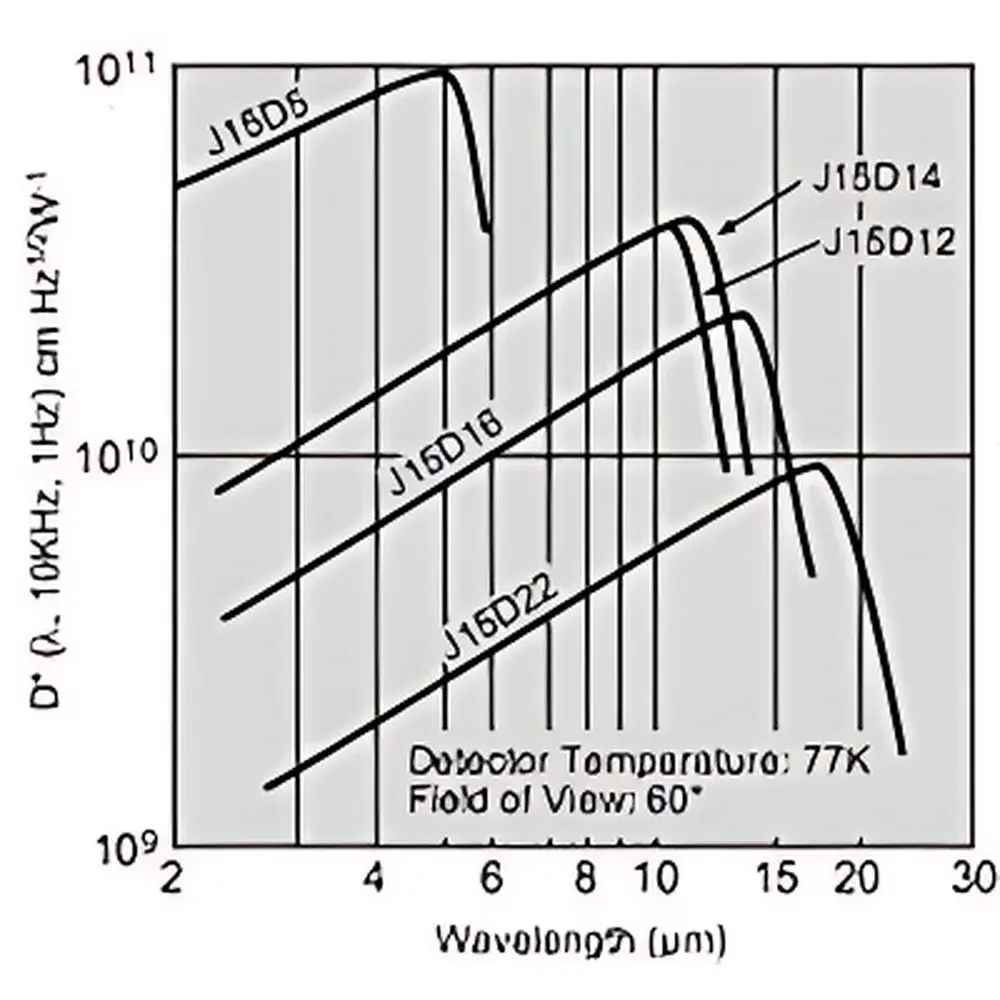
The Teledyne Judson MCT (Mercury Cadmium Telluride) infrared detector is a high-sensitivity, narrow-bandgap semiconductor photodetector engineered for demanding mid-wave (MWIR) and long-wave infrared (LWIR) applications. Based on the tunable bandgap property of Hg1−xCdxTe alloy, its cutoff wavelength is precisely controlled by varying the cadmium composition (x), enabling spectral response customization across 0.5–26 µm. Two fundamental architectures are offered: photovoltaic (PV) detectors—optimized for low-noise, zero-bias operation in precision spectroscopy and FTIR systems—and photoconductive (PC) detectors—designed for high-gain, fast-response applications such as CO2 laser monitoring and missile seeker head integration. All variants operate at cryogenic temperatures (typically 77 K via liquid nitrogen dewars or stabilized TE coolers) to suppress thermal noise and maximize detectivity (D* > 1 × 1011 cm·√Hz/W for PV types at 77 K). The detector’s responsivity, noise-equivalent power (NEP), and time constant are rigorously characterized per ASTM E1543 and ISO 11341 standards for infrared detector performance evaluation.
Key Features
- Material-tailored spectral response: PV variants cover 0.5–5.5 µm (cutoffs at 2.8 µm, 5.0 µm, 5.5 µm); PC variants extend to 2–26 µm (cutoffs at 5 µm, 12 µm, 26 µm)
- High quantum efficiency (>70% typical in peak response region) enabled by optimized anti-reflection coatings and surface passivation
- Low dark current density (<1 nA/mm² at 77 K for 5.0 µm PV devices), critical for high-dynamic-range FTIR measurements
- Modular packaging options: TO-8, TO-66, and hermetically sealed ceramic headers with integrated cold fingers for direct integration into spectrometer optical benches
- Available with matched transimpedance amplifiers (TIAs) and low-noise bias networks for analog output compatibility with lock-in amplifiers and DAQ systems
- Military-grade qualification available: compliant with MIL-STD-883 Method 5005 (thermal shock), 5007 (vibration), and 5010 (hermeticity)
Sample Compatibility & Compliance
The MCT detector is compatible with standard Fourier-transform infrared (FTIR) spectrometers (e.g., Thermo Nicolet iS50, Bruker Vertex 80v), tunable diode laser absorption spectrometers (TDLAS), and quantum cascade laser (QCL)-based gas analyzers. Its spectral responsivity aligns with key molecular absorption bands—including CO2 (4.26 µm), CH4 (3.3 µm), NOx (5.3 µm), and SF6 (10.6 µm)—enabling quantitative trace gas analysis per EPA Method 320 and ISO 14956. For regulated environments, detector modules support audit-ready calibration traceability to NIST SRM 2065 (blackbody reference) and comply with GLP data integrity requirements when paired with validated acquisition software. Optional versions meet IEC 61000-4-2/3/4 for electromagnetic compatibility in industrial control cabinets.
Software & Data Management
While the MCT detector itself is an analog sensing element, Teledyne Judson provides comprehensive driver support for integration into third-party platforms including LabVIEW™ (NI-DAQmx compatible), MATLAB® Instrument Control Toolbox, and Python-based acquisition frameworks (PyVISA, PySerial). Detector characterization reports include full spectral responsivity curves (µV/W vs. wavelength), NEP spectra, and temperature-dependent D* maps—delivered in HDF5 format for interoperability with spectroscopic data reduction pipelines (e.g., OPUS, GRAMS/AI, or custom Python workflows using SciPy and h5py). All calibration certificates adhere to ISO/IEC 17025:2017 requirements and include uncertainty budgets traceable to national metrology institutes.
Applications
- Fourier-transform infrared (FTIR) spectroscopy: High-fidelity detection of organic functional groups and inorganic lattice vibrations in pharmaceutical QC, polymer characterization, and environmental forensics
- Industrial process monitoring: Real-time CO2 laser power feedback control in cutting/welding systems and closed-loop combustion optimization in power generation
- Defense and aerospace: Seeker head detection in infrared homing missiles, airborne IRST (infrared search and track) systems, and satellite-based Earth observation payloads
- Research-grade thermal imaging: Laboratory-scale microbolometer replacement in cryogenically cooled IR cameras for low-flux radiometry
- Gas-phase reaction kinetics: Time-resolved detection of transient species in shock tubes and plasma reactors using gated acquisition synchronized to pulsed lasers
FAQ
What cooling method is required for optimal performance?
All MCT detectors require cryogenic cooling—either liquid nitrogen (77 K) for maximum sensitivity and lowest NEP, or multi-stage thermoelectric (TE) coolers for compact, maintenance-free operation (achieving ~180–200 K depending on ambient conditions).
Can this detector be integrated into an existing FTIR system?
Yes—standard TO-8 and TO-66 packages are mechanically and electrically compatible with most commercial FTIR detector mounts. Pinout schematics and bias voltage specifications are provided in the Integration Manual (Rev. 4.2).
Is factory calibration included with purchase?
Each detector ships with a NIST-traceable spectral responsivity certificate, dark current vs. bias curve, and NEP measurement report at specified operating temperature.
Are there FDA or 21 CFR Part 11 considerations for use in pharmaceutical labs?
While the detector itself is hardware-only, when integrated into validated analytical instruments (e.g., USP <857> compliant FTIR systems), its calibration records and change-control documentation support Part 11 compliance for electronic records and signatures.
What is the typical lead time for custom cutoff wavelengths or active area configurations?
Standard configurations ship within 4–6 weeks; custom compositions (e.g., x = 0.225 for 10.6 µm PC) require wafer-level fabrication and typically have a 14–18 week lead time, subject to material availability and process validation.





