
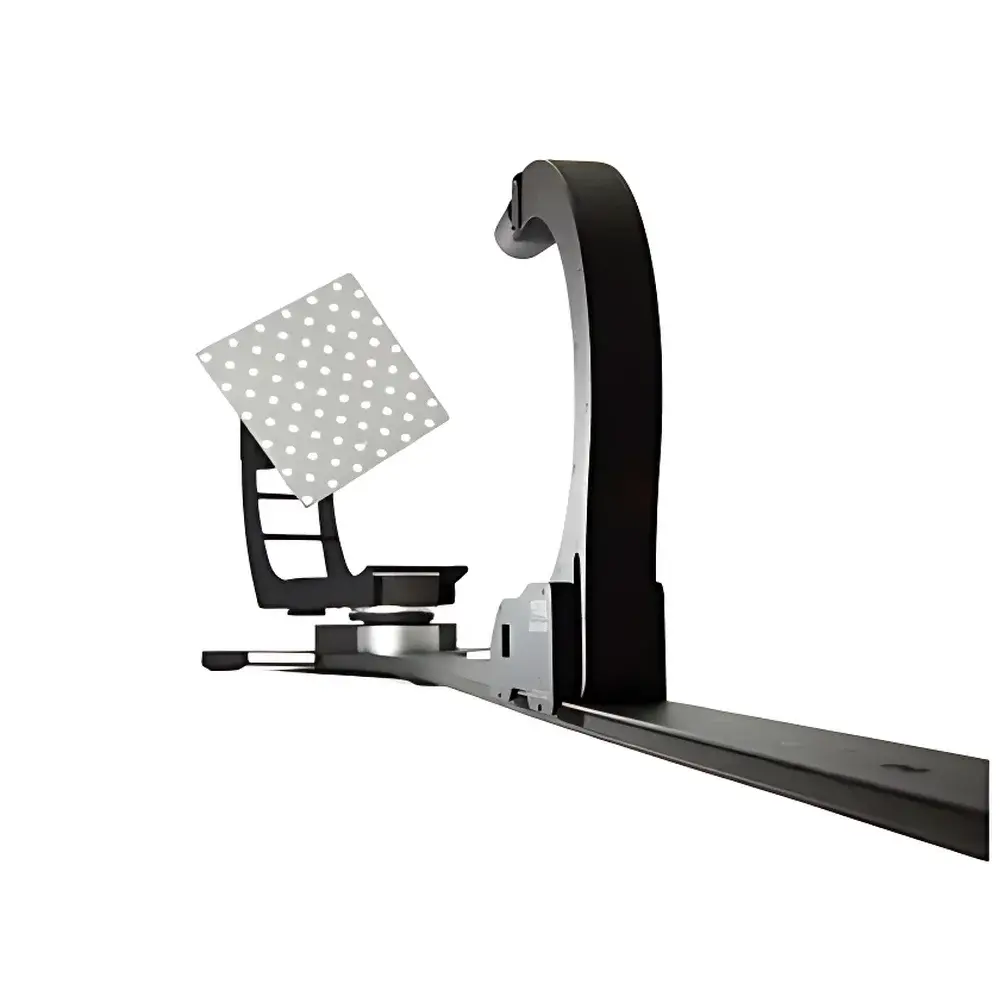
BaseSpion Compact Far-Field Goniophotometer
| Origin | Denmark |
|---|---|
| Manufacturer Type | Authorized Distributor |
| Origin Category | Imported |
| Model | BASESPION |
| Price | ¥280,000 |
Overview
The BaseSpion Compact Far-Field Goniophotometer is a fully integrated, benchtop-grade photometric measurement system engineered for precision characterization of medium-sized light sources under far-field conditions. Based on the fundamental principle of goniophotometry—measuring luminous intensity distribution as a function of solid angle—the BaseSpion employs a dual-axis rotating goniometer to acquire full 3D photometric data sets (LDT/IES files) compliant with CIE S 025/E:2015 and IES LM-79-19 standards. Unlike conventional integrating sphere systems, the BaseSpion operates in true far-field geometry, where detector distance satisfies the condition L ≥ 10× source maximum dimension (minimum 8×), ensuring minimal near-field artifacts and high spatial fidelity in angular radiance and luminous intensity profiles. Its compact footprint (360 × 56 × 55 cm), built-in power analyzer, and USB-hosted control architecture enable rapid deployment in QC labs, R&D facilities, and third-party testing centers without requiring dedicated infrastructure or environmental conditioning.
Key Features
- Dual-axis motorized goniometer with programmable angular resolution: 2°/step (LOW mode) or 0.5°/step (HIGH mode), enabling flexible trade-offs between measurement speed and data granularity
- Integrated Class A power analyzer (90–260 VAC, 50/60 Hz) with ±0.2 V voltage accuracy, ±0.1 mA current resolution, and 70 kS/s sampling rate for synchronized electrical–photometric correlation
- Ibsen Photonics FREEDOM spectrometer with high-transmission custom grating, 360–830 nm spectral range, 1024-pixel SONY ILX511B linear CCD detector, and factory-traceable NIST-calibrated spectral response
- Automated detector positioning via precision linear rail with integrated distance sensor; adjustable measurement distance from 35 cm to 300 cm, dynamically optimized per DUT geometry
- Full photometric calibration suite included: luminous flux (±4% uncertainty at 1 m), luminous intensity (up to 90,000 cd at 3 m), CCT (1,000–10,000 K, ±35 K), and CRI (0–100, ±0.7)
- Plug-and-play operation: system boots and acquires first LDT file within 30 seconds of USB connection to Windows host PC; no external power supplies or signal conditioners required
Sample Compatibility & Compliance
The BaseSpion accommodates light sources up to 375 mm in maximum diameter and 9 kg in mass—including LED chips on carriers, COB modules, flat-panel luminaires, downlights, A-lamps, and directional point sources. Its mechanical design conforms to CIE 121-1996 and EN 13032-1:2020 requirements for goniophotometric geometry, including minimum source-to-detector distance validation and collimation verification protocols. All photometric and colorimetric measurements are traceable to national metrology institutes via documented calibration certificates. The system supports generation of IESNA LM-63, EULUMDAT (.ldt), and CIE 13.3-compliant export formats for downstream optical simulation (e.g., LightTools, Dialux, AGi32). Electrical safety compliance includes CE marking per EU Machinery Directive 2006/42/EC and EMC Directive 2014/30/EU.
Software & Data Management
Control and analysis are performed via BaseSpion Control Suite—a native Windows application supporting automated C-plane scanning, real-time spectral preview, and batch processing of multi-DUT test sequences. The software implements audit-trail logging per ISO/IEC 17025:2017 requirements, recording operator ID, timestamp, calibration status, environmental metadata (ambient temperature/humidity), and raw spectral acquisition parameters. Export modules generate PDF test reports with embedded uncertainty budgets, as well as CSV/Excel datasets for statistical process control (SPC) integration. Optional FDA 21 CFR Part 11 compliance package available, providing electronic signature support, role-based access control, and immutable record retention.
Applications
- LED module qualification per ENERGY STAR SSL Program Requirements v2.2 and DesignLights Consortium (DLC) Premium Tier
- Luminous intensity distribution modeling for automotive headlamp homologation (UNECE Regulation 112)
- Photobiological safety assessment (IEC 62471) using spectral irradiance data acquired at multiple field angles
- Color uniformity mapping across large-area OLED panels via multi-point goniometric sampling
- Thermal drift monitoring during extended burn-in tests, correlating spectral shift (ΔCCT) and lumen depreciation (ΔΦv) with junction temperature estimates
- Validation of optical designs prior to injection molding—comparing simulated vs. measured candela distributions in polar coordinate format
FAQ
What is the minimum recommended detector distance for a 100-mm-diameter LED panel?
The system enforces L ≥ 10× source dimension; for a 100-mm panel, minimum distance is 1,000 mm. The BaseSpion’s auto-distance algorithm defaults to 1,200 mm unless overridden.
Does the BaseSpion support flicker measurement (IEEE 1789, IEC TR 61000-3-3)?
Yes—integrated 70 kS/s power analyzer and spectrometer enable simultaneous acquisition of voltage, current, and spectral flux waveforms for percent flicker, flicker index, and SVM calculation.
Can the system measure UV-A (365 nm) and deep-red (830 nm) LEDs with equal accuracy?
The Ibsen FREEDOM spectrometer maintains >85% relative responsivity across the full 360–830 nm range; NIST-traceable calibration ensures <±0.5 nm wavelength accuracy at both extremes.
Is remote operation possible over LAN or Ethernet?
Standard USB 2.0 interface only; optional Ethernet-to-USB bridge module available for networked lab environments with centralized data archiving.
How often must the system be recalibrated?
Annual recalibration is recommended; spectral and photometric calibrations are decoupled—spectral calibration retains validity for 24 months if stored in dark, temperature-stable conditions.






