
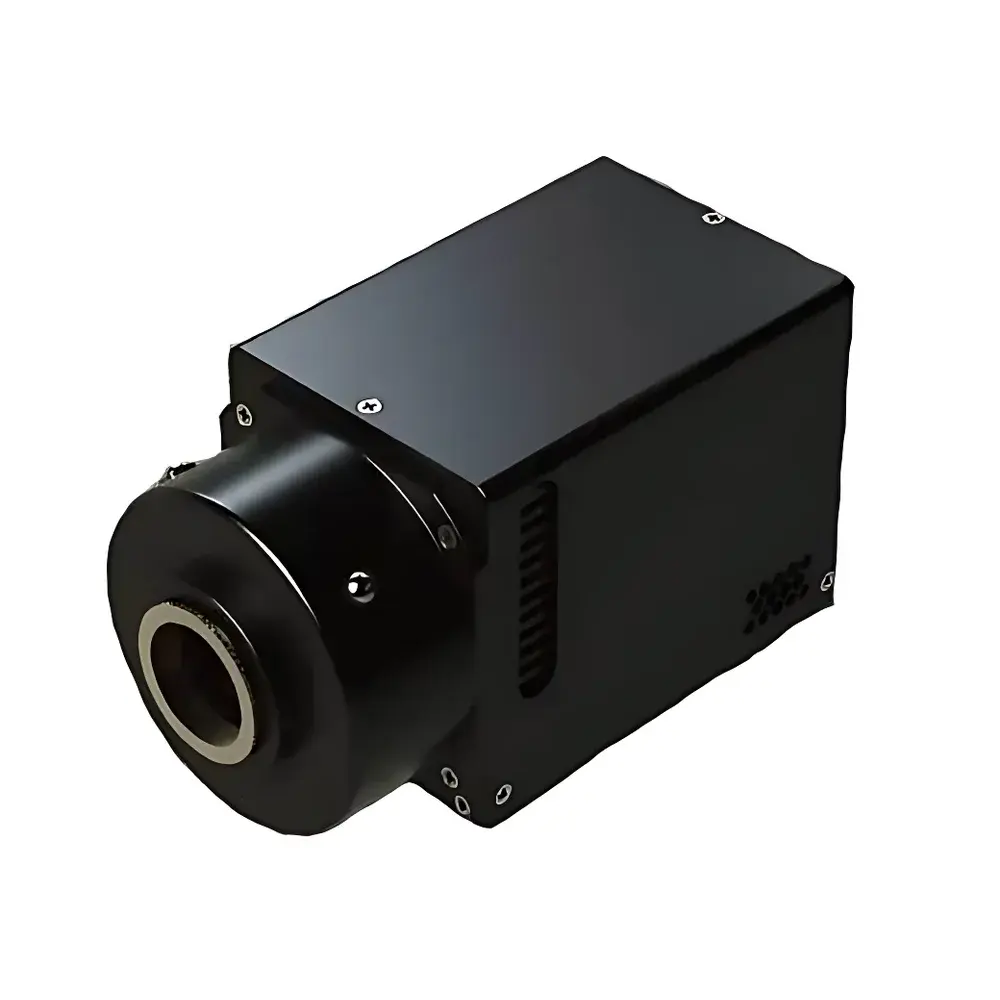
PSEL VGA and qVGA InGaAs Short-Wave Infrared (SWIR) Imaging Camera
| Origin | UK |
|---|---|
| Manufacturer Type | Authorized Distributor |
| Origin Category | Imported |
| Model | PSEL VGA / PSEL qVGA |
| Price Range | USD 6,800 – 13,600 (FOB) |
| Effective Pixels | 640 × 512 (VGA), 320 × 256 (qVGA) |
| Pixel Pitch | 15 µm (VGA), 30 µm (qVGA) |
| Spectral Response | 900–1700 nm |
| Frame Rate | up to 174 fps (full VGA), 570 fps (quarter VGA), 7200 fps (line-scan or spectral mode) |
| Read Noise | 28–38 e⁻ (high-gain, VGA), 110–200 e⁻ (high-gain, qVGA) |
| Dark Current | <0.7 fA (air-cooled, VGA), <0.1 fA (water-cooled, VGA) |
| Cooling | −25°C (air), −40°C (water) |
| Full Well Capacity | 20–23 ke⁻ (high-gain VGA), 110–150 ke⁻ (high-gain qVGA) |
| A/D Conversion | 14-bit digitization, 16-bit image processing |
| Exposure Time | 30 µs – 60 s (VGA), 1 µs – 1 s (qVGA) |
| Quantum Efficiency @ 1500 nm | 80% |
| Interface | GigE Vision & Camera Link (base configuration) |
| SDK | C/C++, Python, MATLAB, LabVIEW VI included |
| Compliance | CE, RoHS, ISO 9001 manufacturing traceability |
Overview
The PSEL VGA and qVGA InGaAs Short-Wave Infrared (SWIR) Imaging Cameras are high-performance, thermoelectrically cooled scientific imaging systems engineered for quantitative radiometric measurement across the 900–1700 nm spectral band. Based on lattice-matched InGaAs photodiode arrays fabricated using low-defect epitaxial growth processes, these cameras deliver exceptional signal fidelity through ultra-low dark current (<0.1 fA under water cooling), high quantum efficiency (80% at 1500 nm), and linear photoresponse over six orders of magnitude. The architecture employs a stabilized bias baseline and active thermal management—achieving −40°C detector operating temperature via optional water cooling—to suppress thermal noise and ensure long-exposure stability. Designed for integration into precision optical instrumentation, the platform supports both full-frame and region-of-interest (ROI) readout modes, including high-speed line-scan and spectral acquisition configurations. Its dual-resolution offering (640 × 512 VGA and 320 × 256 qVGA) enables optimization for spatial resolution versus sensitivity trade-offs in applications ranging from semiconductor metrology to astronomical spectroscopy.
Key Features
- Scientific-grade InGaAs focal plane array with <0.1 fA dark current (water-cooled, −40°C)
- 14-bit analog-to-digital conversion with 16-bit internal image processing pipeline
- Low read noise: 28–38 e⁻ (VGA, high-gain mode); 110–200 e⁻ (qVGA, high-gain mode)
- Flexible frame rates: up to 174 fps at full VGA resolution; 7200 fps in narrow-line or spectral acquisition mode
- Dual interface support: GigE Vision (GenICam-compliant) and Camera Link (Base configuration)
- Programmable exposure control from 30 µs to 60 seconds (VGA) or 1 µs to 1 second (qVGA)
- Onboard non-uniformity correction (NUC), bad-pixel replacement, and gain/offset calibration tables
- OEM-ready mechanical design with customizable cooling options (air/water), lens mounts (C-mount, F-mount), and housing form factors
Sample Compatibility & Compliance
The PSEL SWIR camera is compatible with standard reflective and transmissive optical setups used in semiconductor inspection, photovoltaic characterization, and microspectroscopy. It interfaces seamlessly with microscope objectives (e.g., 6× and 20× SWIR-corrected lenses), monochromators, and fiber-coupled spectrometers. All models comply with CE marking requirements for electromagnetic compatibility (EMC Directive 2014/30/EU) and low-voltage safety (LVD Directive 2014/35/EU). Manufacturing adheres to ISO 9001:2015 quality management standards, with full traceability of wafer-level testing and detector calibration records. While not certified for medical or aerospace use out-of-the-box, the platform supports integration into FDA 21 CFR Part 11–compliant environments when deployed with validated third-party software and audit-trail-enabled acquisition workflows.
Software & Data Management
A comprehensive Software Development Kit (SDK) is provided, supporting C/C++, Python (via ctypes bindings), MATLAB, and LabVIEW (with native VIs). The SDK implements GenICam-compliant parameter control—including ROI selection, gain/offset adjustment, NUC table loading, and trigger synchronization—and enables direct memory-mapped frame capture for real-time processing pipelines. Acquired data is output in standard 16-bit TIFF or raw binary formats, preserving full dynamic range without compression artifacts. Optional middleware packages include spectral analysis modules for hyperspectral cube generation and time-resolved photoluminescence decay fitting. All firmware updates and calibration files are digitally signed and version-controlled, ensuring reproducibility across instrument deployments in multi-site GLP or GMP-regulated laboratories.
Applications
- IC failure analysis and process monitoring via SWIR transmission imaging of silicon wafers
- Photoluminescence mapping of III–V solar cells and perovskite absorbers
- MEMS device inspection under NIR illumination with sub-10 µs temporal resolution
- Astronomical high-resolution spectroscopy using slit-scanning and Fabry–Pérot interferometry
- Laser beam profiling and M² measurement in telecom and industrial laser systems
- Embedded vision for autonomous vehicle perception in fog, smoke, or low-visibility conditions
- Non-destructive evaluation of polymer composites and pharmaceutical tablet coatings
FAQ
What cooling options are available, and how do they affect dark current performance?
Air cooling achieves −25°C (VGA) or −20°C (qVGA), yielding dark currents below 0.7 fA and 8 fA respectively. Water cooling extends operation to −40°C, reducing dark current to <0.1 fA (VGA) and 10 s.
Is the camera compatible with existing machine vision infrastructure?
Yes—both GigE Vision (IEEE 1588 time synchronization supported) and Camera Link interfaces are fully compliant with standard industrial vision frameworks, including HALCON, OpenCV, and Common Vision Blox.
Can I perform radiometric calibration with this camera?
Absolutely—the system includes factory-measured responsivity maps, linearity curves, and NUC tables. Users may perform absolute calibration using NIST-traceable blackbody sources and SWIR reference lamps following ASTM E1256-22 guidelines.
Does the SDK support real-time streaming to GPU-accelerated processing pipelines?
Yes—the low-latency memory-mapped buffer interface allows direct CUDA or OpenCL access to frame buffers without intermediate copying, enabling real-time FFT, deconvolution, or deep learning inference.
Are custom optics or vacuum-compatible housings available?
OEM integration services include C-mount/F-mount adaptation, hermetic sealing, vacuum-rated variants (up to 10⁻⁶ mbar), and co-aligned visible-SWIR dual-channel configurations upon request.




