
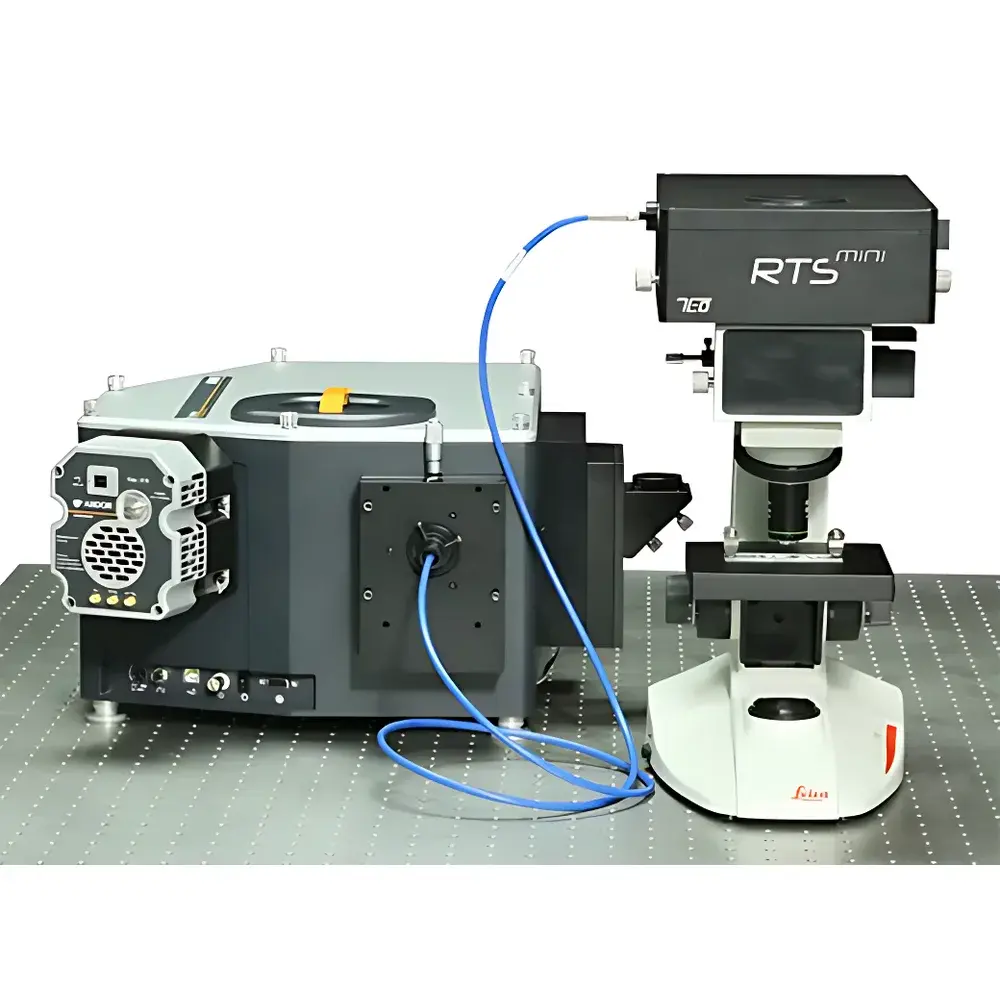
TEO RTS-mini Confocal Raman Microscopy System
| Brand | TEO |
|---|---|
| Origin | Beijing, China |
| Manufacturer Type | Authorized Distributor |
| Product Category | Domestic |
| Model | RTS-mini |
| Price Range | USD 14,000 – 28,000 |
| Instrument Type | Confocal Micro-Raman Spectrometer |
| Spectral Range | 300–1100 nm |
| Spectral Resolution | 1 cm⁻¹ |
| Spatial Resolution | Lateral 1 µm, Axial 2 µm |
| Minimum Wavenumber | 10 cm⁻¹ |
| Spectral Reproducibility | ±0.1 cm⁻¹ |
Overview
The TEO RTS-mini Confocal Raman Microscopy System is a modular, research-grade confocal micro-Raman platform engineered for high-sensitivity vibrational spectroscopic imaging at diffraction-limited spatial resolution. Based on the principle of confocal laser-induced Raman scattering, the system employs pinhole-based optical sectioning to reject out-of-focus fluorescence and stray light, enabling depth-resolved chemical mapping of heterogeneous samples with sub-micrometer lateral precision. Designed for integration rather than standalone operation, the RTS-mini functions as a plug-in confocal interface module—compatible with standard upright and inverted optical microscopes (e.g., Leica DM2700 M, Olympus BX53) and interchangeable spectrometers (including Andor i-series, Zolix 300i, and OTO EagleEye fiber spectrometers). Its architecture supports three excitation wavelengths—532 nm (100 mW), 638 nm (60 mW), and 785 nm (100 mW)—each optimized for distinct application profiles: 532 nm for maximum Raman cross-section and crystalline silicon benchmarking (e.g., Si tri-phonon peak SNR >20:1 under 10 mW, 300 s integration), 638 nm for reduced fluorescence in organic polymers, and 785 nm for minimized photodamage in biological tissues and surface-enhanced Raman spectroscopy (SERS) configurations.
Key Features
- Modular confocal interface box with integrated laser sources (532/638/785 nm) and SMA-fiber coupling—enabling direct stacking and wavelength-selective configuration
- Lateral spatial resolution down to 1 µm and axial resolution of 2 µm (measured with 100×/0.85 NA objective under 532 nm excitation)
- Full spectral coverage from 80 cm⁻¹ to 6000 cm⁻¹, depending on laser wavelength and spectrometer selection
- High spectral fidelity: ≤1 cm⁻¹ resolution (FWHM) and ±0.1 cm⁻¹ wavenumber reproducibility over 24-hour operation
- Open software architecture supporting Micro-Manager API and custom SDK for third-party hardware synchronization (e.g., motorized stages, shutters, filter wheels)
- Low-background optical design: negligible atmospheric O₂/N₂ Raman peaks confirm effective confocality and stray-light suppression
Sample Compatibility & Compliance
The RTS-mini accommodates solid, liquid, and thin-film specimens without vacuum or cryogenic requirements. It is routinely deployed in quality control laboratories for pharmaceutical tablet layer analysis (per USP and ICH Q5A), forensic trace evidence identification (in accordance with ASTM E2926-22 for Raman spectral matching), semiconductor defect localization (aligned with SEMI S2/S8 safety and metrology guidelines), and biomedical tissue section screening (GLP-compliant when paired with audit-trail-enabled acquisition software). All laser modules comply with IEC 60825-1:2014 Class 3B safety standards; optical enclosures meet EN 61000-6-3 EMC emission limits. The system supports 21 CFR Part 11–ready metadata logging—including operator ID, timestamp, instrument configuration hash, and raw spectrum provenance—when operated with validated acquisition software.
Software & Data Management
Acquisition and processing are performed via TEO’s cross-platform RamanSuite software (Windows/macOS/Linux), which provides real-time spectral preview, multi-point mapping, false-color chemical image generation, and baseline correction using asymmetric least squares (ALS) and polynomial fitting. Raw data is saved in HDF5 format with embedded metadata (wavelength calibration, grating position, exposure parameters), ensuring FAIR (Findable, Accessible, Interoperable, Reusable) compliance. The included Software Development Kit (SDK) exposes low-level control of laser power modulation, spectrometer grating rotation, CCD readout timing, and stage coordinates—facilitating integration into automated QC lines or synchrotron beamline endstations. Optional MATLAB and Python (PyQt/NumPy) wrappers enable custom algorithm deployment for machine learning–driven spectral classification or multivariate curve resolution (MCR-ALS).
Applications
- Pharmaceutical: Polymorph identification in active pharmaceutical ingredients (APIs), coating thickness verification, and counterfeit drug detection via spectral library matching
- Materials Science: Strain mapping in 2D materials (graphene, MoS₂), phase segregation in battery cathodes (NMC, LFP), and carbon nanotube chirality assignment
- Forensics: Non-destructive identification of explosives residues (e.g., RDX, PETN), illicit drugs (fentanyl analogues), and ink differentiation on questioned documents
- Life Sciences: Label-free subcellular lipid/protein distribution imaging in fixed and live cells, collagen cross-linking assessment in connective tissues
- Semiconductors: Dopant profiling in SiGe heterostructures, stress evaluation in FinFET gate stacks, and contamination source tracing on wafer surfaces
FAQ
Can the RTS-mini be retrofitted onto an existing microscope?
Yes—the confocal interface box is designed for drop-in installation on standard microscope C-mount or side-port ports, requiring only mechanical alignment and fiber-optic coupling.
What spectrometer options are supported for high-resolution measurements?
The system natively interfaces with Andor iDus 328i (328 mm focal length) and iDus 500i (500 mm focal length) spectrometers for resolutions down to 0.8 cm⁻¹, as well as Zolix Omni-λ300i and OTO EagleEye fiber spectrometers for portable SERS applications.
Is spectral calibration traceable to NIST standards?
Yes—factory calibration uses neon and argon emission lines (NIST SRM 2519, 2520); users may perform daily recalibration using silicon (520.7 cm⁻¹) and cyclohexane (2847 cm⁻¹) reference peaks.
Does the system support time-resolved or kinetic Raman measurements?
Yes—via TTL-triggered acquisition mode with sub-millisecond shutter synchronization and programmable exposure ramping across mapping grids.
What level of technical support and documentation is provided?
TEO supplies ISO 9001–certified installation qualification (IQ) and operational qualification (OQ) protocols, full English-language user manuals, application notes for 12+ industry use cases, and remote troubleshooting via TeamViewer-assisted engineering support.
Related Products






