
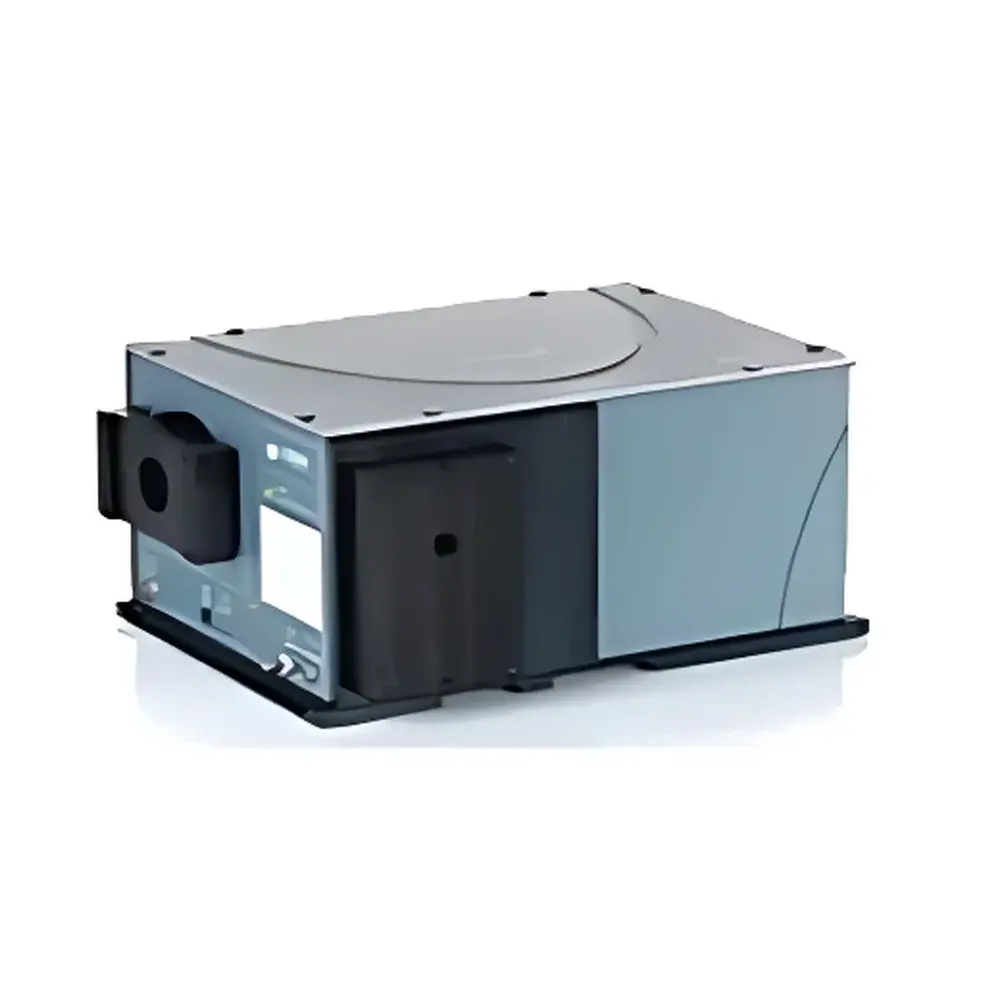
Andor SR303i Research-Grade Imaging-Corrected Grating Spectrometer
| Brand | Andor |
|---|---|
| Origin | United Kingdom |
| Model | SR303i |
| Spectral Range | 303–800 nm |
| F/# | F/4 |
| Wavelength Accuracy | ±0.04 nm |
| Wavelength Repeatability | ±0.004 nm |
| Spectral Resolution | 0.08 nm @ 2400 grooves/mm, 300 nm |
| Dispersion | 2.2 nm/mm |
| Stray Light Suppression | ≤2.2×10⁻⁵ |
| Grating Configuration | Triple-grating turret |
| Input/Output Ports | Configurable (1 or 2 CCD outputs, motorized slit) |
| 焦平面尺寸 | 28 mm × 14 mm |
| Grating Size | 68 mm × 68 mm |
| Slit Width | Dynamic, up to 12 mm |
Overview
The Andor SR303i is a research-grade, imaging-corrected grating spectrometer engineered for high-fidelity spectral acquisition in low-light and multi-channel applications. Based on an optimized Czerny–Turner optical architecture with aspheric and toroidal mirror correction, the SR303i eliminates spatial distortion across the focal plane—enabling simultaneous, pixel-accurate wavelength registration for all spectral channels. This imaging correction is essential for quantitative microspectroscopy, time-resolved luminescence mapping, and spatially resolved Raman or PL measurements where spectral fidelity must be preserved across extended detector arrays. With a 303 mm focal length and F/4 throughput, the instrument balances light-gathering efficiency with resolution and dispersion control. Its modular design supports direct coupling to Andor’s scientific-grade detectors—including back-illuminated CCDs, ICCDs, EMCCDs, and InGaAs array sensors—facilitating system integration for photon-starved experiments such as single-molecule spectroscopy or ultrafast transient absorption.
Key Features
- Imaging-corrected optical design using precision toroidal mirrors, ensuring diffraction-limited spot imaging across the full 28 mm × 14 mm focal plane—critical for multi-channel and imaging spectroscopy.
- Triple-grating turret with motorized selection; no realignment required when switching gratings—maintains calibration integrity and reduces setup drift.
- Motorized dynamic slit (up to 12 mm width) compatible with standard microscope interfaces, enabling seamless integration into confocal, widefield, or fiber-coupled microspectroscopy platforms.
- Wavelength accuracy of ±0.04 nm and repeatability of ±0.004 nm—validated against NIST-traceable emission lines—supporting compliance with ISO/IEC 17025 requirements for metrological traceability in analytical laboratories.
- Stray light suppression ratio of ≤2.2×10⁻⁵ (0.00022% T), achieved via optimized baffling, blackened internal surfaces, and groove geometry selection—essential for measuring weak emission bands adjacent to intense spectral features.
- F/4 optical speed combined with high-efficiency coatings (including optional silver-coated optics for enhanced UV–NIR response) maximizes signal-to-noise in demanding fluorescence and Raman applications.
Sample Compatibility & Compliance
The SR303i supports transmission, reflection, and fluorescence spectroscopy configurations via standardized SMA905, FC/PC, or kinematic flange interfaces. It is routinely deployed in GLP-compliant QC labs for material characterization (e.g., quantum dot photoluminescence, thin-film interference analysis) and in academic settings for pump–probe spectroscopy and hyperspectral imaging. The instrument complies with IEC 61000-6-3 (EMC emissions) and IEC 61010-1 (safety for laboratory equipment). When operated with Andor Solis software under audit-trail-enabled mode, it meets data integrity requirements aligned with FDA 21 CFR Part 11 for electronic records and signatures—supporting full traceability of acquisition parameters, calibration history, and raw spectral metadata.
Software & Data Management
Control and acquisition are fully managed through Andor Solis—a validated, Windows-based platform supporting real-time spectral preview, multi-region-of-interest (ROI) extraction, and automated wavelength calibration routines. Solis implements hardware-synchronized triggering for time-resolved experiments and provides export formats compliant with ASTM E131 (standard terminology for molecular spectroscopy) and HDF5 for long-term archival. All configuration changes—including grating position, slit width, and detector gain—are logged with timestamps and user IDs. Optional SDK support (C++, Python, MATLAB) enables integration into custom automation frameworks compliant with LabVIEW or Python-based experiment control stacks used in synchrotron beamlines and quantum optics facilities.
Applications
- Microspectroscopy of semiconductor nanostructures and 2D materials (e.g., MoS₂ photoluminescence mapping with sub-5 meV spectral resolution)
- Time-resolved fluorescence decay analysis using TCSPC-compatible ICCD/EMCCD coupling
- High-resolution reflectance and transmittance measurements of optical coatings and metamaterials
- Low-light Raman spectroscopy of biological tissues and pharmaceutical crystallinity assessment
- Hyperspectral imaging in combination with scanning stages or tunable laser excitation sources
- Calibration reference systems for UV–VIS–NIR radiometric standards laboratories
FAQ
What detector types are natively supported?
The SR303i is mechanically and electronically optimized for Andor’s scientific detectors—including iStar ICCDs, Newton CCDs, iXon EMCCDs, and Rasor InGaAs arrays—with native driver integration in Solis.
Can the SR303i be used in vacuum or purged environments?
Yes—the housing features optional O-ring sealed ports and vacuum-compatible flange variants (CF35/CF63) for operation down to 10⁻⁶ mbar in UHV spectroscopy setups.
Is wavelength calibration traceable to national standards?
Yes—factory calibration uses Hg/Ar/Ne spectral lamps with NIST-traceable line positions; users may perform in-house recalibration using certified line sources per ISO/IEC 17025 clause 5.10.
How is stray light performance verified?
Stray light ratio is measured per ASTM E275-20 using a double-monochromator reference method, with results documented in the instrument’s Certificate of Conformance.
Does the triple-grating turret support custom gratings?
Yes—grating mounts accept standard 68 mm × 68 mm ruled or holographic gratings; customers may supply third-party gratings with specified blaze angles and coating specifications.




