
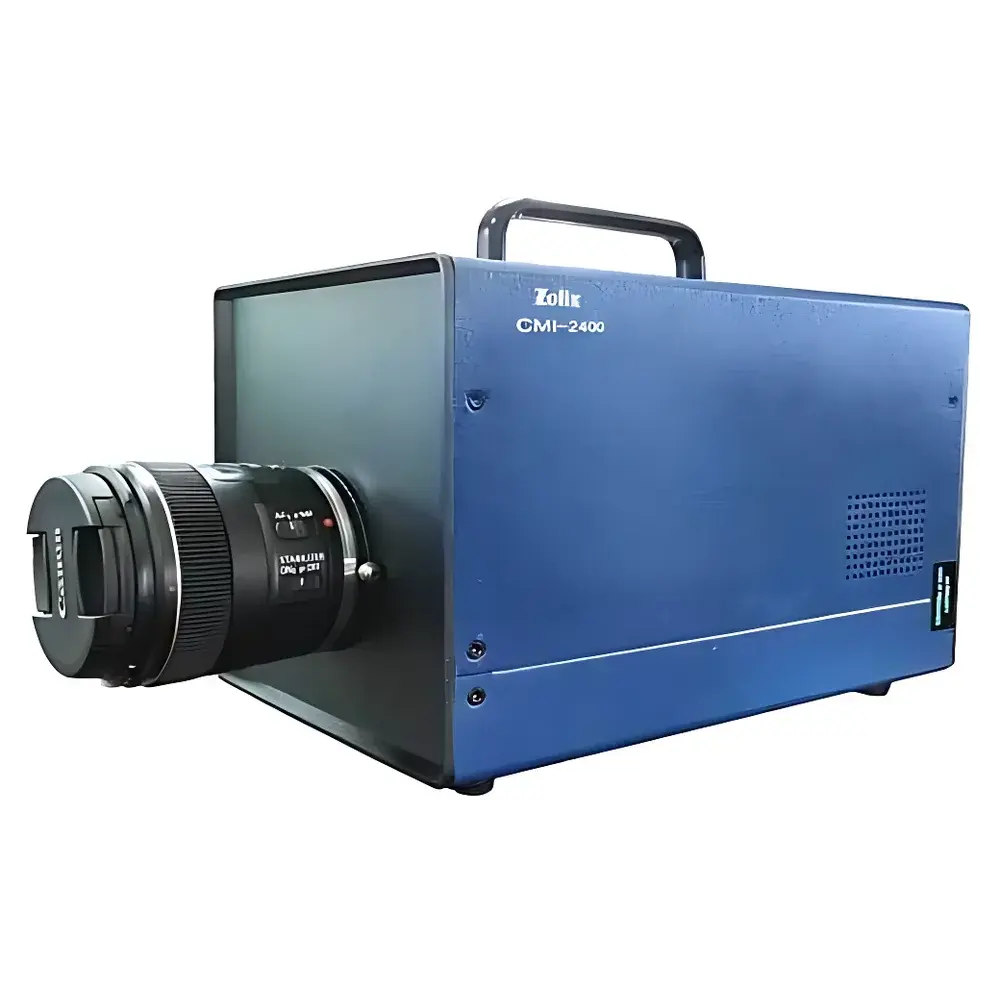
ZOLIX CMI Series Imaging Luminance and Chrominance Meter
| Brand | ZOLIX |
|---|---|
| Model | CMI Series |
| Detector Resolution | 2.28 MP to 60.92 MP |
| Pixel Size | 3.76–5.68 µm |
| Dynamic Range | >1,000,000:1 (via multi-exposure or ND filters) |
| Cooling | Two-stage thermoelectric cooling (ΔT ≤ −45°C below ambient) |
| Exposure Time | 16 µs – 60 s |
| Luminance Range | 0.0001 – 100,000 cd/m² |
| Luminance Accuracy | ±3% |
| Luminance Repeatability | ±0.5% |
| Chromaticity Accuracy (Std A) | ±0.002 in CIE x,y |
| Chromaticity Repeatability (Std A) | ±0.0003 in CIE x,y |
| Bit Depth | 16-bit |
| Interface | USB 3.0/2.0 |
| Power Supply | AC adapter |
| Operating Temperature | 5–50°C |
| Dimensions (L×W×H, w/o lens) | 240 × 110 × 150 mm |
Overview
The ZOLIX CMI Series Imaging Luminance and Chrominance Meter is a high-precision, scientific-grade instrument engineered for spatially resolved photometric and colorimetric analysis of self-luminous and reflective surfaces. Based on calibrated CMOS imaging sensor architecture with integrated thermoelectric cooling and programmable exposure control, the system implements standardized measurement principles aligned with CIE Publication No. 127, ISO/CIE 19899, and IEC 62368-1 Annex G for display and lighting evaluation. Unlike point-measurement luminance meters, the CMI captures full-field radiance distribution in a single acquisition—enabling pixel-level quantification of luminance (cd/m²), chromaticity (CIE 1931 x,y or u’v’), correlated color temperature (CCT), dominant wavelength, tristimulus values (X, Y, Z), and uniformity metrics across planar emission zones. Its dual-path dynamic range extension—leveraging both hardware ND filtration and software-controlled multi-frame exposure fusion—ensures metrological integrity across six orders of magnitude, from ultra-low-emission OLED subpixels (≥0.0001 cd/m²) to high-brightness automotive headlamps (>100,000 cd/m²).
Key Features
- Modular detector platform with six resolution variants: CMI-200 (2.28 MP), CMI-1000 (11.2 MP), CMI-1600 (16.2 MP), CMI-2400 (24 MP), CMI-3600 (36.2 MP), and CMI-6100 (60.9 MP), all featuring 16-bit digitization and global shutter operation.
- Two-stage thermoelectric cooling system maintaining sensor temperature up to 45°C below ambient—reducing dark current noise by >90% and enabling stable low-light measurements down to 0.0001 cd/m² with <0.5% repeatability.
- Hardware-accelerated dynamic range optimization via motorized neutral density (ND) filter wheel (OD 0.3–3.0) combined with synchronized multi-exposure capture (up to 8 frames) and HDR fusion algorithm compliant with CIE TN 006:2022.
- USB 3.0 interface with onboard 128 MB DDR buffer memory ensures full-frame readout at maximum resolution without host CPU dependency—even on entry-level industrial PCs.
- Optical compatibility with interchangeable prime lenses (24 mm, 28 mm, 35 mm, 50 mm, 100 mm) supporting working distances from 150 mm to ∞, with M42 or F-mount options for third-party telecentric and macro configurations.
Sample Compatibility & Compliance
The CMI Series supports quantitative assessment of emissive and reflective samples conforming to industry-standard test geometries defined in ASTM E308-22 (computing tristimulus values), ISO 9241-307 (display uniformity), and SAE J1383 (automotive lighting). It accommodates flat-panel displays (LCD, OLED, MicroLED), backlit keypads, aircraft cockpit panels, vehicle exterior lighting (DRLs, taillamps, adaptive headlights), architectural LED modules, cinema projection systems, and roadway signage. All factory calibrations are traceable to NIM (National Institute of Metrology, China) standards, with optional NIST-traceable calibration certificates available per ISO/IEC 17025 requirements. The system meets electromagnetic compatibility (EMC) Class B per EN 61326-1 and safety compliance per IEC 61010-1.
Software & Data Management
The included ZOLIX Photometric Analysis Suite provides a validated, audit-ready environment for measurement execution, data reduction, and reporting. Core capabilities include ROI-based statistical extraction (mean, min/max, std dev, histogram), luminance uniformity mapping (ΔL%, Δu’v’), defect detection via thresholded gradient analysis, and automated pass/fail evaluation against user-defined specification limits. Raw image data is stored in TIFF-6.0 format with embedded EXIF metadata (exposure, ND position, lens ID, calibration timestamp). Software supports FDA 21 CFR Part 11-compliant electronic signatures, audit trail logging, and role-based access control—facilitating GLP/GMP-aligned workflows in regulated R&D and QC laboratories.
Applications
- Display manufacturing: Mura detection, backlight uniformity grading, pixel-level luminance binning for AMOLED fabs.
- Automotive lighting validation: Near-field intensity distribution of headlamps per ECE R112, glare index computation for interior ambient lighting per UNECE R149.
- AR/VR microdisplay characterization: Spatial chromaticity shift analysis across FOV, speckle contrast quantification.
- LED lighting design: Far-field photometric distribution modeling (via goniophotometer integration), CCT spatial homogeneity assessment for horticultural and medical-grade fixtures.
- Cinema and broadcast: Digital projector uniformity certification per DCI-P3 and Rec.2020 gamut coverage mapping.
- Regulatory testing: Road sign retroreflectivity verification (EN 12899-1), tunnel lighting compliance (CIE 88:2004).
FAQ
What calibration standards does the CMI Series support?
The system ships with factory calibration traceable to NIM reference sources; optional NIST-traceable certificates (including spectral responsivity, linearity, and uniformity corrections) are available upon request.
Can the CMI operate in continuous acquisition mode for production-line inspection?
Yes—via trigger-synchronized burst capture and real-time ROI streaming over USB 3.0, achieving sustained frame rates up to 12 fps at 4K-equivalent resolution with on-device histogram processing.
Is the software compatible with LabVIEW or Python-based automation frameworks?
A documented DLL API and Python SDK (PyZOLIX-CMI) are provided, enabling integration with NI TestStand, MATLAB, or custom CI/CD pipelines for automated test sequence execution.
How is thermal drift compensated during long-duration measurements?
The two-stage TEC maintains sensor junction temperature within ±0.1°C over 8-hour sessions; dark frame subtraction and gain normalization algorithms further suppress residual drift in sub-millilumen measurements.
Does the system meet requirements for ISO/IEC 17025 accredited laboratories?
When operated with documented procedures, certified operators, and periodic inter-laboratory comparison participation, the CMI platform satisfies Clause 6.4 (Equipment) and Clause 7.7 (Uncertainty of Measurement) of ISO/IEC 17025:2017.





