
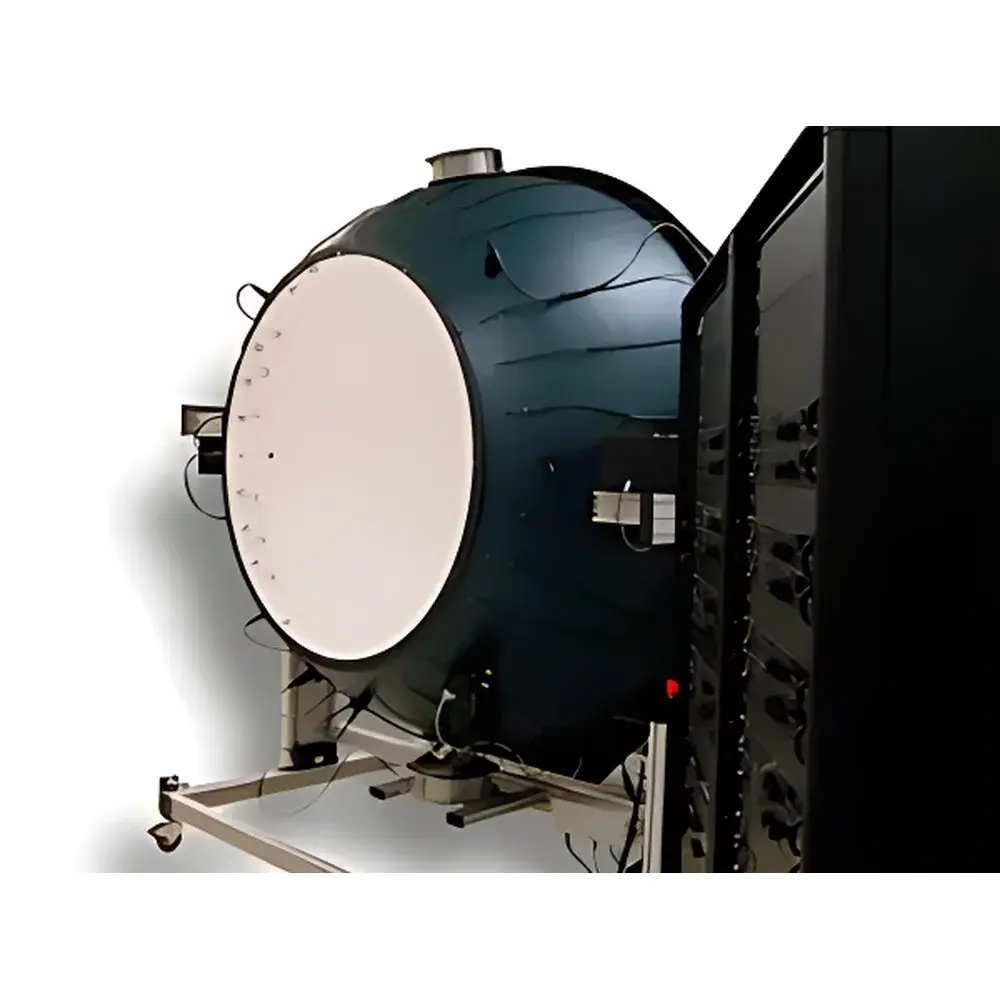
LabSphere XTH-6500C Large-Area Uniform Source System
| Brand | LabSphere |
|---|---|
| Origin | USA |
| Manufacturer Type | Authorized Distributor |
| Import Status | Imported |
| Model | XTH-6500C |
| Calibration Traceability | NIST-traceable Certificate Provided |
| Light Source Configuration | Dual-lamp (Xenon + Tungsten-Halogen) |
| Spectral Range | 250–2500 nm |
| Color Temperature Tunability | 2800 K to 6500 K (continuous) |
| Output Control | Motorized stepwise & analog continuous dimming |
| Software Interface | LabSphere Uniformity Control Suite (UCCS) v3.2 |
Overview
The LabSphere XTH-6500C Large-Area Uniform Source System is a precision-engineered optical calibration platform designed for radiometric and photometric validation of imaging and non-imaging optical systems with apertures up to 650 mm in diameter. Built upon LabSphere’s decades-long heritage in integrating sphere and uniform source technology, the XTH-6500C employs a dual-lamp architecture—combining a stabilized short-arc xenon lamp and a high-stability tungsten-halogen lamp—to deliver spectrally continuous, spatially uniform output across the ultraviolet (250 nm), visible (380–780 nm), and near-infrared (780–2500 nm) spectral bands. Its core measurement principle relies on Lambertian emission from a highly reflective, spectrally neutral coating (BaSO₄ or PTFE-based) applied to an internally baffled, large-volume integrating cavity. This ensures <±0.2% spatial non-uniformity over a defined 10° field-of-view at the output port—meeting the stringent homogeneity requirements specified in ASTM E308, ISO/CIE 11664-3, and MIL-STD-150A for radiometric system characterization.
Key Features
- Dual-spectrum illumination: Xenon lamp provides strong UV and blue-rich output; tungsten-halogen lamp delivers stable, high-CRI continuum in red/NIR—enabling seamless spectral bridging without gaps.
- Continuous color temperature tuning from 2800 K to 6500 K via real-time power ratio control between lamps, supporting white-point verification per CIE 15:2018 and ISO 12232.
- Motorized brightness adjustment with both discrete step mode (0.1% increments) and analog continuous dimming (0–10 V input or RS-485 command), enabling repeatable irradiance ramping for dynamic range testing.
- NIST-traceable factory calibration performed at three discrete wavelengths (365 nm, 550 nm, and 940 nm) with full uncertainty budget documentation per ISO/IEC 17025:2017.
- Robust mechanical architecture featuring thermally stabilized lamp housings, active airflow management, and vibration-isolated optical baseplate to minimize drift (<0.3% over 4 hours at constant setpoint).
Sample Compatibility & Compliance
The XTH-6500C accommodates flat-field calibration of large-format sensors—including scientific CMOS, EMCCD, InGaAs, and microbolometer arrays—as well as full-aperture testing of telescope focal planes, star trackers, Earth observation payloads, and automotive ADAS cameras. Its output port geometry (650 mm clear aperture, f/2.5 effective beam) supports direct coupling with collimators and relay optics. The system complies with radiometric traceability frameworks required under FDA 21 CFR Part 11 for regulated medical imaging device validation, and its calibration methodology aligns with the reference standards referenced in USP for optical sensor qualification. All delivered units include a comprehensive compliance dossier containing design verification reports, thermal stability test logs, and NIST-traceable spectral radiance maps.
Software & Data Management
Control and automation are managed through LabSphere’s Uniformity Control Suite (UCCS) v3.2—a Windows-based application supporting local GUI operation and remote API access via TCP/IP or USB virtual COM port. UCCS enables script-driven calibration sequences, time-stamped irradiance logging (10 Hz sampling), and automatic generation of calibration certificates compliant with ISO 17025 Annex A. Audit trail functionality records all user actions, parameter changes, and calibration events with timestamp, operator ID, and digital signature—fully satisfying GLP/GMP data integrity requirements. Export formats include CSV, HDF5, and XML metadata-compliant files compatible with MATLAB, Python (NumPy/Pandas), and LabVIEW environments.
Applications
- Radiometric calibration of spaceborne and airborne remote sensing instruments (e.g., VIIRS, OLI, MSI simulators)
- Flat-field correction and linearity verification of astronomical CCD/CMOS detectors
- Dynamic range and SNR characterization of thermal imaging systems operating in MWIR/LWIR bands (via calibrated NIR proxy illumination)
- Photometric validation of automotive headlamp and ADAS camera modules per SAE J1937 and ISO 16505
- Verification of spectral response functions for hyperspectral push-broom scanners using tunable bandpass filtering downstream
FAQ
Is the XTH-6500C suitable for absolute radiometric calibration?
Yes—the system ships with a full NIST-traceable spectral radiance calibration certificate covering 250–2500 nm at three primary wavelengths, with expanded uncertainty reported per GUM (JCGM 100:2008).
Can the system be integrated into an automated production test station?
Yes—UCCS supports SCPI-style command syntax over Ethernet and includes a documented DLL interface for custom integration with LabVIEW, Python, or C++ test executive frameworks.
What maintenance intervals are recommended for lamp life and reflectance stability?
Xenon lamps require replacement every 1,000 ± 100 hours; tungsten-halogen lamps every 2,000 ± 200 hours. Annual re-characterization of sphere reflectance is advised to maintain calibration confidence within ±0.5% uncertainty bounds.
Does LabSphere provide on-site installation and IQ/OQ support?
Yes—qualified field service engineers offer commissioning, operational qualification (OQ), and installation qualification (IQ) services aligned with ISO 9001 and pharmaceutical-grade validation protocols.



