
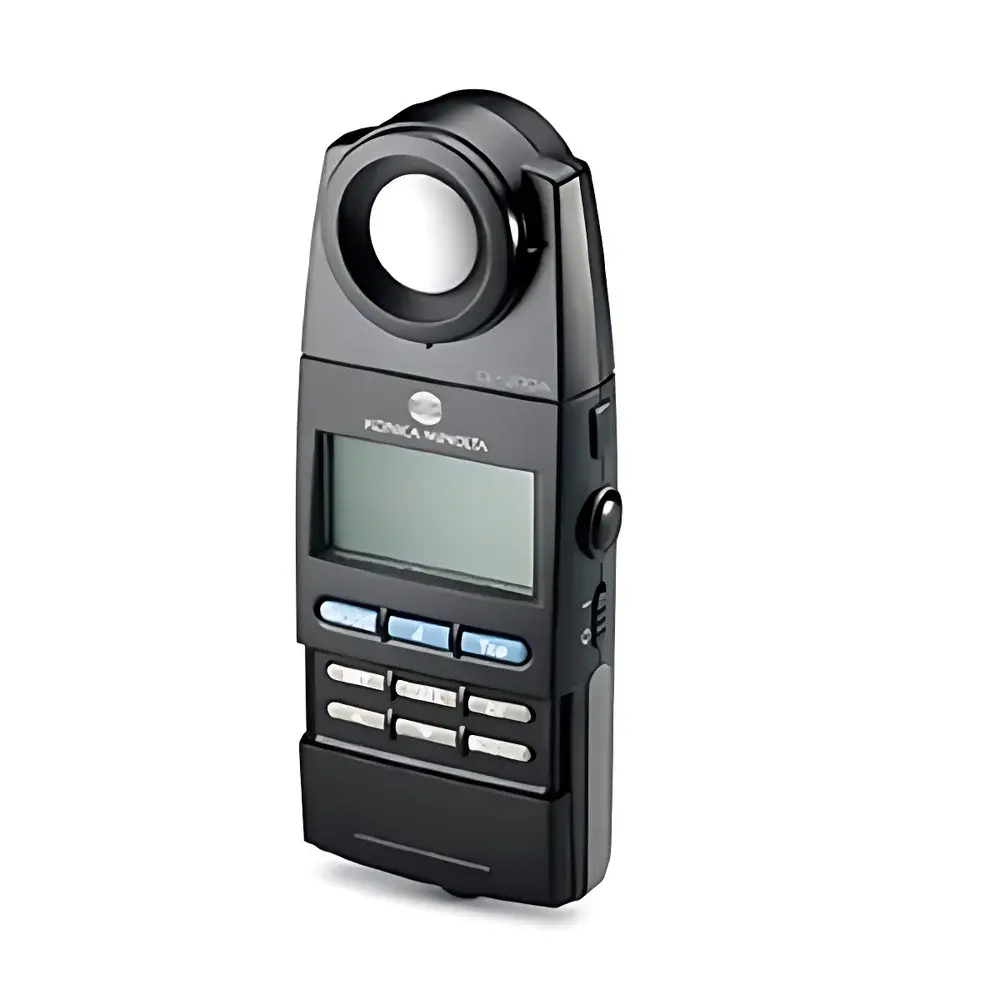
Konica Minolta CL-200A Color Illuminance Meter
| Brand | Konica Minolta |
|---|---|
| Origin | Japan |
| Model | CL-200A |
| Illuminance Range | 0.1–99,990 lx |
| Luminance Range | 0.01–9,999 fcd |
| Chromaticity Accuracy (xy) | ±0.002 at 800 lx (Standard Illuminant A) |
| Repeatability (xy) | ±0.0005 (2σ) |
| Cosine Correction Error (f₂) | <3% |
| f₁' Error vs. CIE Photopic Luminosity Function | <6% |
| Response Time | 0.5 s (continuous measurement) |
| Operating Temp. | −10–40°C, RH ≤85% (non-condensing) |
| Battery Life | >72 h (alkaline, continuous use) |
| Dimensions | 69 × 174 × 35 mm |
| Weight | 215 g (without batteries) |
Overview
The Konica Minolta CL-200A Color Illuminance Meter is a handheld, precision optical instrument engineered for simultaneous measurement of illuminance (Ev), chromaticity coordinates (x, y and u′, v′), correlated color temperature (Tcp), dominant wavelength, excitation purity, and color difference (ΔE) under real-world lighting conditions. Based on tristimulus colorimetric principles aligned with the CIE 1931 Standard Observer and photopic luminosity function V(λ), the CL-200A employs a silicon photodiode sensor with spectral response corrected to meet JIS C 1609-1:2006 Class AA accuracy requirements. Its optical design integrates high-fidelity cosine correction (f₂ < 3%) and spectral matching error (f₁′ < 6%), ensuring metrological traceability for applications demanding compliance with ISO/CIE lighting standards and industrial visual assessment protocols.
Key Features
- Compact ergonomic form factor (69 × 174 × 35 mm, 215 g) optimized for one-handed operation and field deployment
- Detachable probe architecture enabling remote sensing in confined or optically isolated environments (e.g., integrating spheres, darkrooms, optical test benches) — requires optional T-A20/T-A21 adapter kit
- Four-range auto-scaling illuminance measurement (0.1–99,990 lx) with dual-unit output (lx and fcd) and chromaticity evaluation down to 5 lx minimum
- On-device data logging and USB-triggered export directly to Microsoft Excel® via integrated CL-S10w software — no external PC required during acquisition
- User calibration capability with reference light sources, multi-point averaging (2–30 points), and hold function for transient or unstable illumination
- Backlit LCD display with 4-digit resolution, real-time numerical readout of Ev, x, y, u′, v′, Tcp, and ΔE against user-defined standard values
Sample Compatibility & Compliance
The CL-200A is validated for quantitative photometric and colorimetric analysis of diverse light-emitting systems including LED modules, fluorescent and halogen lamps, OLED panels, projection systems, and architectural lighting installations. It supports routine verification of standard viewing booths per ISO 3664:2009 (graphic technology) and ASTM E308-22 (computing color using CIE system). While not certified for GLP/GMP production environments, its measurement uncertainty profile meets technical requirements for R&D validation, QC pass/fail screening, and maintenance diagnostics in printing, paint, textile, and display manufacturing. Data integrity complies with basic audit trail expectations when used with CL-S10w under Windows OS platforms supporting Excel® 2007–2016 (32-/64-bit).
Software & Data Management
CL-S10w is the dedicated data management application bundled with the CL-200A. Installed on Windows-based workstations, it enables direct USB communication, batch export to Excel®, customizable report templates, and comparative analysis against stored reference spectra or target chromaticity points. The software supports multilingual UI (English, Japanese, Simplified/Traditional Chinese) and enforces structured metadata tagging (operator ID, timestamp, location, instrument serial number). Though not compliant with FDA 21 CFR Part 11 electronic signature requirements, CL-S10w provides timestamped raw data logs suitable for internal QA documentation and ISO 9001 process record retention.
Applications
- Lighting product development: Characterization of white LED CCT shift, spatial uniformity mapping, and binning validation
- Standard light booth maintenance: Scheduled verification of lamp aging effects on D50/D65 spectral output and illuminance decay
- F& B lighting optimization: Spectral tuning of ambient lighting to enhance food appearance through controlled chromaticity adjustment
- Projection system qualification: White balance calibration and screen luminance/chromaticity homogeneity assessment across active area
- Outdoor LED display commissioning: Module-level color consistency screening to mitigate metamerism and patchiness in large-format signage
- Academic and metrology labs: Teaching photometry fundamentals, validating CIE color spaces, and cross-referencing spectroradiometer measurements
FAQ
Is the CL-200A suitable for measuring pulsed or modulated light sources?
The CL-200A uses an analog integration method with 0.5 s response time; it is not designed for high-frequency PWM or stroboscopic sources. For flicker analysis, Konica Minolta recommends the CL-500A or spectroradiometers.
Can multiple probes be connected simultaneously?
Yes — up to 30 probes may be operated concurrently using the AC-A311 external power adapter and optional T-A20/T-A21 interface hardware.
Does the device support NIST-traceable calibration certificates?
Calibration services are available through Konica Minolta authorized service centers; certificates include uncertainty budgets referenced to NIST-traceable standards.
What is the minimum illuminance level for reliable chromaticity measurement?
Chromaticity parameters are specified for Ev ≥ 5 lx (or 0.5 fcd); below this threshold, signal-to-noise ratio degrades significantly.
Is CL-S10w compatible with macOS or cloud-based spreadsheet platforms?
No — CL-S10w is Windows-exclusive and requires locally installed Excel®; it does not support web-based or Apple ecosystem environments.




