
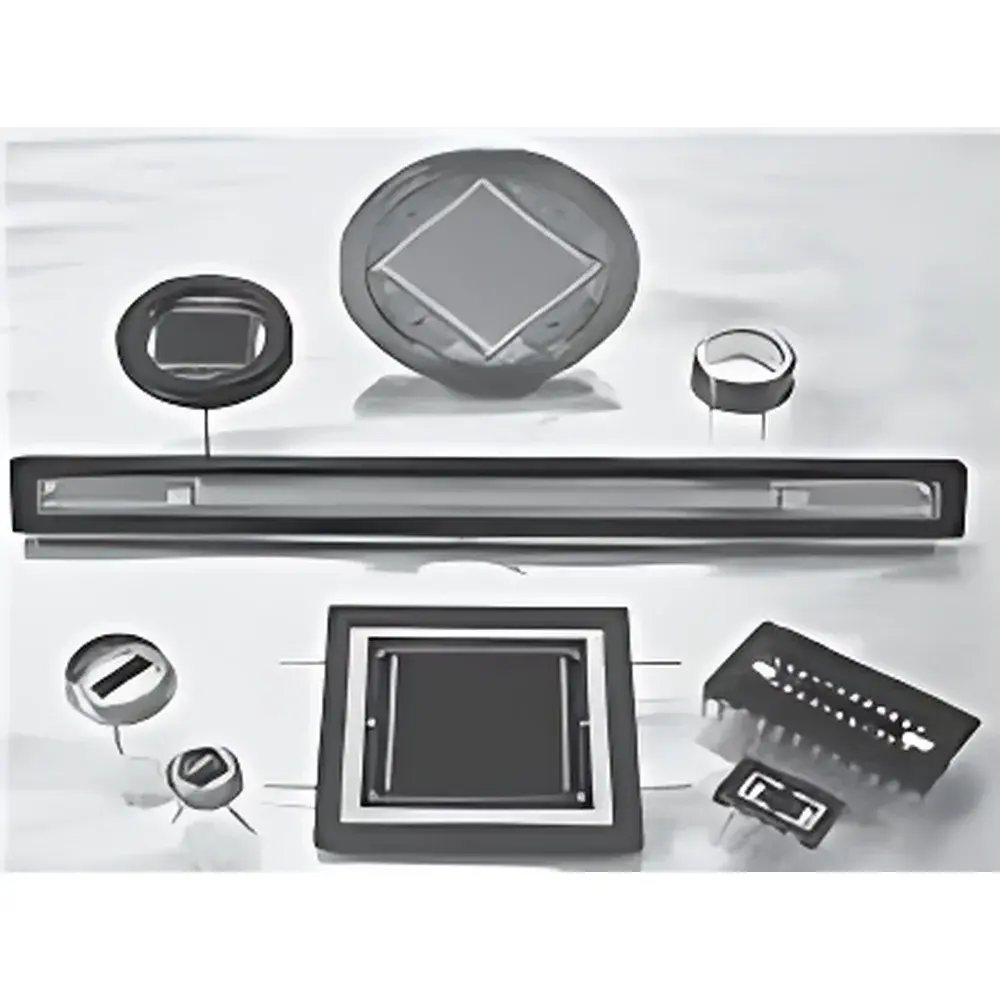
Pyreos PSD Position Sensitive Device
| Brand | Pyreos |
|---|---|
| Origin | United Kingdom |
| Manufacturer Type | Authorized Distributor |
| Origin Category | Imported |
| Model | PSD |
| Pricing | Upon Request |
Overview
The Pyreos PSD Position Sensitive Device is a high-precision, solid-state optoelectronic sensor engineered for real-time, analog position measurement of focused light spots. Operating on the principle of lateral photoelectric effect (for continuous-type devices) or segmented photocurrent ratio analysis (for discrete-section devices), the PSD delivers sub-micron spatial resolution without mechanical scanning or pixelated readout. Unlike CCD or CMOS imaging sensors, the PSD provides true centroid-based position detection — outputting continuous voltage or current signals proportional to the incident light spot’s geometric center relative to the device’s active area. This makes it ideal for closed-loop optical alignment, beam stabilization, interferometric displacement monitoring, and dynamic tracking applications where bandwidth, linearity, and analog simplicity are critical. The device architecture is based on monolithic silicon photodiode structures with precisely doped p–n junctions and resistive layers optimized for uniform carrier transport and minimal nonlinearity.
Key Features
- Two fundamental architectures: continuous lateral-effect PSDs (for wide-dynamic-range, edge-to-edge position sensing) and discrete-section (2- or 4-pixel) PSDs (for enhanced stability, temperature insensitivity, and pulse-compatible operation)
- Sub-micron position resolution: <0.5 µm for lateral-effect variants; <0.1 µm for matched-section configurations — independent of signal-to-noise ratio in segmented designs
- Ultrafast response: rise times from 0.3 µs to 7 µs, depending on active area and configuration (1D: 2.5 × 0.6 mm² to 60.0 × 3.0 mm²; 2D: 2.0 × 2.0 mm² to 45.0 × 45.0 mm²)
- High linearity (typical nonlinearity <0.5% F.S.) across full active area, validated per ISO 10110-5 and IEC 61223-3-1 test protocols
- Integrated signal-conditioning options available — including transimpedance amplifiers, differential output stages, and temperature-compensated bias circuits — supporting direct interface with DAQ systems compliant with IEEE 1451.4 TEDS standards
- UV-enhanced variants available with SiC or quartz window coatings for spectral response down to 200 nm
Sample Compatibility & Compliance
The Pyreos PSD is compatible with coherent (laser), quasi-monochromatic (LED, filtered arc lamps), and broadband illumination sources. Its responsivity profile (350–1100 nm for standard Si devices) supports integration into UV-Vis-NIR spectroscopic setups, ellipsometers, and laser-induced breakdown spectroscopy (LIBS) beam diagnostics. All units comply with RoHS 2011/65/EU and REACH (EC) No. 1907/2006 directives. For regulated environments, the PSD — when paired with validated analog front-end electronics — meets functional safety requirements outlined in IEC 61508 (SIL2) for optical feedback loops in industrial automation. Traceable calibration certificates (NPL-traceable) are available upon request for GLP/GMP-aligned laboratories.
Software & Data Management
While the PSD itself is an analog transducer, Pyreos provides reference firmware libraries (C/C++, Python, LabVIEW) for interfacing with common data acquisition platforms (NI PXI, Keysight U2300A, Dewesoft X). These libraries support real-time centroid calculation, drift compensation via dual-sensor referencing, and timestamp-synchronized multi-channel acquisition. When deployed within FDA-regulated workflows (e.g., pharmaceutical laser alignment in USP spectrophotometer qualification), the system can be configured to meet 21 CFR Part 11 requirements through audit-trail-enabled host software and electronic signature modules. Raw analog outputs (I₁, I₂, I₃, I₄) are preserved for post-acquisition reprocessing, ensuring full traceability per ISO/IEC 17025 clause 7.7.
Applications
- Laser beam pointing stabilization in Raman and FTIR spectrometers
- Real-time focus tracking in confocal microscopy and adaptive optics systems
- Non-contact displacement metrology in semiconductor wafer inspection tools
- Optical lever feedback in atomic force microscopy (AFM) and scanning probe instrumentation
- Angle-of-arrival sensing in free-space optical communication terminals
- Position feedback for motorized mirror mounts and piezoelectric stage control in synchrotron beamlines
FAQ
What is the difference between lateral-effect and segmented PSDs?
Lateral-effect PSDs use a continuous resistive layer to provide position output over the entire active area — ideal for variable-spot-size applications. Segmented PSDs divide the photosensitive region into discrete electrodes, enabling higher stability and SNR-independent resolution but requiring full illumination across all segments.
Can the PSD operate under vacuum or elevated temperature?
Standard units are rated for 0–70°C ambient operation and atmospheric pressure. Hermetically sealed variants with Kovar headers and ceramic packages are available for vacuum-compatible (10⁻⁶ mbar) and extended-temperature (–40°C to +125°C) deployment.
Is calibration required before installation?
Each unit ships with factory-measured linearity and centroid offset data. Field recalibration is optional and supported via Pyreos’ PSDCal v2.1 utility, which implements NIST-traceable spot-scanning routines using motorized translation stages.
How is electrical noise minimized in high-gain configurations?
Shielded twisted-pair cabling, guarded PCB layouts, and synchronous demodulation (when used with modulated light sources) reduce EMI susceptibility. Pyreos recommends grounding the substrate potential at a single point and avoiding ground loops in multi-device arrays.



